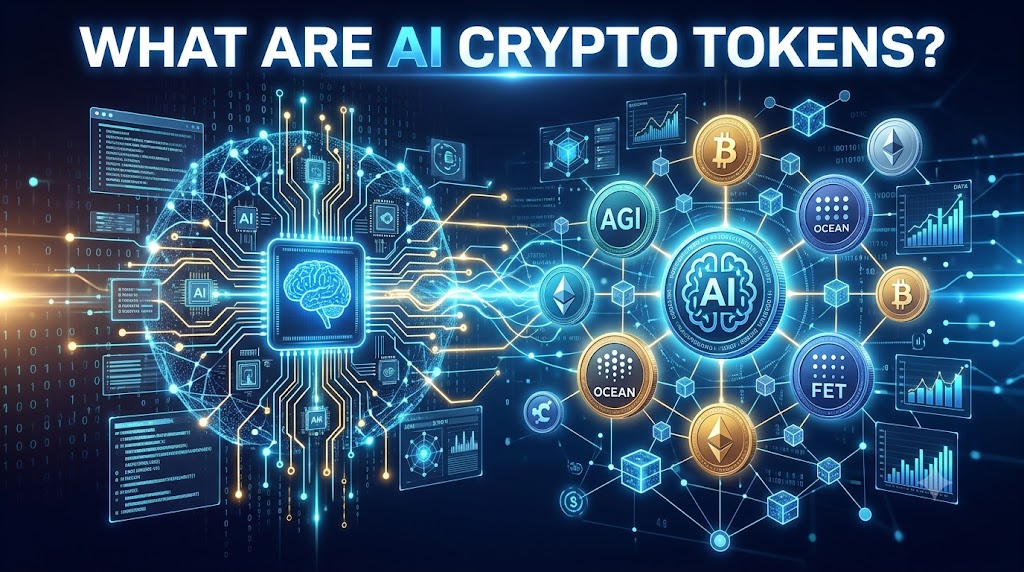
AI crypto tokens are digital assets connected to blockchain projects that use artificial intelligence, machine learning, or AI related infrastructure.
These tokens can serve different purposes depending on the project. Some may provide access to AI services, support decentralized computing, reward participants, enable governance, or facilitate payments within an ecosystem.
The term “AI crypto token” does not describe one specific type of cryptocurrency. It is a broad category that includes many different blockchain projects combining elements of artificial intelligence and decentralized technology.
How Do AI Crypto Tokens Work?
AI crypto tokens operate on blockchain networks.
A project may create a token that performs a specific function within its ecosystem. The token could be used to pay for computing resources, access an AI service, reward network participants, or participate in governance.
The exact function depends on the project.
For example, an AI focused blockchain network might allow users to contribute computing resources. The network could use its token to reward participants who provide those resources.
Another project might use a token to provide access to AI based applications.
Why Combine AI and Blockchain?
Artificial intelligence and blockchain solve different types of problems.
AI is primarily associated with areas such as:
- Machine learning
- Data analysis
- Automation
- Prediction
- Natural language processing
- Computer vision
Blockchain is primarily associated with:
- Decentralized networks
- Digital ownership
- Transactions
- Cryptographic verification
- Smart contracts
- Tokenized incentives
Combining the two technologies can create systems where AI services, computing resources, data, and financial incentives interact through blockchain networks.
What Is the Purpose of an AI Token?
An AI token can have different purposes.
Common functions include:
Payments
Tokens can be used to pay for AI related services or computational resources.
Network Incentives
Tokens can reward people or organizations that contribute computing power, data, models, or other resources.
Governance
Some tokens give holders voting rights over certain project decisions.
Access
A token may provide access to particular features, applications, or services.
Resource Allocation
Tokens can help coordinate access to decentralized computing or other resources.
The actual rights associated with a token depend on its project and technical design.
Are AI Crypto Tokens the Same as AI Stocks?
No.
An AI crypto token is a blockchain based digital asset.
An AI stock represents ownership in a publicly traded company.
Owning a token does not automatically mean owning part of the company or project behind it.
The economic and legal rights associated with a token depend on its design and applicable regulations.
Examples of AI Crypto Token Categories
AI crypto projects can be grouped into several broad categories.
AI Computing Networks
These projects focus on providing decentralized computing resources.
Participants may contribute processing power to a network and receive tokens as rewards.
AI Data Networks
Some projects focus on data marketplaces or decentralized systems for sharing and accessing data.
Tokens may be used to compensate data providers or access certain services.
AI Model Networks
These projects may focus on sharing, training, hosting, or accessing machine learning models.
Tokens can provide incentives for participants who contribute models or computing resources.
AI Agent Projects
Some blockchain projects explore AI agents that can perform tasks autonomously.
Tokens may be used for payments, coordination, governance, or interaction between agents.
AI Infrastructure Projects
These projects focus on infrastructure that can support AI applications.
Infrastructure may include computing, data, model hosting, or decentralized services.
What Are AI Agents in Crypto?
AI agents are software systems that can perform tasks based on programmed objectives and AI models.
In blockchain environments, AI agents could potentially:
- Monitor blockchain activity
- Execute predefined transactions
- Interact with decentralized applications
- Manage digital assets according to rules
- Coordinate with other agents
- Purchase computational resources
However, autonomous blockchain activity introduces additional security and financial risks.
An AI agent that makes an incorrect decision could potentially cause a transaction that cannot easily be reversed.
How Are AI Tokens Used in Decentralized AI?
Decentralized AI refers to approaches that distribute parts of AI infrastructure across multiple participants instead of relying entirely on one centralized provider.
A decentralized AI network could involve:
- Computing providers
- Data providers
- Model developers
- Application developers
- Users
Tokens can provide economic incentives for these participants.
For example, a network might reward someone for contributing computing resources.
What Is AI Compute?
AI compute refers to the processing resources required to train or run AI models.
Large AI models can require significant computing power.
This has created interest in decentralized computing networks that allow participants to contribute available hardware.
AI crypto tokens can potentially be used to coordinate payments between users who need computing resources and participants who provide them.
Can AI Tokens Pay for Computing?
Some projects are designed to use tokens for computing related services.
A user may spend tokens to access computing resources, while a provider receives tokens for supplying those resources.
This creates a marketplace model.
However, the practical usefulness of such a system depends on factors such as computing availability, performance, pricing, network reliability, and demand.
What Role Does Blockchain Play?
Blockchain can provide a shared transaction and ownership system for an AI ecosystem.
It can record:
- Token transfers
- Payments
- Ownership
- Governance decisions
- Resource contributions
- Other blockchain based activities
Smart contracts can automate certain interactions between participants.
Blockchain does not automatically make an AI model decentralized.
The architecture of the entire system determines how decentralized it actually is.
Can AI Crypto Tokens Be Used for Governance?
Some AI related crypto projects use token based governance.
Token holders may be able to vote on certain proposals.
Governance could involve:
- Protocol upgrades
- Treasury decisions
- Network parameters
- Development priorities
The voting structure varies between projects.
Holding tokens does not necessarily provide legal ownership of the project or company.
Why Are AI Crypto Tokens Popular?
Interest in AI crypto tokens has grown alongside broader interest in artificial intelligence and blockchain technology.
Investors and technology enthusiasts may be attracted to the idea of combining two rapidly developing fields.
Projects may also use tokens to create economic incentives around AI infrastructure and services.
However, popularity does not guarantee that a project has a sustainable business model.
What Are the Risks of AI Crypto Tokens?
AI crypto tokens can involve substantial risks.
Price Volatility
Token prices can change rapidly.
Project Risk
A project may fail to attract users, developers, or sufficient network activity.
Technology Risk
The underlying AI or blockchain technology may not perform as expected.
Smart Contract Risk
Software vulnerabilities can potentially lead to financial losses.
Security Risk
Wallets, exchanges, and applications can be targeted by attackers.
Regulatory Risk
Rules governing crypto assets and AI related services continue to develop in many jurisdictions.
Liquidity Risk
Some tokens may have limited trading activity, making them difficult to buy or sell at expected prices.
Are All AI Crypto Tokens Actually Connected to AI?
No.
The label “AI” can be used broadly in the cryptocurrency industry.
A project may have a genuine AI application, while another may use AI primarily as part of its marketing.
Before evaluating an AI token, examine what the technology actually does.
Ask:
What AI technology is being used?
What problem does it solve?
Is there a working product?
Who uses it?
How does the token contribute to the system?
These questions can help distinguish technology from marketing claims.
How to Evaluate an AI Crypto Token
Research should begin with the project’s actual utility.
Consider the following areas.
Technology
Understand what the project is building and how AI is actually involved.
Token Utility
Determine why the token exists.
If the project can operate without the token, its role may require closer examination.
Development Activity
Look for evidence that the technology is actively being developed.
Users
Consider whether real people or businesses are using the product.
Network Activity
Where relevant, examine usage, transactions, or other measurable activity.
Team and Transparency
Understand who is developing the project and how much information is publicly available.
Token Supply
Research the total supply, circulating supply, distribution, and release schedule.
Security
Consider whether smart contracts and other critical components have undergone appropriate security reviews.
What Is Tokenomics?
Tokenomics refers to the economic design of a cryptocurrency or token.
For an AI crypto token, important factors can include:
- Total supply
- Circulating supply
- Token distribution
- Unlock schedules
- Incentives
- Utility
- Staking
- Governance
- Demand
Understanding tokenomics can help explain how a token may function within its ecosystem.
Why Token Supply Matters
A token’s supply can influence its economics.
A project may have a limited supply, while another may have an expanding supply.
Investors should look beyond the token’s price.
A token priced at a small amount is not necessarily inexpensive if there are billions of tokens in circulation.
Market capitalization and fully diluted valuation can provide additional context.
What Is Fully Diluted Valuation?
Fully diluted valuation is an estimate of the project’s value if all tokens expected under its token supply model were in circulation.
This can be useful when evaluating projects with large numbers of tokens that have not yet entered circulation.
Large future token unlocks can create additional market supply.
Can AI Crypto Tokens Make Money?
Some people buy AI crypto tokens hoping their prices will increase.
However, no cryptocurrency investment has a guaranteed return.
Token prices can rise or fall significantly.
A project’s technology may succeed while its token performs poorly, or a token may experience speculative price increases without corresponding growth in actual utility.
These possibilities make careful research important.
Are AI Crypto Tokens a Good Investment?
There is no universal answer.
The suitability of any cryptocurrency depends on an individual’s financial situation, risk tolerance, investment objectives, and understanding of the asset.
AI crypto tokens can be particularly speculative because they combine risks associated with cryptocurrency markets with risks associated with emerging technology.
Anyone considering them should research carefully and avoid investing money they cannot afford to lose.
AI Tokens and Traditional AI Companies
Traditional AI companies generally operate through centralized business structures.
They may own or control:
- Computing infrastructure
- AI models
- Data
- Software
- Distribution channels
AI crypto projects may attempt to distribute some of these functions across networks of independent participants.
This can create new possibilities but also introduces technical and governance challenges.
Can AI Crypto Tokens Support Decentralized AI?
Potentially.
Tokens can provide incentives for participants to contribute resources to decentralized AI networks.
For example, participants could contribute:
- Computing power
- Data
- AI models
- Model evaluation
- Storage
- Other infrastructure
The network could use tokens to compensate contributors.
The effectiveness of this model depends on whether the decentralized network can provide competitive quality, cost, speed, and reliability.
AI Crypto Tokens and Data
Data is important to artificial intelligence.
Some blockchain projects explore decentralized marketplaces where users or organizations can contribute and potentially receive compensation for data.
However, data ownership and privacy are complicated.
Personal or sensitive information should not be placed on a public blockchain without carefully considering privacy, legal requirements, and technical consequences.
AI Crypto Tokens and Privacy
Blockchain transactions can be publicly visible depending on the network.
This creates an important consideration for AI projects that involve sensitive data.
A well designed system may keep sensitive information off chain while using blockchain for verification or payments.
The exact architecture matters.
AI Crypto Tokens and Regulation
Cryptocurrency and artificial intelligence are both areas of evolving regulation.
Rules can differ by country and may depend on how a token is structured and how the associated service operates.
Businesses and investors should consider applicable laws before launching, purchasing, or using AI crypto assets.
The Future of AI Crypto Tokens
The combination of AI and blockchain is still developing.
Potential areas of growth include:
- Decentralized AI infrastructure
- AI computing marketplaces
- Autonomous agents
- AI data marketplaces
- Tokenized machine learning resources
- Decentralized model networks
- Blockchain based AI payments
Some projects may become useful infrastructure, while others may fail to gain adoption.
The long term outcome remains uncertain.
What Should Beginners Know?
Beginners should understand that an AI crypto token is not automatically valuable simply because it is connected to artificial intelligence.
Look beyond the name.
Understand the technology.
Research the token’s purpose.
Check whether a working product exists.
Review token economics.
Understand the risks.
Be cautious of projects making unrealistic promises.
Final Thoughts
AI crypto tokens are digital assets associated with blockchain projects that incorporate artificial intelligence, machine learning, decentralized computing, data networks, or related technologies.
Their functions can range from payments and governance to resource coordination and access to AI services.
The concept is interesting because AI requires significant computing power, data, models, and infrastructure, while blockchain can provide decentralized networks and token based incentives.
However, AI crypto tokens remain an emerging and highly speculative area.
Not every project using the AI label has meaningful AI technology, and not every useful AI project requires a cryptocurrency token.
The most important factors are real technology, genuine utility, active development, user adoption, transparent token economics, and responsible security practices.
Frequently Asked Questions
What are AI crypto tokens?
AI crypto tokens are blockchain based digital assets associated with projects that use artificial intelligence, machine learning, decentralized computing, data, or related technologies.
What is an AI token used for?
Depending on the project, an AI token can be used for payments, governance, access, network incentives, computing resources, or other ecosystem functions.
Are AI crypto tokens cryptocurrencies?
They can be cryptocurrencies or tokens operating on existing blockchain networks, depending on the project’s architecture.
Are AI tokens the same as AI stocks?
No. AI tokens are blockchain based digital assets, while AI stocks represent shares of publicly traded companies.
Do AI crypto tokens use artificial intelligence?
Some do, but the level and purpose of AI use varies considerably between projects. Investors should examine the actual technology rather than relying on the project’s name.
What is decentralized AI?
Decentralized AI refers to approaches where parts of AI infrastructure, computing, data, models, or services are distributed among multiple participants rather than controlled entirely by one organization.
Can AI tokens be used for computing?
Some projects use tokens to coordinate payments between users who need computing resources and providers who supply computing power.
Can AI crypto tokens be used for governance?
Some projects give token holders voting rights over certain protocol or community decisions.
Are AI crypto tokens risky?
Yes. They can involve cryptocurrency volatility, technology risks, smart contract vulnerabilities, security threats, liquidity issues, project failures, and regulatory uncertainty.
Are AI crypto tokens a good investment?
There is no guaranteed answer. They can be highly speculative, and suitability depends on an individual’s financial circumstances, goals, and tolerance for risk.
How can I evaluate an AI crypto token?
Research its technology, token utility, development activity, users, token supply, distribution, security, governance, and actual adoption.
What is tokenomics?
Tokenomics describes the economic design of a cryptocurrency or token, including its supply, distribution, incentives, utility, and release schedule.
Can AI tokens increase in value?
Their prices can increase or decrease based on market conditions, demand, project development, speculation, and other factors. There is no guaranteed price outcome.
Are all AI crypto projects decentralized?
No. Some projects may use blockchain for specific functions while relying on centralized infrastructure for other parts of their technology.
Can AI crypto tokens support AI agents?
Some projects are exploring token based systems for AI agents, including payments, coordination, and interaction with blockchain applications.
Why are AI and crypto being combined?
AI provides intelligence and automation, while blockchain can provide decentralized infrastructure, digital ownership, transactions, and token based incentives.
What is the biggest risk with AI crypto tokens?
One major risk is assuming that a project has meaningful technology or utility simply because it uses AI related terminology. Researching the actual product and token function is essential.
What is the future of AI crypto tokens?
Potential areas include decentralized computing, AI infrastructure, data marketplaces, autonomous agents, and blockchain based AI services. However, the long term success of individual projects remains uncertain.