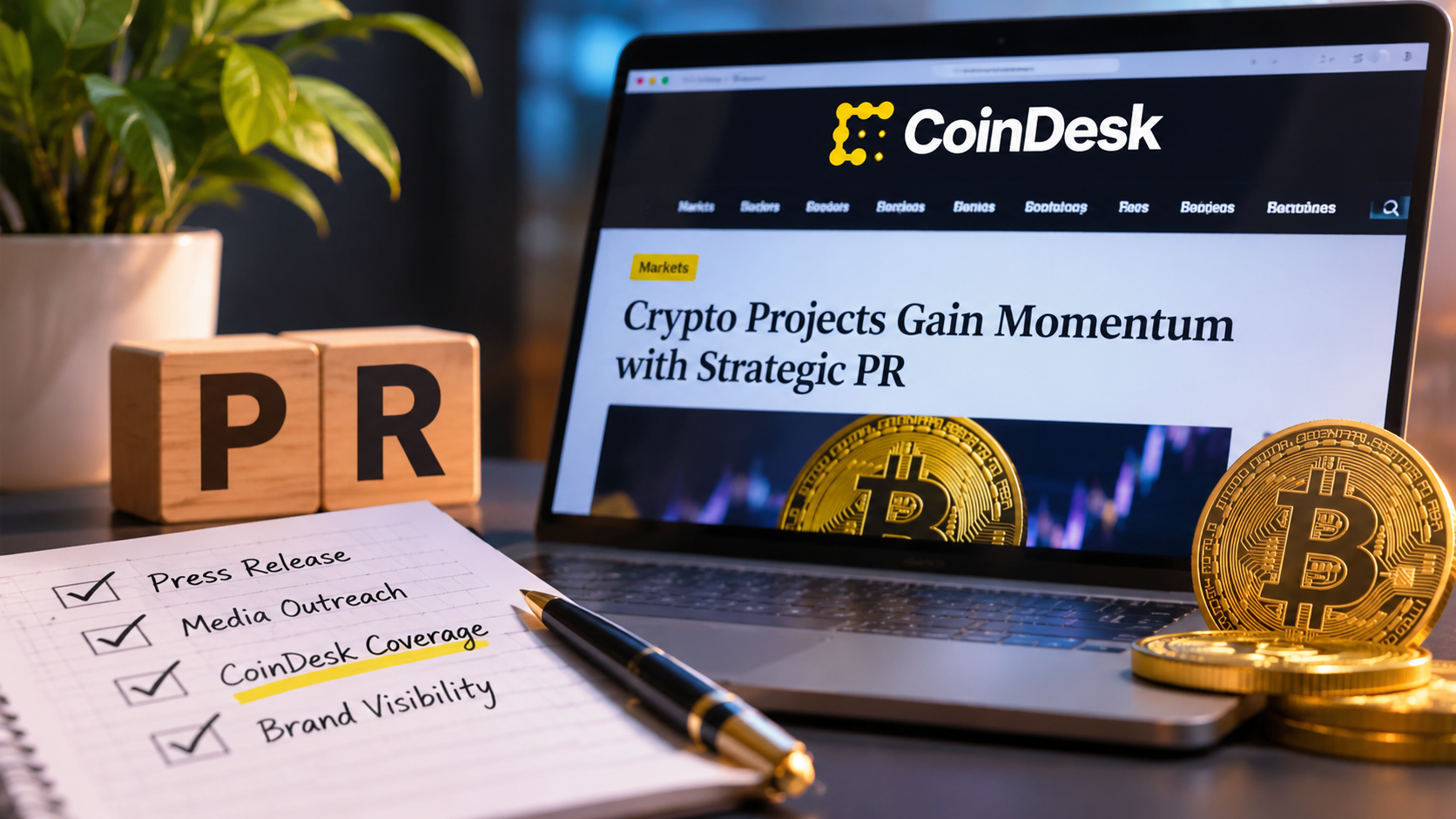
To get PR on CoinDesk, a crypto project needs three things: a major, confirmed milestone that matters to a serious audience, a factual press release written to institutional standards, and a CoinDesk placement purchased through a distribution partner that offers it in its premium finance and crypto tier. Most projects that land well on CoinDesk did not start there. They climbed a coverage ladder, building a record of credible releases on standard crypto and finance outlets before taking their defining announcement to the top. This article walks up that ladder, rung by rung, and explains what you need at each stage before CoinDesk makes sense.
Why CoinDesk Is the Top Rung
CoinDesk is one of the most established names in crypto media. Its readers include traders, fund managers, developers, journalists, analysts and policy watchers. When a project appears there, it signals significance to an audience that is hard to impress. That credibility is valuable for fundraising, exchange relationships, institutional partnerships and hiring.
Because it sits at the top of the market, CoinDesk also rewards preparation. Readers notice vague claims, unconfirmed partnerships and hype. A placement amplifies whatever is in your release, so the stronger your story and your track record, the more value you get from it.
The Coverage Ladder: Five Rungs to CoinDesk
| Rung | Stage | Typical Announcement | Outlet Level |
|---|---|---|---|
| 1 | Existence | Project introduction, testnet | Affordable crypto outlets |
| 2 | Credibility | Audit, team, documentation | Crypto-native news sites |
| 3 | Traction | Users, integrations, partners | Crypto and finance outlets |
| 4 | Recognition | Launch, major product release | Recognised finance-crypto brands |
| 5 | Significance | Funding, major listing, institutional deal | CoinDesk and premium crypto media |
Rung 1: Prove You Exist
Before anyone takes your project seriously, they need to find it. Your first releases introduce the project, explain what it does and announce a testnet or early product. These releases do not need premium outlets. Their job is to create the first indexed mentions of your project name on news domains, so that when people search, they find more than your own website.
What to have ready: a one-sentence project description, official website, documentation and verified social channels.
Rung 2: Prove You Are Credible
The second rung is about trust. Security audits, team transparency and clear documentation are the foundations crypto readers look for. A release announcing a completed independent audit, with a public report, is one of the strongest credibility signals a project can publish.
What to have ready: the audit report, named team members or a clear explanation of a pseudonymous team, and a public roadmap.
Rung 3: Prove People Use It
At this stage, you announce traction: user milestones, transaction volume, integrations with other protocols or wallets, and partnerships. Confirmed numbers matter here. “More than 20,000 active wallets in three months” is far stronger than “rapid growth.”
What to have ready: confirmed metrics, partner approvals and quotes from partners where possible.
Rung 4: Prove You Are a Serious Player
Major launches, such as a mainnet, a public token generation event or a flagship product release, deserve recognised finance and crypto brands. This is where you start building the kind of name recognition that makes your eventual CoinDesk placement feel natural rather than surprising.
What to have ready: a live product, launch-day community plan and supporting outlets for broader reach.
Rung 5: Announce Something Significant
Now CoinDesk becomes the right home. A significant funding round with named investors, a listing on a major exchange, an institutional partnership or a regulatory milestone all fit CoinDesk’s audience. Your previous four rungs mean that anyone who reads your CoinDesk coverage and searches your project will find months of consistent, credible progress behind it.
What CoinDesk-Ready Releases Have in Common
| Quality | What It Looks Like |
|---|---|
| Precise headline | “Northline Labs Raises Series A to Expand Tokenised Bond Settlement Network” |
| Complete lead | Who, what, how much, from whom and why, in two sentences |
| Clear mechanics | How the product works, explained in plain language |
| Market context | Why the news matters to the industry now |
| Credible voices | Quotes from the founder and, ideally, a lead investor or partner |
| Confirmed facts | Every name, number and date approved in writing |
| No price talk | No predictions, returns or token price commentary |
The Institutional Lens: How Serious Readers Judge Your Release
CoinDesk’s audience includes people who evaluate projects for a living. When they read a release, they are asking specific questions:
- Who is behind this? Named founders, investors and partners matter.
- Is it real? Confirmed usage, audits and live products carry weight.
- How does it work? A clear explanation of mechanics shows competence.
- Is it compliant? Accurate references to regulatory status show maturity.
- What happens next? A credible plan for the funds or partnership builds confidence.
Write your release so that each of these questions is answered within the first few paragraphs.
How to Get PR on CoinDesk: The Practical Steps
- Confirm your milestone is rung-five worthy. If it is not, publish it on a lower rung and save CoinDesk for later.
- Lock every fact. Get written approval from investors, partners and exchanges you name.
- Draft the release using the qualities in the table above.
- Prepare supporting releases for the weeks before and after, on standard outlets.
- Order the placement through a distribution partner. You can review the CoinDesk premium finance and crypto release on BHMarketer.ai to see placement details and guidelines.
- Submit early so there is time for any edit requests.
- Coordinate your channels so community, website and partners share the coverage on the same day.
- Reuse the link in investor updates, exchange applications and partnership decks.
Skipping Rungs: When It Works and When It Does Not
Some projects jump straight to CoinDesk. Occasionally this works, for example when a well-known team announces a large funding round from recognised investors. In those cases, the team’s reputation substitutes for the missing rungs.
For most projects, though, skipping rungs creates a mismatch. A reader finds an impressive CoinDesk release, searches the project and finds almost nothing else. That gap raises questions. Building the ladder first makes the top-tier placement more convincing and more valuable.
| Situation | Skip to CoinDesk? |
|---|---|
| Well-known founders, large confirmed raise | Often reasonable |
| New team, first announcement | No, start at rung 1 |
| Live product, little coverage, major listing confirmed | Possible, but add supporting releases quickly |
| Presale stage update | No, use presale placements |
| Roadmap or plans only | No, wait for something real |
After Publication: Making Top-Tier Coverage Work
The First 48 Hours
- Share the link across X, Telegram, Discord and LinkedIn
- Add a “Featured on CoinDesk” mention to your website
- Brief community moderators with the same facts as the release
- Send the coverage to investors, partners and advisers
- Warn your community about impersonation scams, which often follow major news
The Following Months
- Include the link in fundraising decks and exchange applications
- Reference the milestone in later releases to show momentum
- Use it in hiring posts to attract senior talent
- Track brand search results and AI answers to see how coverage shapes your project’s profile
How CoinDesk Coverage Supports Google and AI Visibility
CoinDesk is a widely indexed, trusted domain. A release published there can appear when people search your project name and is the type of source AI assistants may draw on when asked about your project. The effect is strongest when the CoinDesk release uses the same project description as your earlier releases and your website, because consistent information across many trusted sources helps search engines and AI systems describe your project accurately.
Common Mistakes on the Way to CoinDesk
- Using a premium placement for a minor update
- Announcing partners or investors before they approve
- Burying the main fact deep in the release
- Filling the release with marketing language instead of mechanics
- Going silent after the CoinDesk placement
- Describing the project differently from earlier coverage
Climbing the Ladder in Practice
Here is how one fictional infrastructure project climbed over twelve months:
- Month 1: Project introduction on two affordable crypto outlets
- Month 3: Audit completed, published on a crypto-native site
- Month 5: First integrations and pilot users on crypto and finance outlets
- Month 7: Mainnet launch on a recognised finance-crypto brand
- Month 10: Series A with named investors on CoinDesk
- Month 12: Year-in-review release on standard outlets
When the CoinDesk release went live, investors, exchanges and journalists who searched the project found a clear, consistent timeline. The top-tier coverage did not stand alone. It crowned a year of steady, credible progress.
Choosing Which Rung to Climb Next
Not every project needs to reach the top rung right away. Use your current stage to choose the next step. A team with a live product but no audit should focus on proof before premium coverage, while a team with audits, partners and users is ready for a CoinDesk placement.
| If Your Project Has… | Your Next Rung Is… |
|---|---|
| A website and whitepaper only | Ship a working product and publish on crypto-native outlets |
| A live product but no audit | Complete an audit and announce it |
| Audit, users and partners | A premium CoinDesk placement for your biggest milestone |
| Several premium placements | Founder interviews and editorial pitching |
Moving up one rung at a time keeps your coverage believable. Readers who find your CoinDesk release and then search further should see a sensible history behind it, not a single expensive announcement surrounded by silence.
Signals That You Are Ready for CoinDesk
Before ordering, run a quick readiness check. You are ready when your product is live and usable, an audit is published, your team or contributors are publicly identifiable or otherwise credible, and you have at least one earlier release that readers can find. If any of these are missing, fix them first. A premium placement amplifies whatever story already exists, so make sure that story is solid before you put it in front of CoinDesk’s audience.
Reaching the Top Rung
Getting PR on CoinDesk is less about one perfect release and more about arriving at the right moment with the right foundation. Build your ladder, rung by rung, with honest and consistent releases. Then, when a genuinely significant milestone arrives, take it to CoinDesk, and let your track record do the rest.
CoinDesk PR: Frequently Asked Questions
How do I get PR on CoinDesk?
Prepare a factual release about a major confirmed milestone and order a CoinDesk placement through a distribution partner that offers it in its premium crypto tier.
Is a CoinDesk press release the same as a CoinDesk article?
No. It is a company announcement published through a placement, not a story written by CoinDesk journalists.
What announcements are right for CoinDesk?
Significant funding rounds, major exchange listings, institutional partnerships, mainnet launches and regulatory milestones.
Should a new project start with CoinDesk?
Usually not. Building a record of credible coverage on standard outlets first makes a later CoinDesk placement more effective.
Can I mention token price in a CoinDesk release?
Avoid it. Focus on mechanics, confirmed facts and why the news matters.
How often should a project publish on CoinDesk?
For most projects, once or twice a year for their most significant announcements.