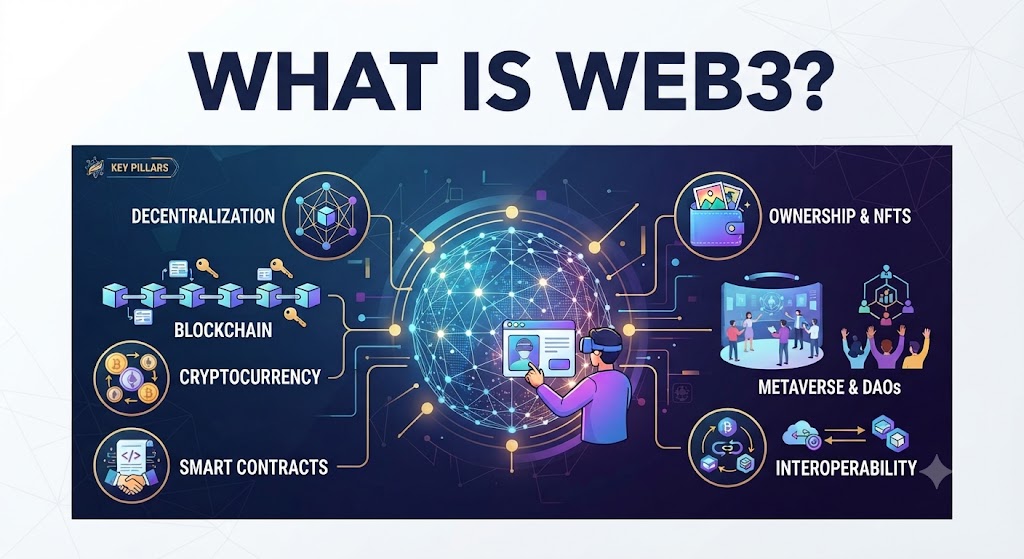
Web3 is a broad term used to describe a vision for a more decentralized internet where users can have greater control over digital assets, identity, and online interactions.
Unlike the traditional internet, where many services are operated by centralized companies, Web3 applications can use blockchain networks, smart contracts, digital wallets, and tokens to distribute ownership and control.
Web3 is still developing, and there is no single definition that everyone agrees on. The term generally refers to an internet ecosystem built around decentralized technologies and user ownership.
How Does Web3 Work?
Web3 applications can use blockchain networks as part of their underlying infrastructure.
Instead of storing every piece of information on one company’s servers, certain records can be stored or verified using decentralized networks.
Users may interact with Web3 services through digital wallets rather than traditional usernames and passwords.
For example, a user could connect a wallet to a decentralized application and use blockchain based assets without creating a separate account with the application.
What Is the Difference Between Web2 and Web3?
Web2 refers to the modern internet dominated by interactive websites, mobile applications, social networks, cloud platforms, and centralized services.
Web3 aims to introduce greater decentralization and user ownership.
| Web2 | Web3 |
|---|---|
| Mostly centralized platforms | Greater use of decentralized networks |
| Accounts managed by platforms | Wallet based identity can be used |
| Platforms generally control user data and infrastructure | Users can have greater control over certain assets |
| Digital ownership often depends on platform rules | Blockchain can provide verifiable ownership |
| Traditional payment systems are common | Blockchain based payments can be integrated |
The distinction is not absolute. Many modern applications combine centralized and decentralized technologies.
What Is the Role of Blockchain in Web3?
Blockchain technology is one of the main foundations associated with Web3.
A blockchain can provide a shared record of transactions and digital ownership.
It can also support smart contracts that allow applications to execute programmed rules.
This makes it possible to build services where some functions operate without relying entirely on a central company.
What Are Web3 Applications?
Web3 applications are applications that use decentralized technologies such as blockchains or smart contracts.
They are sometimes called decentralized applications, or dApps.
Examples can include:
- Decentralized exchanges
- Blockchain games
- Digital asset marketplaces
- Decentralized finance applications
- Community governance platforms
- Digital identity systems
The level of decentralization can vary significantly between applications.
What Is a Web3 Wallet?
A Web3 wallet is a digital tool that allows users to manage blockchain based assets and interact with decentralized applications.
Depending on the wallet, users may be able to:
- Store digital assets
- Send and receive tokens
- Connect to decentralized applications
- Approve blockchain transactions
- Manage digital collectibles
- Participate in certain blockchain based services
A wallet does not simply store coins in the same way a physical wallet stores cash. Blockchain assets remain recorded on the relevant network, while the wallet manages the cryptographic credentials needed to control them.
What Are Private Keys?
A private key is a cryptographic credential associated with control of blockchain assets.
It is extremely important to protect private keys and recovery information.
If someone obtains unauthorized access to a private key, they may be able to control the associated blockchain assets.
If a user loses access to the necessary recovery information, recovering the assets may be difficult or impossible.
What Are Web3 Tokens?
Tokens are digital assets that can operate on blockchain networks.
In Web3, tokens may serve different purposes.
They can represent:
- Digital currencies
- Utility within an application
- Governance rights
- Digital collectibles
- Membership
- Tokenized assets
- Other blockchain based rights or functions
Not every token has the same purpose or value.
What Are NFTs in Web3?
NFT stands for non fungible token.
An NFT is a blockchain based digital asset designed to represent something unique.
NFTs have been used for:
- Digital artwork
- Collectibles
- Gaming assets
- Memberships
- Event access
- Digital certificates
- Other forms of digital ownership
Owning an NFT does not automatically mean owning the copyright or every legal right associated with the content it represents.
The rights depend on the specific project and its terms.
What Is Web3 Gaming?
Web3 gaming refers to games that incorporate blockchain based assets or technologies.
Players may be able to own certain digital items as blockchain assets.
These assets could include:
- Characters
- Equipment
- Collectibles
- Virtual items
- Tokens
The extent to which players can transfer or use these assets outside a particular game depends on the game’s design and supporting infrastructure.
What Is Decentralized Finance?
Decentralized finance, commonly called DeFi, is a major area of Web3.
DeFi applications use blockchain technology and smart contracts to provide financial functions.
Examples include:
- Token exchanges
- Lending
- Borrowing
- Staking
- Liquidity services
- Asset management
DeFi can provide new ways to interact with financial services, but it also involves significant risks.
Smart contract vulnerabilities, market volatility, scams, liquidity problems, and transaction errors can result in financial losses.
What Is Web3 Governance?
Some Web3 projects use blockchain based governance systems.
Participants may receive governance tokens that allow them to vote on certain decisions.
These decisions could involve:
- Protocol changes
- Treasury management
- Product development
- Community proposals
Governance systems differ significantly between projects.
Holding a token does not automatically mean that a person has legal ownership of an organization.
What Is Decentralized Identity?
Decentralized identity is an approach that aims to give individuals greater control over digital identity information.
Instead of depending entirely on accounts controlled by individual platforms, users could potentially manage credentials through digital wallets or decentralized identity systems.
Potential applications include:
- Professional credentials
- Educational certificates
- Identity verification
- Membership credentials
- Access management
Privacy and security remain important considerations.
How Can Web3 Give Users More Ownership?
Traditional online platforms often control the databases and infrastructure where user accounts and digital content are stored.
Web3 can allow certain assets to be recorded on a blockchain.
For example, a digital collectible can be associated with a blockchain address controlled by the user.
This can provide verifiable ownership of the blockchain asset.
However, ownership does not automatically mean complete control over the underlying application or content.
Is Web3 Completely Decentralized?
No.
The term Web3 is broad, and many projects described as Web3 still rely on centralized infrastructure.
A Web3 application may use blockchain technology for transactions while relying on centralized servers for other functions.
Decentralization exists on a spectrum rather than being a simple yes or no characteristic.
What Are the Benefits of Web3?
Web3 can offer several potential benefits.
User Ownership
Blockchain technology can provide verifiable ownership of certain digital assets.
Greater Portability
Some blockchain assets can potentially be transferred between compatible applications.
Open Access
Public blockchain networks can allow users to interact with applications without requiring approval from a traditional intermediary.
Programmable Transactions
Smart contracts can automate certain transactions and agreements.
Global Accessibility
Many blockchain networks operate across borders and can be accessed by users in different countries, subject to local laws and restrictions.
What Are the Challenges of Web3?
Web3 also has important limitations.
These include:
- Technical complexity
- Cryptocurrency volatility
- Security risks
- Scams
- Smart contract vulnerabilities
- Difficult user experiences
- Regulatory uncertainty
- Scalability challenges
- Privacy concerns
- Dependence on centralized infrastructure in some applications
These issues continue to influence Web3 adoption.
Is Web3 Safe?
Web3 is not automatically safe simply because it uses blockchain technology.
Users can face risks involving:
- Phishing
- Fake applications
- Fraudulent tokens
- Malicious smart contracts
- Private key theft
- Wallet compromises
- Price volatility
- Project failures
Users should carefully verify applications and protect wallet credentials.
Why Is Web3 Difficult for Beginners?
Web3 can introduce unfamiliar concepts.
New users may need to understand:
- Wallets
- Private keys
- Network fees
- Blockchain transactions
- Tokens
- Smart contracts
- Digital signatures
A mistake can sometimes be difficult to reverse.
Improving the user experience is therefore one of the major challenges for wider Web3 adoption.
How Does Web3 Handle Payments?
Web3 applications can use blockchain based digital assets for payments.
A user may connect a wallet and authorize a blockchain transaction.
This can allow payments to occur without traditional payment infrastructure in certain situations.
However, transaction fees, cryptocurrency volatility, regulations, and merchant acceptance can affect practical use.
What Is Web3 Social Media?
Web3 social media refers to social platforms that incorporate decentralized technologies.
Some projects aim to give users greater control over identity, content, social connections, or digital assets.
The concept is still evolving.
Different platforms use very different approaches to decentralization.
What Is Web3 Marketing?
Web3 marketing refers to marketing strategies designed for blockchain based communities and decentralized applications.
It can involve:
- Community building
- Token based incentives
- Digital collectibles
- Creator communities
- Decentralized governance
- Blockchain based loyalty programs
Web3 marketing often places greater emphasis on community participation than traditional advertising.
What Is the Relationship Between Web3 and Cryptocurrency?
Cryptocurrency is an important part of many Web3 ecosystems.
Tokens can be used for payments, governance, incentives, ownership, or access.
However, Web3 is broader than cryptocurrency.
A Web3 application may use blockchain technology without making cryptocurrency speculation its primary purpose.
What Is the Relationship Between Web3 and AI?
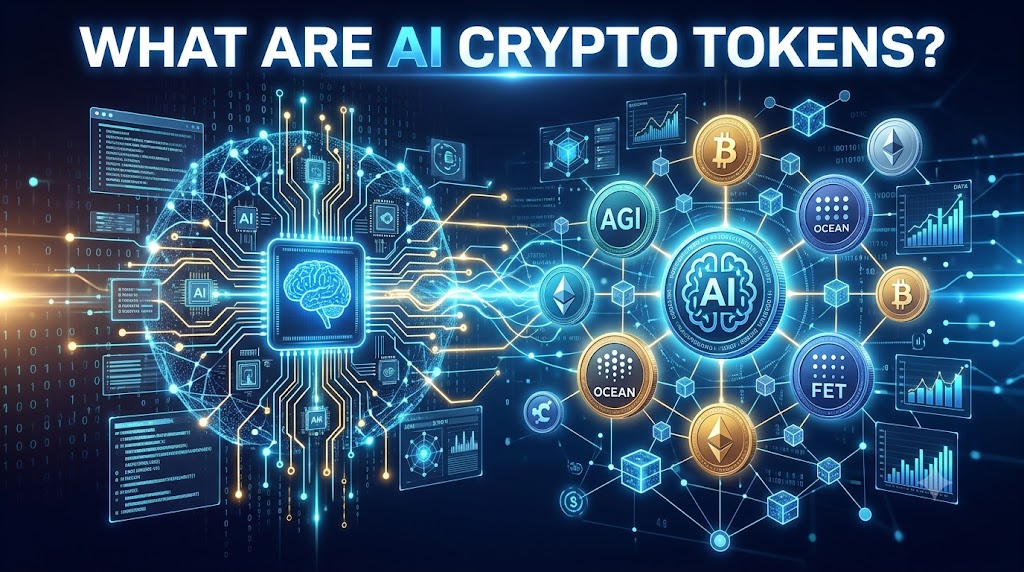
AI and Web3 are separate technology areas, but they can be combined.
Potential applications include:
- Decentralized AI marketplaces
- Blockchain based data ownership
- AI agent payments
- Decentralized computing
- Digital identity
- Data verification
These ideas are still developing, and practical implementations vary.
Why Is Web3 Important?
Web3 represents a different approach to how online services can be built.
Instead of relying entirely on centralized platforms, Web3 explores models where users, developers, communities, and decentralized networks can share control.
Whether this vision becomes widely adopted will depend on usability, security, regulation, scalability, and whether decentralized systems provide meaningful advantages.
The Future of Web3
The future of Web3 remains uncertain.
Some applications may become widely adopted, while others may disappear.
Areas that could continue developing include:
- Digital ownership
- Tokenization
- Decentralized finance
- Blockchain gaming
- Digital identity
- Community governance
- Decentralized infrastructure
- Blockchain based payments
The technology will likely continue evolving alongside artificial intelligence, traditional software, financial systems, and the broader internet.
How Can Beginners Learn About Web3?
Beginners can start by understanding the basic concepts.
Learn what blockchains are.
Understand how cryptocurrency wallets work.
Learn about private keys.
Understand transaction fees.
Explore how smart contracts operate.
Study common security risks.
Only after understanding the fundamentals should users consider interacting with unfamiliar Web3 applications or digital assets.
Final Thoughts
Web3 is a broad concept describing a more decentralized approach to the internet.
It combines technologies such as blockchain networks, smart contracts, digital wallets, tokens, and decentralized applications.
Its central ideas include user ownership, digital assets, open networks, and reduced dependence on centralized intermediaries.
Web3 is still developing and faces challenges involving security, usability, scalability, regulation, and decentralization.
For businesses and users, understanding both its potential and limitations is important.
The future of Web3 will ultimately depend on whether these technologies can solve real problems and provide experiences that are useful, secure, affordable, and easy enough for everyday users.
Frequently Asked Questions
What is Web3 in simple words?
Web3 is a vision for a more decentralized internet where blockchain technology can give users greater control over certain digital assets, identities, and online interactions.
Is Web3 the same as cryptocurrency?
No. Cryptocurrency is one part of many Web3 ecosystems. Web3 is a broader concept involving blockchain, smart contracts, digital wallets, tokens, and decentralized applications.
What technology is used in Web3?
Web3 can use blockchain networks, smart contracts, digital wallets, cryptography, decentralized applications, tokens, and other decentralized technologies.
What is a Web3 wallet?
A Web3 wallet is a tool that allows users to manage blockchain credentials and digital assets and interact with decentralized applications.
What are Web3 tokens?
Web3 tokens are blockchain based digital assets that can represent currencies, utility, governance rights, collectibles, memberships, or other functions.
What are NFTs?
NFTs are non fungible tokens designed to represent unique blockchain based digital assets or ownership records.
Is Web3 decentralized?
Some Web3 applications are highly decentralized, while others still rely on centralized infrastructure. Decentralization varies from one project to another.
Is Web3 safe?
Web3 can involve significant security risks, including scams, phishing, wallet theft, fraudulent applications, smart contract vulnerabilities, and cryptocurrency volatility.
What is DeFi?
DeFi stands for decentralized finance. It refers to blockchain based applications that provide financial functions such as lending, borrowing, trading, and liquidity services.
What are smart contracts?
Smart contracts are blockchain based programs that can automatically execute predefined rules and actions.
Can Web3 replace Web2?
Web3 is not necessarily a complete replacement for Web2. Many applications may combine centralized and decentralized technologies.
Why is Web3 important?
Web3 explores new ways to provide digital ownership, decentralized applications, programmable transactions, and user participation in online services.
What are the biggest challenges of Web3?
Major challenges include usability, security, scalability, regulation, technical complexity, privacy, and dependence on centralized infrastructure.
Can Web3 be used by businesses?
Yes. Businesses can explore Web3 for digital assets, loyalty programs, payments, communities, identity systems, tokenization, and other applications.
Does Web3 require cryptocurrency?
Not every Web3 application requires users to actively hold cryptocurrency, but many blockchain based applications use tokens for transactions or other functions.
What is Web3 gaming?
Web3 gaming refers to games that use blockchain based assets, tokens, NFTs, or decentralized technologies.
What is Web3 social media?
Web3 social media refers to social platforms that incorporate decentralized technologies to potentially give users greater control over identity, content, relationships, or digital assets.
Is Web3 the future of the internet?
Web3 may influence parts of the future internet, but its widespread adoption is not guaranteed. Its success will depend on practical benefits, usability, security, regulation, and user demand.