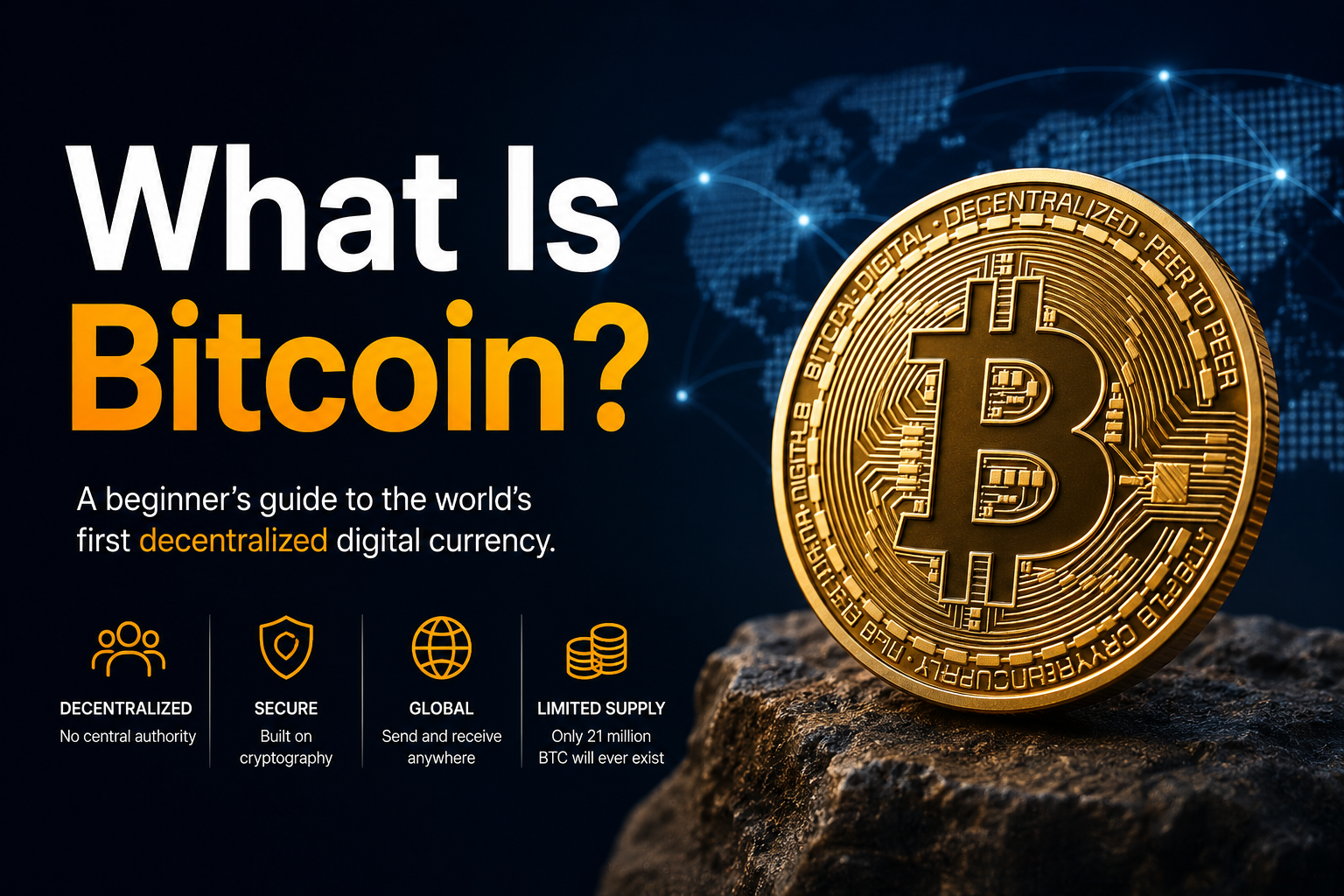
Bitcoin has transformed the way people think about money, payments, and financial freedom. Since its launch in 2009, it has grown from an experimental digital currency into a globally recognized financial asset worth hundreds of billions of dollars. Whether you are new to cryptocurrency or looking to understand why Bitcoin continues to dominate the digital asset market, this guide explains everything you need to know.
Understanding Bitcoin
Bitcoin is a decentralized digital currency that allows people to send and receive money without relying on banks, governments, or other intermediaries. It was created by an anonymous individual or group known as Satoshi Nakamoto, who introduced Bitcoin as a peer-to-peer electronic cash system.
Unlike traditional currencies such as the US Dollar, Euro, or Indian Rupee, Bitcoin exists entirely online. There are no physical coins or banknotes. Instead, ownership is recorded on a public ledger called the blockchain.
The key idea behind Bitcoin is simple: give people complete control over their money while removing the need for a central authority to verify transactions.
How Bitcoin Works
Bitcoin operates on blockchain technology. A blockchain is a distributed digital ledger that records every Bitcoin transaction ever made.
When someone sends Bitcoin:
- The transaction is broadcast to the network.
- Computers known as nodes verify the transaction.
- Miners bundle verified transactions into blocks.
- The block is added to the blockchain.
- The transaction becomes permanent and transparent.
Because thousands of computers maintain the blockchain simultaneously, altering transaction records is extremely difficult.
What Makes Bitcoin Unique?
Decentralization
No single government, company, or organization controls Bitcoin. The network operates through a global community of participants.
Limited Supply
Bitcoin has a maximum supply of 21 million coins. This scarcity is one reason many investors view it as digital gold.
Transparency
Every transaction is recorded publicly on the blockchain, creating a transparent financial system.
Security
Advanced cryptography protects Bitcoin transactions and ownership records.
Global Accessibility
Anyone with an internet connection can send or receive Bitcoin regardless of geographic location.
Bitcoin Mining Explained
Mining is the process that secures the Bitcoin network and creates new coins.
Miners use specialized computers to solve complex mathematical problems. When a miner successfully solves a problem, they validate a block of transactions and receive newly minted Bitcoin as a reward.
Mining serves two important purposes:
- Securing the network
- Issuing new Bitcoin into circulation
Over time, mining rewards decrease through events known as Bitcoin Halvings, which occur approximately every four years.
Why People Buy Bitcoin
Bitcoin attracts investors for various reasons.
Store of Value
Many compare Bitcoin to gold because of its limited supply and resistance to inflation.
Investment Opportunity
Bitcoin has delivered substantial returns over the past decade, attracting both retail and institutional investors.
Financial Independence
Bitcoin enables individuals to hold and transfer wealth without relying on traditional financial institutions.
International Transfers
Cross-border payments can be completed faster and often with lower fees compared to traditional banking systems.
Risks Associated with Bitcoin
While Bitcoin offers significant opportunities, it also carries risks.
Volatility
Bitcoin prices can experience dramatic fluctuations within short periods.
Regulatory Uncertainty
Governments worldwide continue developing cryptocurrency regulations.
Security Risks
Users must properly secure wallets and private keys.
Market Speculation
Short-term trading can expose investors to substantial losses.
Bitcoin Wallets
A Bitcoin wallet is a tool used to store and manage cryptocurrency.
Hot Wallets
These are connected to the internet and offer convenience for everyday transactions.
Cold Wallets
These remain offline and provide enhanced security for long-term storage.
Popular wallet types include:
- Mobile wallets
- Desktop wallets
- Hardware wallets
- Paper wallets
Bitcoin vs Traditional Money
Traditional currencies are controlled by central banks, which can increase money supply when needed. Bitcoin follows a fixed issuance schedule and cannot exceed 21 million coins.
While fiat currencies are accepted universally for daily purchases, Bitcoin is increasingly being adopted by businesses and payment providers around the world.
The Future of Bitcoin
Bitcoin continues to evolve as adoption grows among institutions, governments, and individual users. Many analysts believe Bitcoin could play a significant role in the future of digital finance, serving as both a store of value and a global payment network.
Emerging developments such as the Lightning Network are helping improve transaction speed and scalability, making Bitcoin more practical for everyday use.
Conclusion
Bitcoin is far more than just a cryptocurrency. It represents a new approach to money, ownership, and financial sovereignty. By combining decentralization, transparency, and scarcity, Bitcoin has created an entirely new asset class that continues to influence the future of finance.
Whether viewed as an investment, a payment system, or a technological innovation, Bitcoin remains one of the most important developments in modern financial history.