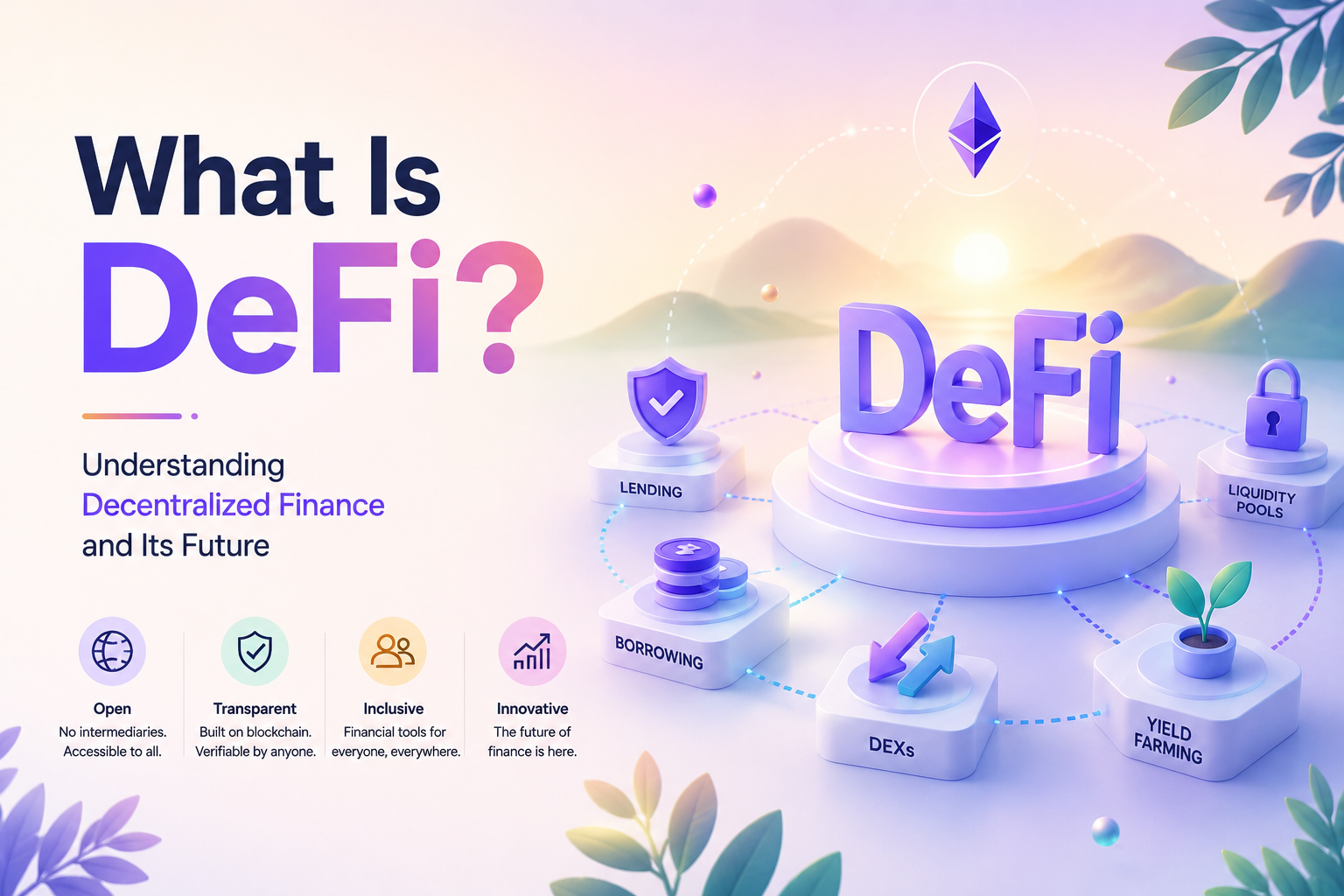
Decentralized Finance, commonly known as DeFi, is one of the most transformative innovations in blockchain technology. By removing intermediaries from financial services, DeFi enables anyone with an internet connection to access lending, borrowing, trading, and investment opportunities.
What Is DeFi?
DeFi refers to a collection of financial applications built on blockchain networks that operate without traditional intermediaries such as banks, brokers, or payment processors.
These applications use smart contracts to automate financial transactions.
The goal is to create an open, transparent, and permissionless financial system accessible to everyone.
How DeFi Works
DeFi applications run primarily on blockchain networks that support smart contracts.
Smart contracts are self-executing programs that automatically perform actions when predefined conditions are met.
This automation eliminates the need for third-party institutions to process transactions.
Core Principles of DeFi
Permissionless Access
Anyone can participate without approval from a central authority.
Transparency
Transactions and smart contract code are publicly visible.
Interoperability
Many DeFi protocols can interact seamlessly with one another.
User Control
Participants retain custody of their assets.
Popular DeFi Services
Decentralized Exchanges
Users can trade assets directly from wallets without centralized exchanges.
Lending Platforms
Users lend assets to earn interest or borrow against collateral.
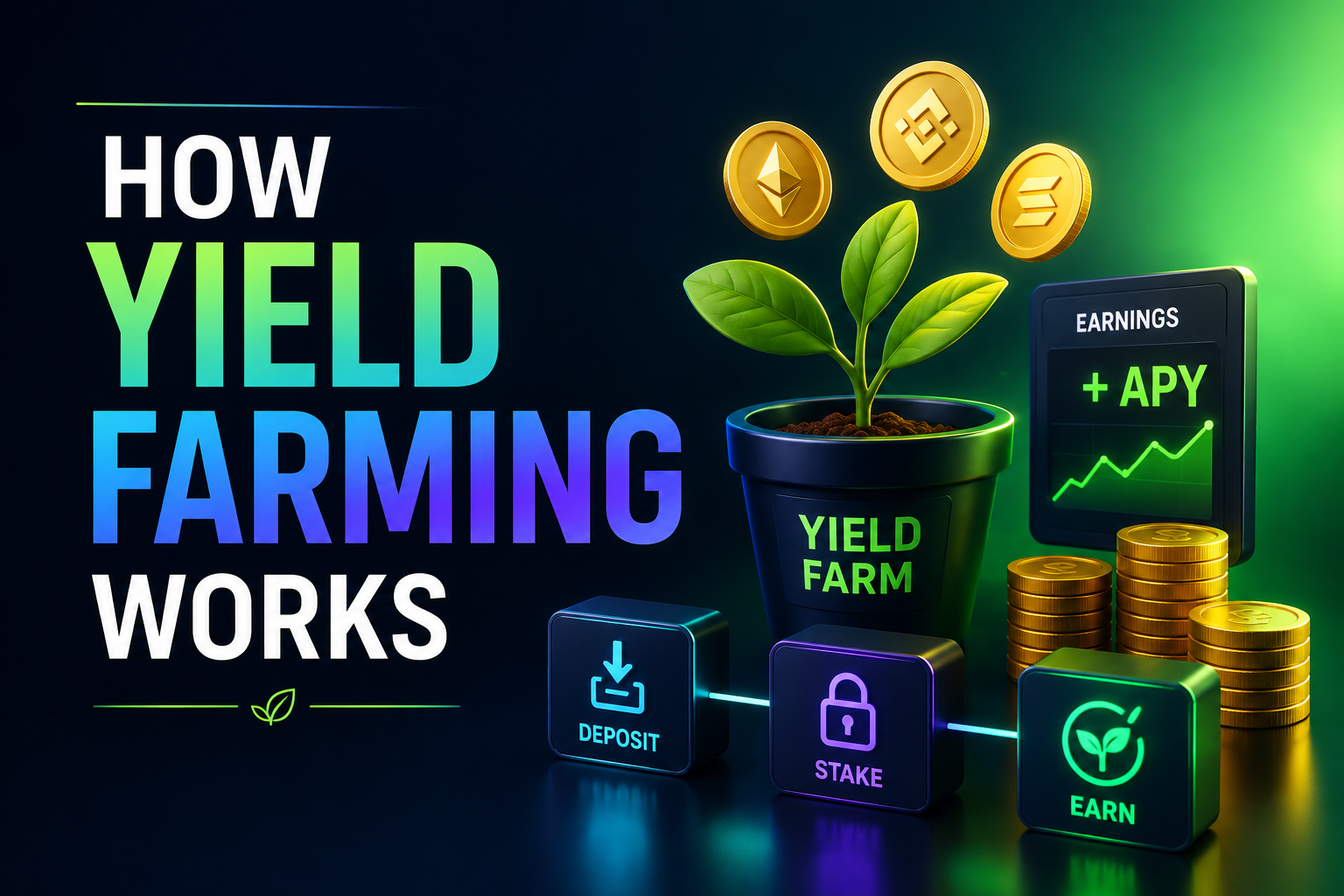
Yield Farming
Investors provide liquidity and earn rewards.
Stablecoins
Stablecoins provide price stability within decentralized ecosystems.
Derivatives and Synthetic Assets
Advanced financial products are increasingly available through DeFi platforms.
Benefits of DeFi
- Global accessibility
- Reduced fees
- Increased transparency
- Financial inclusion
- Greater asset control
- Continuous market availability
Unlike traditional banking systems, DeFi operates around the clock.
Risks Associated with DeFi
Smart Contract Vulnerabilities
Coding errors can create security risks.
Market Volatility
Cryptocurrency prices can fluctuate dramatically.
Regulatory Uncertainty
Governments continue evaluating DeFi regulations.
Liquidity Risks
Some protocols may experience liquidity shortages during market stress.
Why DeFi Matters
Traditional financial systems often exclude large portions of the global population.
DeFi offers alternatives for individuals who:
- Lack bank accounts
- Face high remittance costs
- Encounter financial restrictions
- Need greater financial autonomy
By lowering barriers to entry, DeFi expands access to financial services worldwide.
DeFi and Financial Innovation
DeFi has introduced new concepts including:
- Automated Market Makers
- Liquidity Pools
- Governance Tokens
- Flash Loans
These innovations are reshaping how financial products are designed and delivered.
Challenges Facing DeFi
Despite rapid growth, challenges remain:
- Scalability limitations
- User experience complexity
- Security concerns
- Regulatory developments
Addressing these issues will be crucial for mainstream adoption.
The Future of DeFi
Many experts believe DeFi could become a foundational layer of future financial infrastructure.
Emerging trends include:
- Institutional participation
- Cross-chain interoperability
- Tokenized real-world assets
- Enhanced security frameworks
As technology matures, DeFi may integrate more closely with traditional finance.
Conclusion
DeFi represents a major shift in how financial services are delivered and accessed. By leveraging blockchain technology and smart contracts, decentralized finance creates opportunities for greater transparency, efficiency, and financial inclusion. While risks remain, DeFi continues to demonstrate the potential to reshape the global financial landscape.
5. What Are DAOs? Understanding Decentralized Autonomous Organizations
The rise of blockchain technology has introduced new ways for people to collaborate, govern communities, and manage resources. One of the most significant innovations in this area is the Decentralized Autonomous Organization, commonly known as a DAO.
DAOs are redefining organizational structures by replacing centralized leadership with community-driven governance.
What Is a DAO?
A DAO is a blockchain-based organization governed by rules encoded in smart contracts.
Instead of relying on executives, boards of directors, or centralized management teams, decisions are made collectively by members through voting mechanisms.
The objective is to create transparent, democratic, and decentralized organizations.
How DAOs Work
DAOs operate through smart contracts that define governance rules.
Typical DAO processes include:
- Members submit proposals.
- Community members review proposals.
- Voting takes place using governance tokens.
- Approved proposals are executed.
Because these rules exist on the blockchain, activities remain transparent and verifiable.
Governance Tokens Explained
Governance tokens play a central role in DAO operations.
Token holders can:
- Vote on proposals
- Influence protocol upgrades
- Allocate treasury funds
- Shape strategic direction
Voting power often depends on the number of tokens held.
Key Characteristics of DAOs
Decentralization
Decision-making authority is distributed among members.
Transparency
All proposals, votes, and treasury transactions are publicly visible.
Community Ownership
Participants collectively guide organizational development.
Automation
Smart contracts automate governance processes.
Types of DAOs
Protocol DAOs
Govern blockchain protocols and ecosystems.
Investment DAOs
Pool capital for collective investment decisions.
Social DAOs
Focus on communities, networking, and collaboration.
Creator DAOs
Support artists, content creators, and digital projects.
Grant DAOs
Allocate funding to ecosystem initiatives.
Benefits of DAOs
Democratic Participation
Members directly influence decisions.
Global Collaboration
Participants can join from anywhere in the world.
Increased Transparency
Blockchain records reduce information asymmetry.
Reduced Administrative Costs
Automation lowers operational overhead.
Challenges of DAOs
Governance Inefficiencies
Large communities can struggle to reach consensus.
Voter Participation
Low engagement may affect decision quality.
Regulatory Uncertainty
Legal frameworks for DAOs continue evolving.
Security Risks
Smart contract vulnerabilities remain a concern.
Real-World Applications
DAOs are increasingly used for:
- Protocol governance
- Venture funding
- Community management
- Open-source development
- Charity initiatives
- Creator economies
Their flexibility allows diverse use cases across industries.
Why DAOs Matter
Traditional organizations often concentrate decision-making power among a small group of individuals.
DAOs offer an alternative model that emphasizes:
- Transparency
- Community involvement
- Shared ownership
- Global participation
This shift aligns closely with the broader principles of Web3.
The Future of DAOs
DAO infrastructure continues improving through:
- Better governance systems
- Enhanced voting mechanisms
- Identity solutions
- Legal recognition frameworks
As blockchain adoption grows, DAOs may become increasingly common in business, finance, entertainment, and social communities.
Conclusion
DAOs represent a new organizational paradigm enabled by blockchain technology. By combining transparency, automation, and community governance, they challenge traditional management structures and create new opportunities for collective decision-making. Although challenges remain, DAOs are poised to play a significant role in the evolution of decentralized ecosystems and the future of digital collaboration.