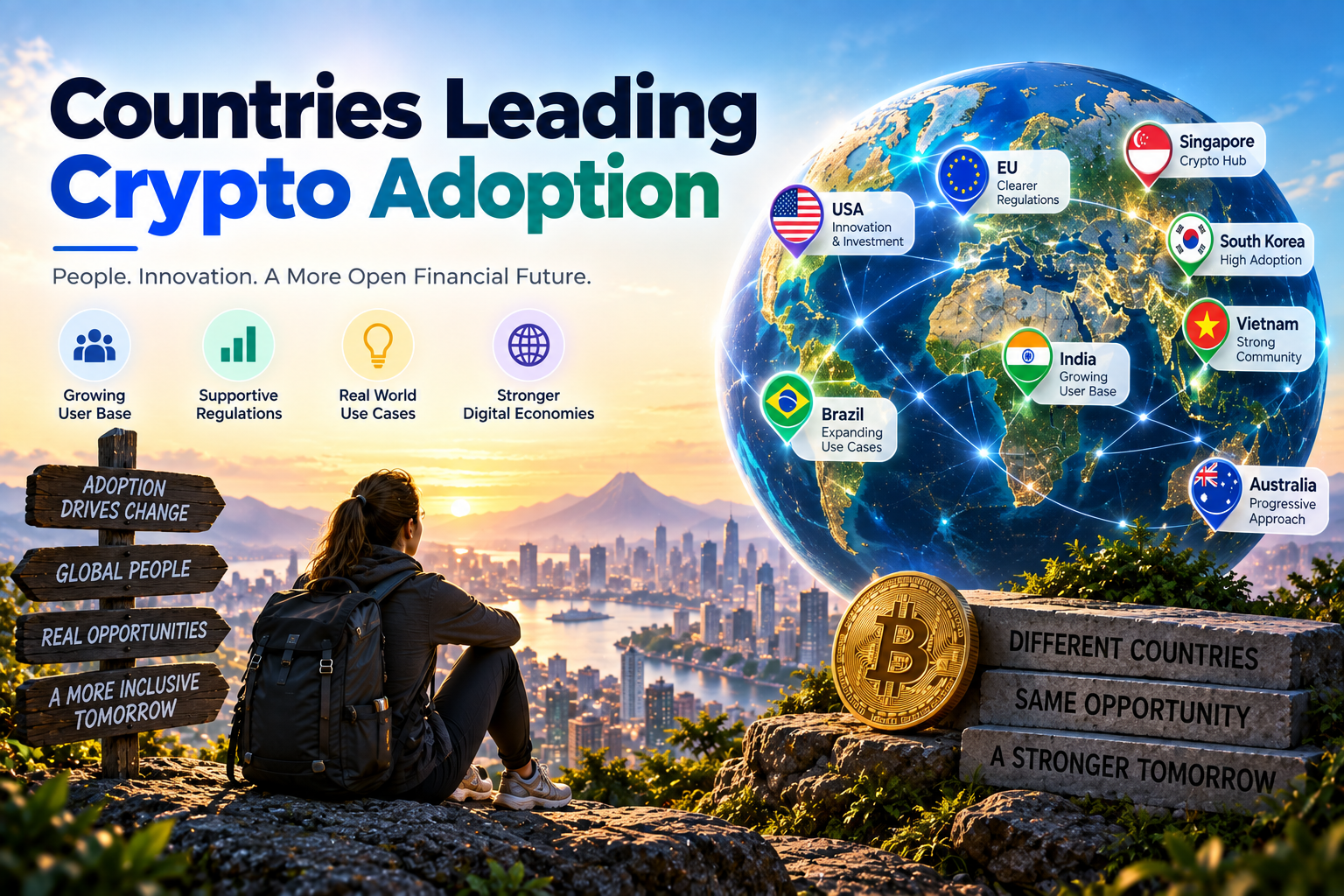
Cryptocurrency adoption has expanded far beyond a small group of technology enthusiasts. In 2026, people and businesses across Asia, North America, Latin America, Africa, and Europe are using digital assets for different reasons.
Some countries have large numbers of retail cryptocurrency users. Others have significant institutional activity, trading volume, stablecoin usage, blockchain development, or decentralized finance participation.
This makes the idea of “crypto adoption” more complicated than simply asking which country has the most cryptocurrency users.
According to recent global adoption research, India remains one of the leading cryptocurrency markets, while the United States has the largest retail transaction volume. South Korea, Russia, Brazil, Turkey, the United Kingdom, Vietnam, Ukraine, and Germany also recorded substantial retail cryptocurrency activity in the first quarter of 2026.
Understanding why different countries are adopting cryptocurrency can provide a clearer picture of how the global digital asset industry is developing.
What Does Crypto Adoption Mean?
Crypto adoption refers to the use of cryptocurrencies and blockchain based financial services by individuals, businesses, institutions, and other organizations.
Adoption can involve several activities, including:
• Buying and holding cryptocurrency
• Trading digital assets
• Sending and receiving cryptocurrency
• Using stablecoins
• Making international transfers
• Using decentralized finance applications
• Investing through cryptocurrency investment products
• Using blockchain based financial services
• Building businesses and applications around blockchain technology
Because there are several ways to measure adoption, different studies can produce different country rankings.
A country may have a high percentage of people using cryptocurrency but relatively low total transaction value. Another country may have fewer users but extremely large institutional and retail transactions.
India
India continues to be one of the world’s most important cryptocurrency markets.
The latest comprehensive global adoption index places India at the top of its overall ranking.
India’s position is supported by its enormous population, widespread smartphone usage, expanding digital economy, large technology sector, and substantial interest in cryptocurrency.
The country also has a large community of blockchain developers and technology businesses.
Cryptocurrency activity in India includes trading, investing, blockchain development, decentralized applications, and digital asset related businesses.
India’s regulatory and taxation environment has also played an important role in shaping the market.
The country’s strong position demonstrates that cryptocurrency adoption can remain substantial even when investors and businesses operate within a developing regulatory framework.
United States
The United States is one of the largest cryptocurrency markets in the world.
While India leads several population adjusted adoption measurements, the United States has enormous absolute transaction activity.
During the first quarter of 2026, the United States recorded approximately $213.3 billion in retail cryptocurrency transaction volume, placing it first in that particular measurement.
The American market is also important because of institutional participation.
Financial institutions, investment companies, technology businesses, cryptocurrency exchanges, and asset managers have all become increasingly involved in digital assets.
Bitcoin and other cryptocurrency investment products have also made digital assets more accessible through traditional financial channels.
This means cryptocurrency adoption in the United States includes both retail and institutional activity.
Pakistan
Pakistan has emerged as another major cryptocurrency adoption market.
The country ranked third in the latest Chainalysis global adoption ranking.
Several factors may contribute to cryptocurrency interest in Pakistan, including international transfers, remittances, investment activity, digital financial services, and a large young population.
Pakistan also has a growing technology community that has contributed to interest in blockchain and cryptocurrency.
The country’s cryptocurrency environment continues to develop as authorities work toward clearer rules and regulatory structures for digital assets.
Vietnam
Vietnam is another country with strong cryptocurrency adoption.
The country ranked fourth in the latest global adoption index and also recorded significant retail cryptocurrency transaction activity during the first quarter of 2026.
Vietnam has a young and technology focused population, high internet usage, and strong interest in blockchain applications.
Cryptocurrency activity includes trading, investment, decentralized applications, blockchain gaming, and other digital asset services.
Vietnam’s position is particularly notable because its cryptocurrency activity is large relative to the size of its economy.
Brazil
Brazil is one of the most important cryptocurrency markets in Latin America.
The country ranked fifth in the latest global adoption index and recorded approximately $40.4 billion in retail cryptocurrency transaction volume during the first quarter of 2026.
Brazil has a large population and an established digital asset ecosystem.
Cryptocurrency is used for trading and investment, while stablecoins are also becoming increasingly relevant for international transfers and digital payments.
Brazil has also developed a formal regulatory environment for digital assets, giving cryptocurrency businesses a clearer framework within which to operate.
Nigeria
Nigeria is one of Africa’s leading cryptocurrency markets.
It ranked sixth in the latest global adoption index.
Cryptocurrency adoption in Nigeria has been connected to several practical financial needs, including international transfers, remittances, currency concerns, and access to alternative financial services.
The country has a young population and a strong technology community.
Stablecoins have also become important because they can provide users with access to digital assets linked to relatively stable currencies.
Nigeria demonstrates how cryptocurrency can be used for practical financial purposes rather than purely for investment speculation.
Indonesia
Indonesia has become a major cryptocurrency market in Asia.
The country ranked seventh in the latest global adoption index.
Its large population, growing internet economy, technology adoption, and interest in digital financial services have helped support cryptocurrency activity.
Indonesia also has an active community of cryptocurrency traders, investors, developers, and blockchain businesses.
Decentralized finance and other blockchain applications have contributed to the country’s broader digital asset ecosystem.
Ukraine
Ukraine has maintained a significant position in global cryptocurrency adoption.
The country ranked eighth in the latest comprehensive adoption index.
Ukraine has a well developed technology sector and a large community of developers interested in blockchain.
Cryptocurrency has also gained importance during periods of financial and economic disruption.
Digital assets can provide additional options for transferring funds and accessing financial services when traditional systems face difficulties.
Ukraine’s experience demonstrates how cryptocurrency adoption can be influenced by both technology and unusual economic circumstances.
Philippines
The Philippines is another major cryptocurrency market.
The country ranked ninth in the latest global adoption index.
Several factors contribute to cryptocurrency activity in the Philippines, including international remittances, digital payments, online employment, gaming, and a young technology friendly population.
Blockchain gaming has also played an important role in introducing digital assets to new users.
For many people, cryptocurrency represents another part of the broader digital economy rather than simply an investment product.
Russia
Russia ranked tenth in the latest comprehensive global adoption index.
The country also recorded significant retail cryptocurrency transaction activity during the first quarter of 2026.
Russian cryptocurrency activity includes trading, investment, international transfers, and other digital asset transactions.
Regulatory developments have continued to influence how cryptocurrency businesses and users operate within the country.
Russia’s position also illustrates why transaction volume and adoption rankings can tell different stories.
United Kingdom
The United Kingdom has one of Europe’s most developed financial and technology markets.
It ranked eleventh in the latest global adoption index.
The country has a large financial services industry, active cryptocurrency businesses, blockchain developers, and investors interested in digital assets.
Institutional participation is particularly relevant to the UK’s cryptocurrency ecosystem.
The country has also been working toward developing clearer regulatory rules for digital assets and cryptocurrency businesses.
Turkey
Turkey has a particularly active cryptocurrency market.
The country ranked fourteenth in the latest comprehensive adoption index and recorded approximately $34.9 billion in retail cryptocurrency transaction volume during the first quarter of 2026.
Cryptocurrency interest in Turkey has been influenced by inflation, currency movements, investment demand, and interest in alternative financial assets.
Stablecoins can also play an important role in markets where people are concerned about the purchasing power of their local currency.
South Korea
South Korea is one of the world’s most active cryptocurrency trading markets.
Although it ranked fifteenth in the latest comprehensive adoption index, its retail transaction volume was considerably larger.
South Korea recorded approximately $66.6 billion in retail cryptocurrency activity during the first quarter of 2026, placing it second in that particular measurement.
The country’s advanced technology industry and large number of active cryptocurrency traders have helped create a strong digital asset ecosystem.
Cryptocurrency exchanges and blockchain businesses are particularly important within South Korea’s technology sector.
Japan
Japan has been involved with cryptocurrency and blockchain technology for many years.
It ranked nineteenth in the latest comprehensive adoption index.
Japan has a mature financial system, advanced technology infrastructure, and established rules covering cryptocurrency exchanges and digital assets.
The country has a combination of retail investors, businesses, technology companies, and blockchain developers participating in the cryptocurrency industry.
Japan’s experience demonstrates how cryptocurrency adoption can develop alongside a structured financial and regulatory system.
Argentina
Argentina is another important cryptocurrency market in Latin America.
The country ranked twentieth in the latest comprehensive adoption index.
Economic conditions have contributed to strong interest in digital assets.
Inflation and concerns about local currency purchasing power can encourage people to explore alternative assets and financial technologies.
Stablecoins can be particularly useful for people looking for digital assets linked to relatively stable currencies.
Argentina therefore represents an example of cryptocurrency adoption being influenced by economic circumstances as well as investment interest.
Why Is Crypto Adoption High in Emerging Markets?
A notable feature of global cryptocurrency adoption is the strong representation of emerging economies.
There are several reasons why cryptocurrency can become attractive in these markets.
Inflation
When local currencies experience significant inflation, some people may look for alternative ways to store or transfer value.
Remittances
Countries with large populations working abroad may have significant demand for international money transfers.
Financial Access
People who have limited access to traditional financial services may explore digital alternatives.
Young Populations
Younger populations tend to be familiar with smartphones, digital payments, online platforms, and emerging technology.
International Commerce
Businesses working with international customers and suppliers may use digital assets for certain transactions.
Stablecoins
Stablecoins can provide users with digital exposure to currencies such as the US dollar without requiring a traditional bank account in another country.
Why Does the United States Have Such Large Crypto Volume?
Population adjusted adoption and total transaction volume are two different measurements.
A country can rank highly for grassroots adoption while having lower absolute transaction volume.
The United States has a large population, high levels of investment capital, substantial institutional participation, and a developed financial system.
As a result, even if cryptocurrency adoption is measured differently from countries such as India or Pakistan, the total value of transactions can be enormous.
This explains why the United States can lead retail transaction volume while India leads a population and wealth adjusted adoption index.
The Growing Importance of Stablecoins
Stablecoins have become an important part of global cryptocurrency adoption.
Unlike assets such as Bitcoin, stablecoins are generally designed to maintain a relatively stable value by being linked to assets such as the US dollar.
They can be used for:
• International payments
• Remittances
• Trading
• Digital transfers
• Business settlements
• Decentralized finance
• Holding digital value
Stablecoins can be particularly important in countries where people experience inflation or difficulty accessing international currencies.
This is why measuring cryptocurrency adoption only through Bitcoin ownership does not provide a complete picture.
Crypto Adoption Is Not the Same as Ownership
A country can have high cryptocurrency adoption without most of its population owning digital assets.
Adoption measurements can include transaction activity, exchange usage, decentralized finance activity, institutional transfers, and other forms of participation.
For example, a country with a relatively small number of wealthy investors may generate substantial transaction volume.
Another country may have millions of smaller users who individually transact much smaller amounts.
Both countries can have significant cryptocurrency adoption, but their markets function differently.
What Is Driving Crypto Adoption in 2026?
Several major developments are influencing global cryptocurrency adoption.
Institutional Investment
Financial institutions are becoming increasingly involved in digital assets through investment products, custody, trading, and blockchain infrastructure.
Stablecoin Expansion
Stablecoins are increasingly being used for transfers, trading, payments, and international transactions.
Tokenization
Financial institutions and technology companies are exploring ways to represent traditional assets on blockchain networks.
Blockchain Applications
Decentralized finance, gaming, payments, tokenized assets, and other applications continue to attract users.
Digital Payments
Countries with strong digital payment ecosystems may find it easier for consumers and businesses to experiment with blockchain based financial services.
Regulatory Development
Clearer cryptocurrency regulations can influence whether businesses, investors, and financial institutions are willing to participate.
Which Region Is Leading Crypto Adoption?
Asia continues to be one of the most important regions for cryptocurrency adoption.
India, Pakistan, Vietnam, Indonesia, and the Philippines all appear among the leading countries in the latest global adoption rankings.
North America is particularly important for institutional cryptocurrency activity, with the United States representing the world’s largest retail market by transaction volume in the first quarter of 2026.
Latin America has also developed significant cryptocurrency adoption, particularly in countries such as Brazil and Argentina.
Africa has strong adoption markets including Nigeria, while European countries such as the United Kingdom, Ukraine, and Germany also have substantial cryptocurrency activity.
The global market is therefore becoming increasingly diverse.
Final Thoughts
Cryptocurrency adoption is developing differently from country to country.
India has emerged as a major global adoption leader, while the United States has enormous retail and institutional market activity. Pakistan, Vietnam, Brazil, Nigeria, Indonesia, Ukraine, the Philippines, and Russia are also among the countries with significant cryptocurrency adoption.
Other markets such as South Korea, Turkey, the United Kingdom, Japan, and Argentina demonstrate that cryptocurrency activity is not limited to one region or economic group.
The reasons behind adoption are also different.
Some users are interested in investment. Others use cryptocurrency for international transfers, remittances, digital payments, decentralized finance, or access to alternative financial services.
As stablecoins, blockchain applications, tokenization, and institutional digital asset infrastructure continue to develop, the global cryptocurrency landscape is likely to remain dynamic.
The countries leading adoption today may not necessarily remain in the same positions in the future.
What matters most is understanding the different factors behind adoption rather than looking at a ranking alone.
Frequently Asked Questions
Which country leads crypto adoption?
India is currently among the leading countries in global cryptocurrency adoption and ranked first in the latest comprehensive Chainalysis adoption index.
Is the United States the biggest crypto market?
The United States is one of the world’s largest cryptocurrency markets and recorded the highest retail cryptocurrency transaction volume in the first quarter of 2026.
Why is crypto popular in India?
India has a large population, widespread digital technology usage, a strong technology sector, and substantial interest in cryptocurrency and blockchain applications.
Why is crypto popular in Pakistan?
Cryptocurrency activity in Pakistan is influenced by factors including investment, international transfers, remittances, digital finance, and a young technology oriented population.
Which countries lead crypto adoption in Asia?
India, Pakistan, Vietnam, Indonesia, the Philippines, South Korea, and Japan are among the important cryptocurrency markets in Asia.
Which countries have strong crypto adoption in Latin America?
Brazil and Argentina are among the major cryptocurrency markets in Latin America.
Why is cryptocurrency popular in Africa?
Countries such as Nigeria have seen strong cryptocurrency activity because of factors including international transfers, financial access, currency concerns, and digital finance.
Are stablecoins important for cryptocurrency adoption?
Yes. Stablecoins are increasingly used for international transfers, trading, payments, remittances, and other financial activities.
Does high crypto adoption mean most people own cryptocurrency?
No. Adoption measurements can include many types of activity, including transaction volume, exchange usage, decentralized finance participation, and institutional activity.
Is cryptocurrency legal everywhere?
No. Cryptocurrency regulations differ significantly between countries. Some have established detailed regulatory frameworks, while others have restrictions or limited regulations.
Why do emerging countries often rank highly for crypto adoption?
Factors such as inflation, remittances, financial access, international payments, young populations, and smartphone usage can contribute to cryptocurrency adoption.
Will crypto adoption continue growing?
Cryptocurrency adoption may continue expanding as digital assets, stablecoins, blockchain applications, tokenization, and institutional infrastructure develop. However, future adoption will depend on regulation, technology, market conditions, and user demand.