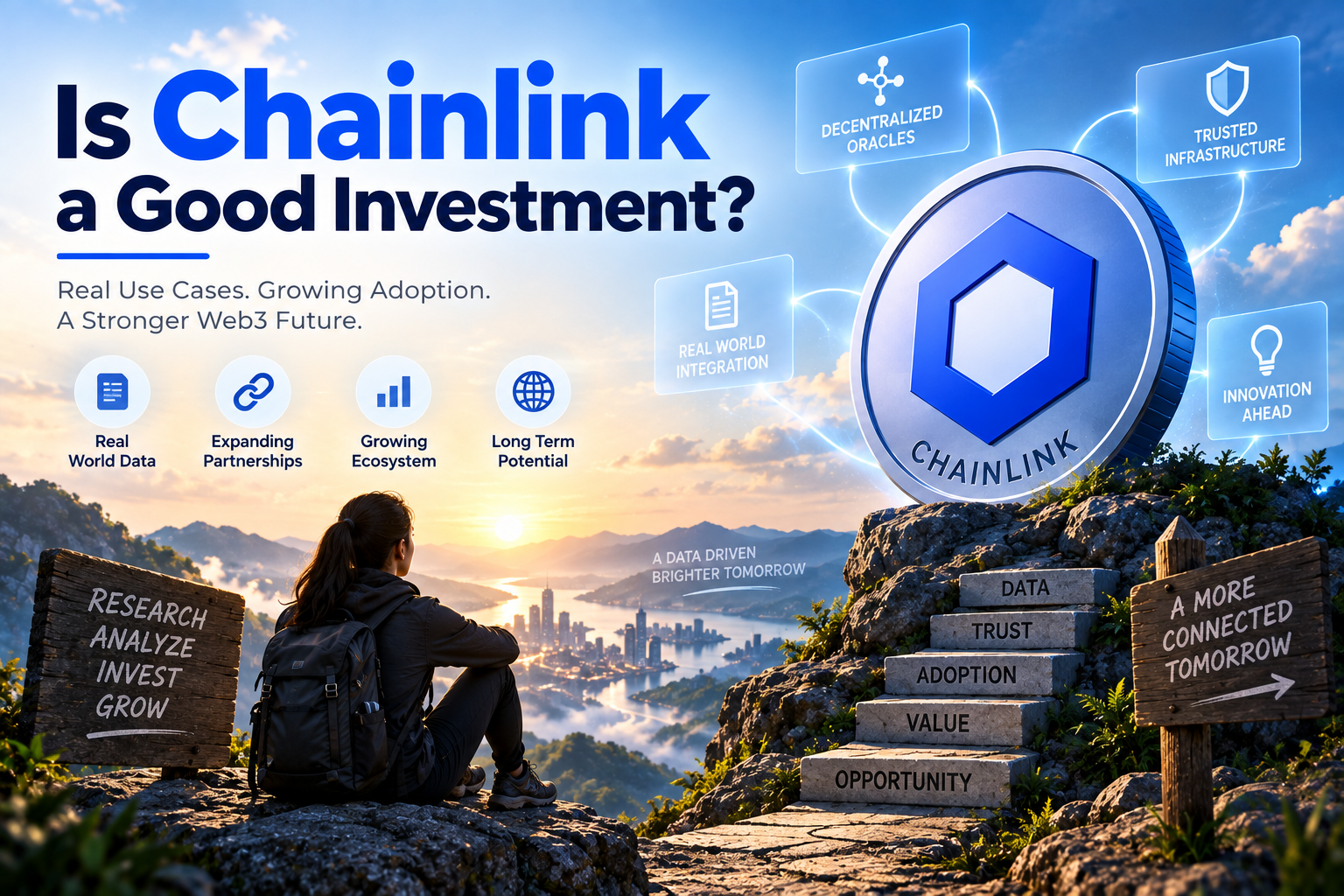
Chainlink has become one of the most important infrastructure projects in the cryptocurrency industry. Unlike cryptocurrencies that mainly focus on payments or digital money, Chainlink provides technology that allows blockchain applications to access external data and communicate with different blockchain networks.
Its native cryptocurrency, LINK, is closely connected to the Chainlink ecosystem and its expanding range of services.
But is Chainlink a good investment in 2026?
There is no universal answer. Chainlink has several developments that could support long term demand, including decentralized oracle services, cross chain infrastructure, institutional blockchain projects, decentralized finance, and tokenized assets. At the same time, LINK remains a cryptocurrency and therefore carries substantial market volatility and investment risk.
For anyone considering LINK in 2026, understanding the technology, token economics, adoption, competition, and risks is more useful than simply looking at its recent price.
What Is Chainlink?
Chainlink is a decentralized oracle network designed to connect blockchain based applications with information and systems outside the blockchain.
Blockchains are excellent at recording transactions and executing smart contracts. However, smart contracts cannot naturally access information from the outside world.
For example, a smart contract might need information about:
• The price of Bitcoin
• The value of a stock
• A foreign exchange rate
• Weather conditions
• The outcome of an event
• The value of collateral
Chainlink provides infrastructure that can deliver this type of external information to blockchain applications.
This makes Chainlink useful for decentralized finance, insurance applications, prediction markets, tokenized assets, and many other blockchain based services.
What Is LINK?
LINK is the native cryptocurrency of the Chainlink ecosystem.
It has several functions within the Chainlink economy, including payments for certain services, network security, staking, and incentives.
Chainlink has a maximum supply of 1 billion LINK.
The existence of a maximum supply is an important consideration for investors, but supply alone does not determine the future value of a cryptocurrency. Demand, adoption, liquidity, market conditions, and investor sentiment also play major roles.
Why Is Chainlink Important?
The growth of blockchain applications creates a need for reliable external information.
Consider a decentralized lending platform.
The platform may need accurate cryptocurrency prices to determine how much a user can borrow or whether collateral needs to be liquidated.
A tokenized asset platform may need information about an underlying asset.
A prediction market may need reliable information to determine an outcome.
A cross chain application may need a secure method for communicating between different blockchain networks.
Chainlink is designed to provide infrastructure for these types of requirements.
This gives Chainlink a different position from cryptocurrencies whose primary purpose is transferring or storing value.
How Chainlink Oracles Work
One of Chainlink’s best known technologies is its decentralized oracle infrastructure.
Instead of relying entirely on one source of information, Chainlink can use multiple data sources and independent oracle nodes.
This approach is designed to reduce dependence on a single source.
Price feeds are particularly important in decentralized finance.
Lending platforms, decentralized exchanges, derivatives applications, and other financial protocols may require accurate market information to operate properly.
If an application receives incorrect data, the consequences can potentially be significant.
Chainlink’s oracle infrastructure is designed to provide blockchain applications with reliable external data while reducing the risks associated with relying on a single centralized source.
Chainlink and Cross Chain Technology
Chainlink’s role has expanded beyond traditional price oracles.
One of its major technologies is the Cross Chain Interoperability Protocol, commonly known as CCIP.
CCIP is designed to allow applications and assets to communicate across different blockchain networks.
This is increasingly important because the cryptocurrency industry consists of many different blockchains.
Ethereum, layer 2 networks, specialized blockchain networks, financial networks, and other blockchain ecosystems can operate independently.
Without interoperability, applications may have difficulty communicating across these environments.
Cross chain infrastructure attempts to solve this problem.
If blockchain adoption continues expanding across multiple networks, interoperability could become increasingly important.
Chainlink and Institutional Adoption
Institutional blockchain adoption is another important part of the Chainlink investment discussion.
Traditional financial institutions are exploring blockchain technology for areas such as tokenized funds, securities, collateral, settlement, payments, and financial data.
These systems require reliable data and communication between different networks.
Chainlink has participated in various institutional blockchain initiatives involving financial institutions and market infrastructure providers.
This is important because it shows that Chainlink’s technology is being explored beyond the traditional cryptocurrency market.
However, investors should make an important distinction.
A partnership, pilot program, or technology integration does not automatically mean that LINK’s market value will increase.
Actual economic adoption and the relationship between network usage and LINK demand are more important factors.
Chainlink and Tokenized Assets
Tokenization is another area that could influence Chainlink’s future.
Tokenized assets are digital representations of real world assets on blockchain networks.
These can include:
• Investment funds
• Securities
• Commodities
• Real estate
• Private credit
• Bank deposits
• Other financial instruments
Tokenized assets require reliable information about ownership, valuations, reserves, transactions, and other data.
They may also need systems that allow different blockchain networks to communicate with one another.
Chainlink provides infrastructure designed to address several of these requirements.
If tokenization becomes a larger part of the financial industry, demand for blockchain infrastructure could potentially increase.
LINK Staking
Chainlink also has a staking system.
Staking allows participating LINK holders and node operators to commit LINK to help strengthen the security of certain Chainlink services.
Staking gives LINK another utility within the ecosystem.
However, staking does not eliminate cryptocurrency investment risk.
If the market price of LINK falls significantly, staking rewards may not compensate for the decline in the value of the underlying tokens.
Investors should therefore view staking rewards and price appreciation as separate considerations.
Potential Advantages of LINK
There are several factors that may make Chainlink interesting to investors.
Strong Infrastructure Focus
Chainlink is primarily focused on blockchain infrastructure.
Its technology supports applications that need external information and cross chain communication.
DeFi Adoption
Decentralized finance requires reliable data.
Chainlink has established itself as an important provider of oracle infrastructure for many DeFi applications.
Cross Chain Potential
As the number of blockchain networks grows, communication between networks becomes increasingly important.
CCIP gives Chainlink an opportunity to participate in this area.
Institutional Interest
Financial institutions are increasingly exploring blockchain based financial products.
Chainlink’s infrastructure could potentially benefit from this trend if institutional blockchain adoption continues.
LINK Utility
LINK has functional roles within the Chainlink ecosystem, including payments, staking, and network incentives.
This provides the token with utility beyond simple speculation.
Risks of Investing in Chainlink
Chainlink also carries several risks that investors should understand.
Cryptocurrency Volatility
LINK can experience substantial price movements.
Even if Chainlink continues developing its technology, the price of LINK can decline during broader cryptocurrency market downturns.
Competition
Chainlink operates in a competitive blockchain infrastructure market.
Other projects are developing oracle networks, cross chain systems, data services, and related technologies.
Chainlink needs to continue maintaining adoption and developer interest to remain competitive.
Token Supply
Chainlink has a maximum supply of 1 billion LINK, but not all tokens are necessarily circulating at the same time.
Investors should consider how changes in circulating supply could affect market dynamics.
Adoption Risk
Technology partnerships and pilot programs do not guarantee widespread commercial adoption.
The long term investment case depends partly on whether Chainlink’s services continue gaining meaningful usage.
Regulatory Risk
Cryptocurrency regulations can affect exchanges, institutional participation, token usage, and access to digital assets.
Changes in regulations could influence LINK’s market.
Technology Risk
Chainlink provides infrastructure that can be important to blockchain applications.
Security vulnerabilities, technical failures, oracle problems, or other technological issues could negatively affect the ecosystem.
Is LINK a Good Long Term Investment?
Chainlink may be interesting to investors who believe blockchain infrastructure will become increasingly important.
The project has established oracle technology, cross chain infrastructure, staking, institutional initiatives, and applications across decentralized finance and tokenization.
However, a strong technology project does not automatically mean its cryptocurrency will generate strong investment returns.
The important question is whether increasing Chainlink adoption ultimately creates sustainable demand for LINK.
The relationship between network usage, fees, token economics, supply, and market valuation needs to be considered carefully.
Chainlink vs Bitcoin
Chainlink and Bitcoin serve very different purposes.
Bitcoin is primarily associated with decentralized digital money, scarcity, and long term value storage.
Chainlink provides infrastructure that allows blockchain applications to access external information and communicate across blockchain networks.
Bitcoin’s investment narrative is strongly connected to its limited supply and decentralized monetary characteristics.
Chainlink’s investment narrative is more closely connected to blockchain adoption and the demand for oracle and interoperability infrastructure.
Because of these differences, comparing LINK and BTC simply by price does not provide a meaningful investment comparison.
Chainlink vs Ethereum
Chainlink and Ethereum also have different functions.
Ethereum is a general purpose blockchain platform designed to run smart contracts and decentralized applications.
Chainlink provides services that can support those applications.
Ethereum applications may require external information, price feeds, automation, or cross chain communication.
Chainlink can provide infrastructure for these requirements.
This means Chainlink and Ethereum can operate as complementary technologies rather than simply being direct competitors.
Should Beginners Invest in LINK?
Beginners should first understand what LINK represents.
Buying LINK does not mean buying shares in a company.
It does not provide ownership of Chainlink Labs or a guaranteed share of company profits.
LINK is a digital asset used within the Chainlink ecosystem.
Anyone considering an investment should understand that LINK can be highly volatile.
Beginners should also avoid investing money needed for essential expenses and should not assume that a cryptocurrency will increase simply because its technology is popular.
Researching the project, understanding token economics, and considering the risks are important before making an investment decision.
What Could Affect LINK in the Future?
Several factors could influence LINK’s future.
Growth of Tokenization
If more financial assets move onto blockchain networks, demand for blockchain infrastructure could increase.
DeFi Growth
More decentralized applications could create additional demand for oracle services.
CCIP Adoption
Greater use of cross chain infrastructure could strengthen Chainlink’s position within the blockchain ecosystem.
Institutional Adoption
More banks, asset managers, financial platforms, and other institutions exploring blockchain could create additional opportunities.
LINK Economics
Changes involving staking, payments, reserves, network revenue, and token circulation could affect the relationship between Chainlink usage and LINK demand.
Cryptocurrency Market Conditions
LINK remains part of the broader cryptocurrency market.
Bitcoin movements, market liquidity, interest rates, investor sentiment, and economic conditions can all influence LINK’s price.
Is Chainlink a Good Investment in 2026?
Chainlink has developed into an important blockchain infrastructure project with applications across decentralized finance, data services, cross chain interoperability, tokenized assets, and institutional blockchain initiatives.
Its potential is closely connected to the continued growth of blockchain technology.
If blockchain applications become more widely used, the need for reliable data and interoperability could also increase.
However, LINK remains a high risk cryptocurrency.
Its future price will depend on many factors, including adoption, competition, token economics, market conditions, regulation, and investor demand.
For someone considering LINK in 2026, the most important thing is to understand the difference between believing in Chainlink’s technology and investing in LINK as an asset.
A successful technology does not automatically guarantee a successful investment.
Investors should evaluate the project’s development, actual usage, token economics, risks, and their own financial situation before deciding whether LINK belongs in their portfolio.
Frequently Asked Questions
What is Chainlink?
Chainlink is a decentralized blockchain infrastructure network that connects smart contracts with external data, services, and other blockchain networks.
What is LINK?
LINK is the native cryptocurrency of the Chainlink ecosystem. It is used for various functions including payments, staking, security, and incentives.
Is Chainlink a cryptocurrency?
Yes. LINK is a cryptocurrency and digital asset associated with the Chainlink ecosystem.
What problem does Chainlink solve?
Chainlink helps blockchain applications access reliable external information and communicate across different blockchain networks.
Does Chainlink have a maximum supply?
Yes. Chainlink has a maximum supply of 1 billion LINK.
Can LINK be staked?
Yes. Chainlink has a staking system that allows eligible participants to stake LINK in support of network security.
Is Chainlink used in DeFi?
Yes. Chainlink infrastructure is widely used by decentralized finance applications, particularly for obtaining market and price information.
What is CCIP?
CCIP stands for Cross Chain Interoperability Protocol. It is designed to help applications and assets communicate across supported blockchain networks.
Is Chainlink used by financial institutions?
Chainlink has participated in institutional blockchain initiatives involving financial institutions and financial infrastructure providers.
Is LINK a good investment for beginners?
LINK is a volatile digital asset. Beginners should understand the technology, token economics, market risks, and their own financial situation before investing.
Can LINK increase in value?
LINK can increase or decrease in value depending on adoption, demand, market conditions, competition, regulation, token supply, and broader cryptocurrency sentiment.
What is the biggest risk of investing in LINK?
Cryptocurrency price volatility is one of the major risks. Competition, regulatory changes, technological issues, token supply dynamics, and adoption risks are also important considerations.
Is Chainlink better than Bitcoin?
Chainlink and Bitcoin have different purposes. Bitcoin focuses on decentralized digital money and value storage, while Chainlink provides blockchain infrastructure and oracle services. They should therefore be evaluated according to their different functions and investment characteristics.