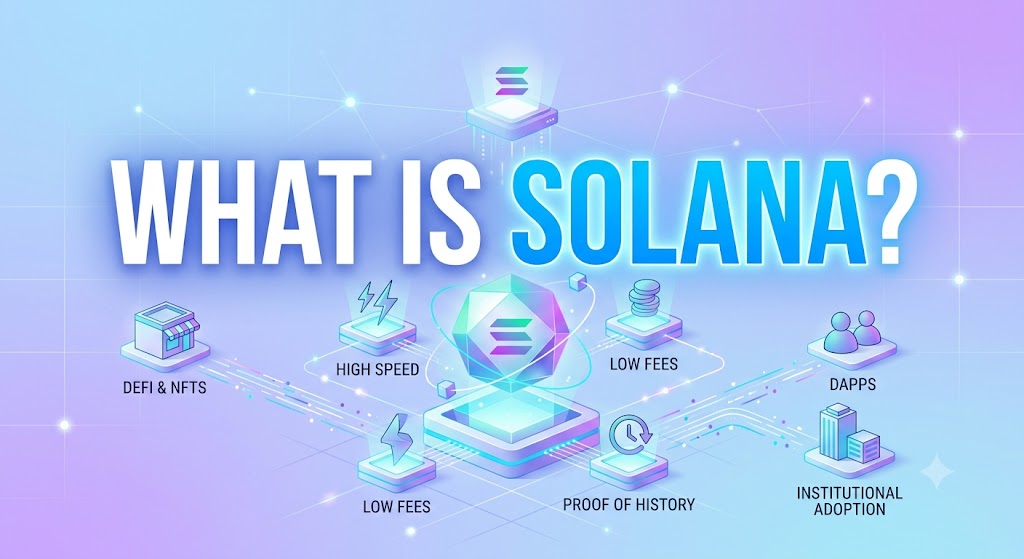
Solana is a blockchain network designed to process digital transactions quickly and support decentralized applications. It is known for its high transaction capacity, relatively low network fees, and growing ecosystem of blockchain based projects.
Solana is often discussed alongside other major blockchain networks such as Ethereum and Bitcoin. However, it has its own technology, architecture, and approach to processing transactions.
Its native cryptocurrency is called SOL.
What Is Solana Used For?
Solana can be used for several blockchain related activities.
Developers can build decentralized applications on the network, while users can interact with those applications using SOL and other digital assets supported by the ecosystem.
Common uses include:
- Decentralized finance applications
- Digital asset transfers
- Blockchain games
- NFT marketplaces
- Token creation
- Decentralized applications
- Payments
- Digital asset trading
The network is designed to support applications that need relatively fast transaction processing.
What Is SOL?
SOL is the native cryptocurrency of the Solana blockchain.
It is used for several purposes within the network.
Users can use SOL to:
- Pay transaction fees
- Transfer value
- Interact with decentralized applications
- Participate in network staking
- Support the operation of the blockchain
Solana and SOL are therefore related but technically different.
Solana refers to the blockchain network.
SOL refers to its native cryptocurrency.
How Does Solana Work?
Solana uses a combination of blockchain technologies to process transactions and maintain network coordination.
One of the technologies associated with Solana is Proof of History, commonly called PoH.
Proof of History provides a way for the network to establish a verifiable sequence of events.
Solana also uses a proof of stake based consensus mechanism. Validators help process transactions and maintain the network.
The combination is designed to reduce the amount of coordination required between participants when processing blockchain activity.
What Is Proof of History?
Proof of History is one of the concepts that makes Solana different from many other blockchain networks.
It creates a cryptographic record that helps establish when events occurred in relation to one another.
Instead of requiring every participant to independently determine the timing of every event, the network can use this verifiable sequence as part of its transaction processing architecture.
This can help the network coordinate transactions efficiently.
What Are Solana Validators?
Validators are computers that participate in maintaining and securing the Solana network.
They help process transactions and participate in the network’s consensus process.
Validators generally require suitable hardware, reliable connectivity, and technical resources to operate effectively.
Users can also delegate their SOL to validators through staking mechanisms.
What Is Solana Staking?
Staking allows SOL holders to participate indirectly in network security by delegating their tokens to validators.
In return, participants may receive staking rewards.
The exact rewards can vary based on network conditions, validator performance, inflation, and other factors.
Staking is not the same as a guaranteed investment return. Cryptocurrency prices can change significantly, which means the market value of the underlying SOL can rise or fall.
Why Is Solana Known for Speed?
Solana was designed with high transaction throughput in mind.
Its architecture allows transactions to be processed in parallel under suitable conditions.
This makes it attractive for applications that may need frequent blockchain interactions.
However, actual performance can depend on network conditions, application design, transaction demand, and other technical factors.
Are Solana Transaction Fees Low?
Solana is generally known for relatively low transaction fees compared with some other major blockchain networks.
This can make frequent transactions more practical for certain applications.
However, fees can vary depending on network conditions and transaction requirements.
Users should always consider current network conditions when evaluating transaction costs.
Solana and Ethereum
Solana and Ethereum are both programmable blockchain networks, but they use different technical designs.
Ethereum has a large ecosystem of decentralized applications and smart contracts.
Solana focuses heavily on high throughput and efficient transaction processing.
Some major differences include:
| Solana | Ethereum |
|---|---|
| Uses SOL | Uses ETH |
| Designed for high transaction throughput | Large smart contract ecosystem |
| Uses Proof of History as part of its architecture | Uses proof of stake |
| Known for relatively low transaction costs | Fees can vary significantly with network demand |
| Supports decentralized applications | Supports decentralized applications |
| Strong focus on parallel transaction processing | Broad ecosystem with extensive developer infrastructure |
Both networks continue to evolve, and their capabilities can change as upgrades and new technologies are introduced.
What Are Solana Smart Contracts?
Solana supports programmable blockchain applications through programs, which are commonly compared with smart contracts on other blockchain networks.
These programs contain rules that determine how applications operate.
Developers can use them to create decentralized exchanges, financial applications, games, marketplaces, token systems, and other blockchain based services.
What Are Solana Tokens?
SOL is not the only digital asset that can exist within the Solana ecosystem.
Developers can create other tokens that operate on the network.
These tokens can represent different types of digital assets or serve specific purposes within applications.
Some may be used for payments, governance, gaming, digital collectibles, or other functions.
What Are Solana NFTs?
Solana can support NFTs, or non fungible tokens.
An NFT is a blockchain based digital asset designed to represent ownership or association with a unique item or piece of digital content.
Solana’s relatively low transaction costs have made it attractive for certain NFT projects and marketplaces.
NFT activity can include digital artwork, collectibles, gaming assets, memberships, and other digital items.
What Is Solana DeFi?
DeFi stands for decentralized finance.
Solana supports various decentralized financial applications that can allow users to interact with financial services through blockchain based systems.
These applications may involve:
- Token exchanges
- Lending
- Borrowing
- Liquidity provision
- Staking
- Other financial services
DeFi applications can involve significant risks, including smart contract vulnerabilities, market volatility, liquidity risks, and potential loss of funds.
Why Do Developers Use Solana?
Developers may choose Solana because of its transaction processing capabilities and relatively low fees.
Other factors can include:
- High throughput
- Parallel processing
- Developer tools
- Growing ecosystem
- Token support
- Decentralized application infrastructure
The right blockchain depends on the specific requirements of a project.
What Are the Risks of Solana?
Like other blockchain networks, Solana involves technical and financial risks.
Potential risks include:
- Cryptocurrency price volatility
- Network congestion
- Software vulnerabilities
- Smart contract risks
- Wallet security issues
- Phishing attacks
- Fraudulent applications
- Lost private keys
- Project failures
Users should understand these risks before interacting with blockchain applications or purchasing digital assets.
Is Solana Decentralized?
Solana is designed as a decentralized blockchain network maintained by a distributed set of validators.
However, decentralization is not a simple yes or no measurement.
Factors such as validator distribution, hardware requirements, stake concentration, network participation, and software infrastructure can influence how decentralized a blockchain is.
Can Solana Be Used for Payments?
SOL can be transferred between compatible wallets and can be used for certain payment applications.
Its relatively low transaction costs and fast processing make it potentially useful for transactions where blockchain based payments are appropriate.
However, acceptance depends on merchants, applications, wallets, and payment providers.
How Do People Store SOL?
SOL can be stored using cryptocurrency wallets that support the Solana network.
Wallets may be software based, browser based, mobile based, or hardware based.
The most important consideration is protecting the wallet’s private keys or recovery information.
Anyone who gains unauthorized access to these credentials may be able to control the associated assets.
Is Solana a Good Investment?
Whether SOL is a good investment depends on an individual’s financial situation, risk tolerance, goals, and understanding of cryptocurrency markets.
SOL can experience significant price fluctuations.
Past performance does not guarantee future results.
Anyone considering cryptocurrency should research the technology, understand the risks, and avoid investing money they cannot afford to lose.
What Makes Solana Different?
Solana’s primary distinction is its focus on high performance blockchain infrastructure.
Its architecture combines proof of stake with Proof of History and other technologies designed to process transactions efficiently.
This has helped Solana develop a significant ecosystem of applications and digital assets.
The Future of Solana
The future of Solana will depend on several factors.
These include:
- Network reliability
- Developer adoption
- Application growth
- Validator participation
- Security
- Scalability
- Competition from other blockchains
- User adoption
- Continued technological development
Blockchain technology continues to evolve, so Solana’s capabilities and ecosystem may change significantly over time.
Final Thoughts
Solana is a programmable blockchain network designed to provide fast transaction processing and relatively low transaction costs.
Its native cryptocurrency, SOL, is used for transactions, network fees, staking, and interaction with applications built on the network.
The ecosystem supports decentralized applications, tokens, NFTs, financial services, games, and other blockchain based projects.
Solana has become an important part of the broader blockchain industry because of its focus on performance and scalability.
However, using Solana or investing in SOL still involves technical, financial, and security risks.
Understanding how the network works, how wallets operate, and how blockchain applications function can help users make more informed decisions.
Frequently Asked Questions
What is Solana in simple words?
Solana is a blockchain network designed to process transactions quickly and support decentralized applications.
What is SOL?
SOL is the native cryptocurrency of the Solana blockchain. It is used for transaction fees, transfers, staking, and interacting with applications.
Is Solana a cryptocurrency?
Solana is the name of the blockchain network. SOL is the cryptocurrency associated with that network.
Is Solana similar to Ethereum?
Both are programmable blockchain networks that support decentralized applications. However, they use different technical architectures and have different ecosystems.
What is Solana used for?
Solana can be used for digital asset transfers, decentralized applications, DeFi, NFTs, blockchain games, token systems, and other blockchain based activities.
Why is Solana considered fast?
Solana was designed to process transactions efficiently using technologies including Proof of History and parallel transaction processing.
Are Solana fees low?
Solana is generally known for relatively low transaction fees, although actual costs can vary depending on network conditions and transaction requirements.
What is Proof of History?
Proof of History is a cryptographic mechanism used by Solana to establish a verifiable sequence of events and help coordinate transaction processing.
Can I stake SOL?
Yes. SOL holders can participate in staking by delegating tokens to validators, subject to the network’s staking mechanisms and conditions.
Does Solana support smart contracts?
Solana supports programmable blockchain applications through programs that perform functions similar to smart contracts on other blockchain networks.
Can Solana support NFTs?
Yes. Solana supports NFTs and has an ecosystem of digital collectibles, marketplaces, and applications.
Is Solana safe?
The Solana blockchain is designed with security mechanisms, but users still face risks involving wallet security, smart contracts, scams, cryptocurrency volatility, and application vulnerabilities.
Is SOL a good investment?
SOL is a highly volatile cryptocurrency. Whether it is appropriate for an individual depends on their financial circumstances, goals, and risk tolerance.
How do I store SOL?
SOL can be stored in compatible cryptocurrency wallets, including software and hardware wallets. Protecting private keys and recovery information is essential.
Can Solana be used for payments?
SOL can be transferred between compatible wallets and may be used by applications and merchants that support Solana based payments.
What is Solana DeFi?
Solana DeFi refers to decentralized financial applications built on the Solana network, including exchanges, lending platforms, and liquidity applications.
What are the main risks of Solana?
Major risks include cryptocurrency price volatility, security vulnerabilities, network issues, fraudulent applications, smart contract risks, and loss of wallet credentials.
Why do developers build on Solana?
Developers may choose Solana because of its transaction processing capabilities, relatively low fees, ecosystem, and infrastructure for decentralized applications.
Is Solana decentralized?
Solana operates through a distributed validator network, although the degree of decentralization depends on factors such as validator distribution, stake concentration, and network infrastructure.
What is the difference between Solana and SOL?
Solana is the blockchain network. SOL is the native cryptocurrency used within that network.