What Is Bitcoin and How Does It Work for Beginners: A Complete Guide
Introduction
Bitcoin has become one of the most talked about financial innovations of the 21st century. Since its launch in 2009, Bitcoin has transformed from an experimental digital currency into a globally recognized asset used by millions of people worldwide. Whether you have heard about Bitcoin through social media, news channels, or investment discussions, understanding how it works is essential for anyone entering the world of cryptocurrency.
For beginners, Bitcoin can initially appear complicated because it involves concepts such as blockchain, decentralized networks, mining, wallets, and cryptographic security. However, once these concepts are broken down into simple terms, Bitcoin becomes much easier to understand.
This beginner’s guide explains what Bitcoin is, how it works, why it was created, and how people use it today.
What Is Bitcoin?
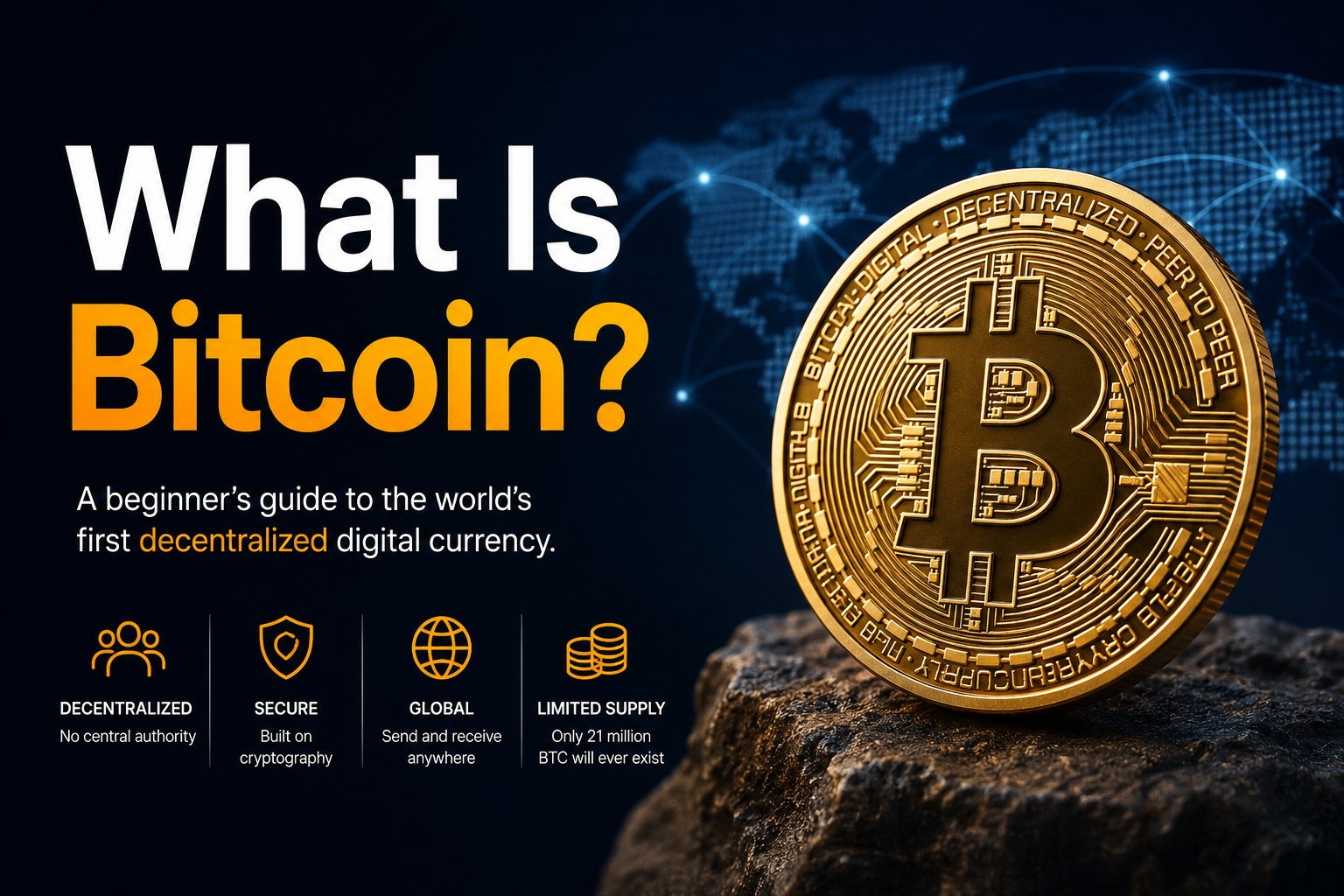
Bitcoin is a digital currency that allows people to send and receive money directly over the internet without relying on banks, governments, or financial institutions. Unlike traditional currencies such as the US Dollar, Euro, or Indian Rupee, Bitcoin exists entirely in digital form.
Bitcoin was created by an anonymous individual or group using the pseudonym Satoshi Nakamoto. In October 2008, Nakamoto published a whitepaper describing a peer to peer electronic cash system designed to eliminate the need for intermediaries in financial transactions.
Bitcoin operates on a decentralized network, meaning no single organization controls it. Instead, thousands of computers around the world maintain and secure the Bitcoin network.
Some key characteristics of Bitcoin include:
- Decentralized ownership
- Limited supply
- Global accessibility
- Transparency
- High security
- Peer to peer transactions
These features have helped Bitcoin become the world’s largest and most valuable cryptocurrency.
Why Was Bitcoin Created?
Before Bitcoin existed, digital payments relied heavily on trusted third parties such as banks and payment processors. This created several challenges:
- High transaction fees
- Slow international payments
- Financial censorship
- Dependence on central authorities
- Risk of inflation caused by excessive money printing
Bitcoin was designed to solve these problems by creating a financial system that operates independently of governments and banks.
The primary goals behind Bitcoin’s creation were:
Eliminate Intermediaries
Bitcoin allows users to send money directly to one another without requiring approval from banks.
Create Scarcity
Unlike traditional currencies that can be printed endlessly, Bitcoin has a fixed supply of 21 million coins.
Improve Financial Freedom
Anyone with internet access can participate in the Bitcoin network regardless of location or banking status.
Increase Transparency
All Bitcoin transactions are publicly recorded on a blockchain, making the system highly transparent.
How Does Bitcoin Work?
At its core, Bitcoin works through a technology called blockchain.
A blockchain is a digital ledger that records every Bitcoin transaction ever made. Instead of storing data in one central location, the blockchain exists on thousands of computers worldwide.
When someone sends Bitcoin to another person, the transaction follows several steps.
Step 1: Creating a Transaction
Suppose Alice wants to send one Bitcoin to Bob.
Alice opens her Bitcoin wallet and enters:
- Bob’s wallet address
- Amount to send
- Transaction fee
She then digitally signs the transaction using her private key.
Step 2: Broadcasting the Transaction
The transaction is sent to the Bitcoin network, where thousands of computers called nodes verify its validity.
The network checks:
- Whether Alice owns the Bitcoin
- Whether the transaction is properly signed
- Whether the Bitcoin has already been spent
Step 3: Transaction Verification
After validation, miners collect multiple transactions and group them into a block.
This block becomes part of the blockchain after solving a complex mathematical problem.
Step 4: Blockchain Confirmation
Once the block is added to the blockchain, Bob receives the Bitcoin, and the transaction becomes permanent.
This entire process usually takes several minutes.
Understanding Blockchain Technology
Blockchain is the technology that makes Bitcoin possible.
A blockchain consists of blocks connected together in chronological order. Each block contains:
- Transaction data
- Timestamp
- Digital signature
- Reference to the previous block
Because every block is linked to the previous one, altering historical data becomes extremely difficult.
This structure creates several advantages:
Transparency
All transactions can be viewed publicly.
Security
Changing transaction history requires enormous computing power.
Immutability
Once recorded, transactions cannot easily be reversed.
Decentralization
No central authority controls the system.
These characteristics make blockchain one of the most important technological innovations behind cryptocurrency.
What Is Bitcoin Mining?
Bitcoin mining is the process of validating transactions and adding them to the blockchain.
Miners use powerful computers to solve complex mathematical puzzles. When a miner successfully solves a puzzle, they receive newly created Bitcoin as a reward.
Mining serves several purposes:
- Verifies transactions
- Secures the network
- Prevents fraud
- Introduces new Bitcoin into circulation
Initially, anyone could mine Bitcoin using a regular computer. Today, mining requires specialized hardware called ASIC miners due to increasing competition.
What Is Bitcoin’s Supply Limit?
One of Bitcoin’s most unique features is its fixed supply.
There will only ever be 21 million Bitcoin created.
This supply limit was programmed into Bitcoin’s code by Satoshi Nakamoto. The scarcity model is intended to protect Bitcoin from inflation.
As of today, most Bitcoin has already been mined, and the remaining coins will be gradually released over many decades.
Because supply is limited while demand can increase, many investors view Bitcoin as a digital store of value.
What Are Bitcoin Wallets?
A Bitcoin wallet is software or hardware that allows users to store, send, and receive Bitcoin.
Importantly, wallets do not actually store Bitcoin itself. Instead, they store cryptographic keys that provide access to Bitcoin stored on the blockchain.
There are two important components:
Public Key
This acts like a bank account number that others use to send Bitcoin.
Private Key
This acts like a password that proves ownership of Bitcoin.
Protecting private keys is essential because anyone with access to them can control the associated Bitcoin.
Types of Bitcoin Wallets
There are several types of Bitcoin wallets available.
Hardware Wallets
Hardware wallets store private keys offline.
Benefits include:
- High security
- Protection from hackers
- Long term storage
Mobile Wallets
Mobile wallets run on smartphones and provide convenient access.
Benefits include:
- Easy to use
- Portable
- Suitable for everyday transactions
Desktop Wallets
Desktop wallets are installed on personal computers.
Benefits include:
- Greater control
- Enhanced security options
Web Wallets
Web wallets operate through internet browsers.
Benefits include:
- Accessibility
- Convenience
However, they generally provide lower security compared to hardware wallets.
Why Is Bitcoin Valuable?
Many beginners wonder why Bitcoin has value if it is only digital.
Bitcoin derives value from several factors.
Scarcity
Only 21 million Bitcoin will ever exist.
Demand
Millions of investors, institutions, and businesses use Bitcoin.
Security
Bitcoin’s blockchain has proven extremely secure over time.
Decentralization
No government or company controls Bitcoin.
Global Acceptance
Bitcoin is recognized and traded worldwide.
Similar to gold, Bitcoin’s value comes largely from collective trust, scarcity, and utility.
What Can You Do With Bitcoin?
Bitcoin can be used in various ways.
Investment
Many people buy Bitcoin as a long term investment.
Payments
Some businesses accept Bitcoin as payment.
International Transfers
Bitcoin enables cross border payments without traditional banking systems.
Portfolio Diversification
Investors often use Bitcoin to diversify traditional investment portfolios.
Store of Value
Some users hold Bitcoin to protect against inflation and currency depreciation.
Is Bitcoin Safe?
Bitcoin itself is considered highly secure due to its decentralized blockchain architecture.
However, users can still lose Bitcoin through:
- Hacking
- Phishing scams
- Lost passwords
- Fraudulent exchanges
- Poor security practices
To stay safe, beginners should:
- Use reputable exchanges
- Enable two factor authentication
- Store assets in hardware wallets
- Protect private keys
- Avoid suspicious investment schemes
Security ultimately depends heavily on the user’s own practices.
Advantages of Bitcoin
Bitcoin offers several benefits.
Financial Freedom
Users control their own money.
Global Accessibility
Anyone with internet access can participate.
Limited Supply
Scarcity protects against inflation.
Transparent Transactions
All transactions remain publicly verifiable.
Decentralization
No single entity controls the network.
Disadvantages of Bitcoin
Bitcoin also has limitations.
Price Volatility
Bitcoin prices can fluctuate significantly.
Regulatory Uncertainty
Government regulations continue evolving globally.
Transaction Speed
Some transactions can take time during network congestion.
Technical Complexity
New users often face a learning curve.
Security Responsibility
Users bear responsibility for protecting their assets.
Is Bitcoin Legal?
Bitcoin legality varies by country.
Many countries allow Bitcoin trading and ownership, while some have imposed restrictions or bans.
Before purchasing Bitcoin, beginners should research the regulations applicable in their country of residence.
Despite regulatory differences, Bitcoin continues gaining acceptance worldwide among investors, financial institutions, and businesses.
How Beginners Can Start Using Bitcoin
If you are interested in Bitcoin, follow these basic steps:
Step 1: Learn the Fundamentals
Understand blockchain, wallets, and cryptocurrency security.
Step 2: Choose a Reputable Exchange
Select a well established cryptocurrency exchange.
Step 3: Verify Your Identity
Complete identity verification requirements.
Step 4: Purchase Bitcoin
Start with a small amount that you can afford.
Step 5: Secure Your Bitcoin
Transfer your Bitcoin to a secure wallet if planning long term storage.
Step 6: Continue Learning
The cryptocurrency industry evolves rapidly, so continuous education is essential.
The Future of Bitcoin
Bitcoin has evolved from an experimental digital currency into a global financial asset with widespread recognition.
Many experts believe Bitcoin may continue playing an important role in:
- Digital finance
- Cross border payments
- Institutional investing
- Asset preservation
- Decentralized financial systems
Although no investment is guaranteed, Bitcoin’s impact on global finance has already been significant.
Final Thoughts
Bitcoin represents a revolutionary approach to money and financial transactions. By removing intermediaries and introducing decentralized blockchain technology, Bitcoin has created an entirely new financial ecosystem.
For beginners, understanding Bitcoin starts with learning a few key concepts: blockchain technology, decentralization, mining, wallets, and digital scarcity. Once these foundations become clear, the broader cryptocurrency world becomes much easier to navigate.
Whether you plan to invest, transact, or simply learn about emerging technologies, understanding Bitcoin provides valuable insight into one of the most important financial innovations of the modern era.
Frequently Asked Questions (FAQs)
1. What exactly is Bitcoin?
Bitcoin is a decentralized digital currency that allows people to send and receive money over the internet without relying on banks or financial institutions. It operates on blockchain technology and has a limited supply of 21 million coins.
2. Who created Bitcoin?
Bitcoin was created by an anonymous individual or group using the name Satoshi Nakamoto. The Bitcoin whitepaper was published in 2008, and the network officially launched in January 2009.
3. How does Bitcoin work?
Bitcoin works through a decentralized network of computers that verify and record transactions on a public ledger called the blockchain. Transactions are validated by miners and permanently stored on the blockchain.
4. Is Bitcoin real money?
Although Bitcoin does not exist in physical form like paper currency, it functions as a digital asset and medium of exchange. Many businesses, investors, and institutions recognize Bitcoin as a valuable financial asset.
5. Is Bitcoin safe for beginners?
Bitcoin itself is highly secure due to blockchain technology. However, beginners should use reputable exchanges, enable two factor authentication, and store their Bitcoin in secure wallets to reduce risks.
6. Can I buy less than one Bitcoin?
Yes. Bitcoin is divisible into smaller units called satoshis. You can purchase a fraction of a Bitcoin, making it accessible for investors with different budgets.
7. What is Bitcoin mining?
Bitcoin mining is the process of verifying transactions and adding them to the blockchain using powerful computers. Miners receive Bitcoin rewards for helping secure the network.
8. Why does Bitcoin have value?
Bitcoin derives its value from scarcity, demand, security, decentralization, and global adoption. Since only 21 million Bitcoin will ever exist, many investors consider it a scarce digital asset.
9. Do I need a Bitcoin wallet?
Yes. A Bitcoin wallet is used to store your private keys and manage your Bitcoin holdings. Wallets can be hardware devices, mobile apps, desktop software, or web-based platforms.
10. Is Bitcoin legal?
Bitcoin is legal in many countries, although regulations vary by region. Before investing, users should check the cryptocurrency laws applicable in their country.