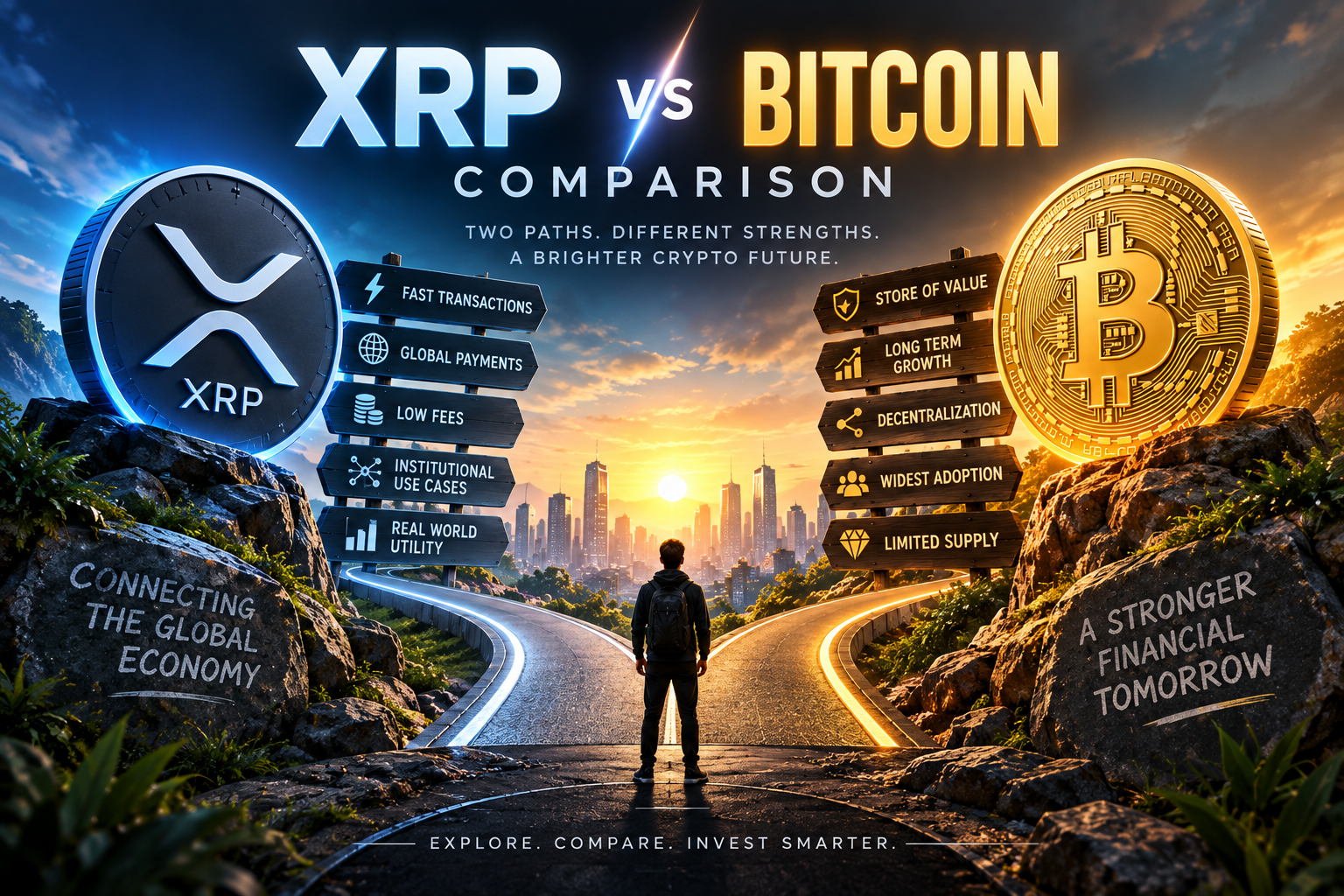
Bitcoin and XRP are two of the most recognized names in the cryptocurrency market, but they were created with very different goals.
Bitcoin was introduced as a decentralized digital currency and has increasingly been viewed as a store of value. XRP, meanwhile, was designed around fast and efficient payments, particularly cross border transactions and settlement.
Because of these differences, comparing XRP and Bitcoin is not simply a matter of looking at their prices. Their technology, supply models, transaction speeds, network structures, and intended uses are all different.
This XRP vs Bitcoin comparison explains the major differences between the two assets and what beginners should understand before deciding which one fits their cryptocurrency strategy.
What Is Bitcoin?
Bitcoin is the first major decentralized cryptocurrency. It was launched in 2009 and operates on a distributed network without a central company controlling the blockchain.
Bitcoin uses a proof of work consensus system. Miners use computing power to process transactions and help secure the network.
One of Bitcoin’s defining characteristics is its limited supply. The network is designed to have a maximum of 21 million BTC.
Because of its scarcity, decentralized structure, long operating history, and growing acceptance among investors, Bitcoin is often described as a digital alternative to gold.
Bitcoin can also be used for peer to peer payments, although its primary investment narrative has increasingly centered around long term value preservation.
What Is XRP?
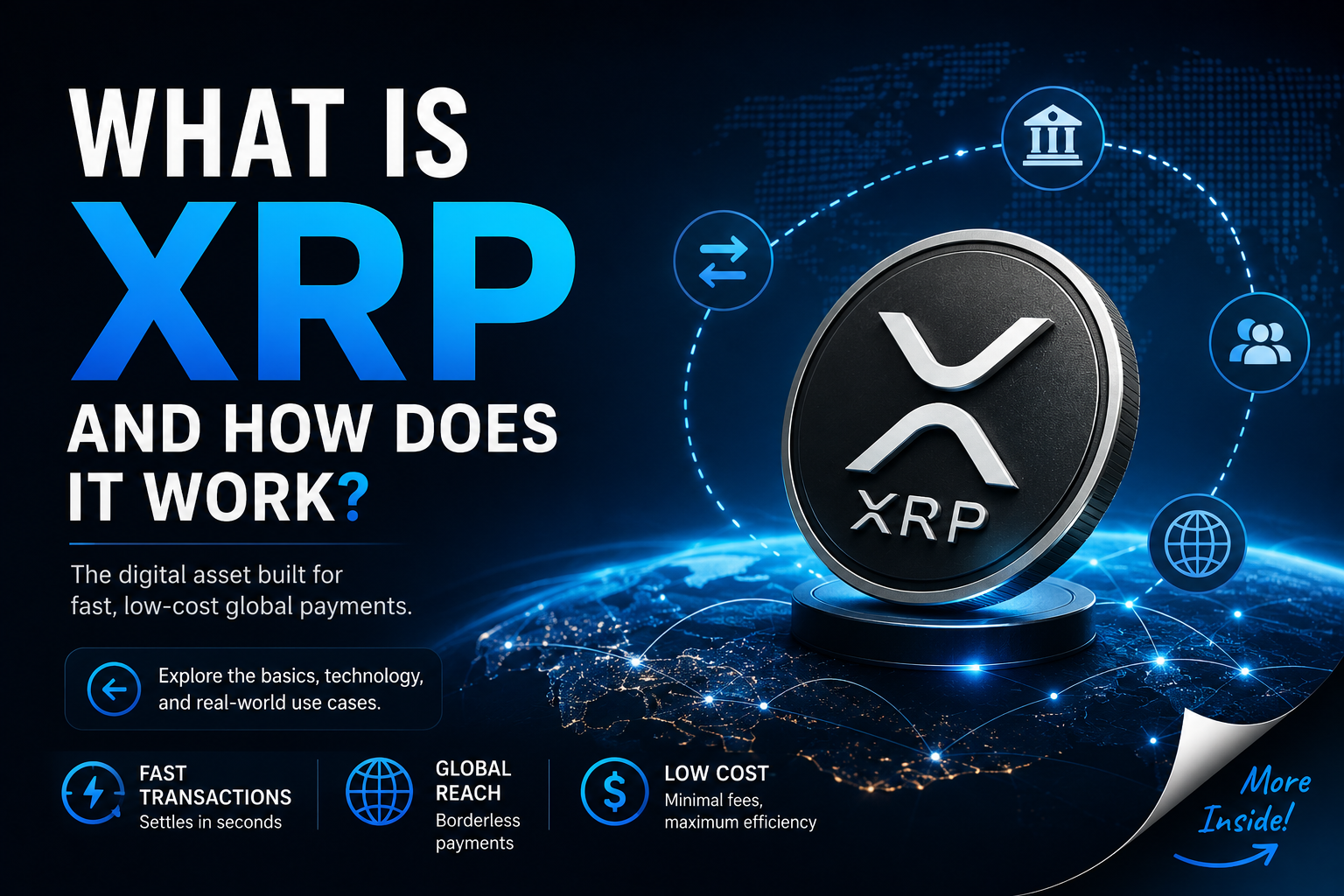
XRP is the native digital asset of the XRP Ledger.
The XRP Ledger was launched in 2012 and was designed with an emphasis on fast and inexpensive transactions.
Unlike Bitcoin, XRP does not use mining or proof of work. The XRP Ledger uses a consensus mechanism in which validators agree on transaction ordering and the state of the ledger.
XRP transactions can settle within a few seconds, making the network suitable for applications involving payments, transfers, and settlement.
XRP is closely associated with Ripple, a technology company that develops financial products using XRP and the XRP Ledger. However, XRP, the XRP Ledger, and Ripple are separate concepts.
XRP vs Bitcoin: Main Differences
The easiest way to understand the difference is to look at what each network was designed to accomplish.
| Feature | Bitcoin | XRP |
|---|---|---|
| Launch | 2009 | 2012 |
| Native asset | BTC | XRP |
| Consensus | Proof of Work | XRP Ledger Consensus Protocol |
| Maximum supply | 21 million BTC | 100 billion XRP |
| Mining | Yes | No |
| Transaction settlement | Generally slower | Generally a few seconds |
| Main focus | Decentralized money and store of value | Payments and settlement |
| Energy requirements | Higher due to mining | Much lower |
| Transaction costs | Can vary with network demand | Generally very low |
| Supply model | Gradual issuance | Pre issued supply |
| Staking | No traditional staking | No native staking |
Transaction Speed
Transaction speed is one of the clearest differences between XRP and Bitcoin.
Bitcoin blocks are generally produced approximately every 10 minutes. Transactions can require additional confirmations depending on how much certainty a user wants before considering a payment final.
XRP was designed for much faster settlement. The XRP Ledger typically reaches ledger agreement within a few seconds.
This makes XRP particularly suitable for situations where rapid settlement is important.
Bitcoin’s slower transaction process is partly related to its design priorities. Its proof of work system places considerable emphasis on security and decentralized participation rather than maximizing transaction speed.
Transaction Fees
XRP is known for very low transaction costs.
The XRP Ledger uses a small transaction fee that is destroyed as part of processing transactions. The minimum standard transaction cost is extremely small compared with many traditional payment systems.
Bitcoin transaction fees are more variable.
Bitcoin users compete for available block space, and fees can change depending on network activity and transaction demand.
During periods of heavy usage, Bitcoin fees can increase substantially.
Therefore, XRP generally has an advantage when the primary requirement is fast and inexpensive on chain transfers.
Bitcoin vs XRP Supply
Supply is another major difference.
Bitcoin has a maximum supply of 21 million coins.
New BTC enters circulation through mining, and the issuance rate decreases over time through Bitcoin’s halving mechanism.
XRP has a total supply of 100 billion tokens. The tokens were created at the beginning of the XRP Ledger rather than being gradually mined like Bitcoin.
A significant amount of XRP has historically been held by Ripple, with portions placed into escrow arrangements.
This creates a very different supply structure from Bitcoin.
For investors, understanding supply is important because changes in circulating supply can influence market dynamics.
Bitcoin and XRP Consensus Mechanisms
Bitcoin uses proof of work.
Miners compete using computing power to solve cryptographic problems and add new blocks to the blockchain. This requires substantial computational resources and energy.
The XRP Ledger uses a different approach.
Validators communicate with one another and reach agreement about which transactions should be included in the next ledger version.
There is no mining process on the XRP Ledger.
This allows XRP to process transactions much faster and with substantially lower energy requirements than Bitcoin’s proof of work system.
Which Has More Decentralization?
Decentralization is a complicated subject and cannot be reduced to one simple number.
Bitcoin allows anyone who meets the technical and economic requirements to operate a full node, while mining participation is open to participants with appropriate hardware and resources.
The network’s security is based on the distribution of computing power and the rules of the Bitcoin protocol.
The XRP Ledger also operates through a distributed network of validators. However, its consensus design involves trusted validator lists and has historically generated discussions about validator diversity and the influence of major XRP holders.
The two networks therefore take different approaches to decentralization.
Bitcoin places strong emphasis on permissionless proof of work participation.
XRP emphasizes fast consensus through a network of validating servers.
Bitcoin vs XRP Use Cases
The two assets are also different in their intended applications.
Bitcoin Use Cases
Bitcoin is commonly associated with:
• Long term value storage
• Peer to peer payments
• Digital asset ownership
• Portfolio diversification
• Cross border value transfer
• An alternative financial asset
Bitcoin’s limited supply is particularly important to its store of value narrative.
XRP Use Cases
XRP is commonly associated with:
• Cross border payments
• Payment settlement
• Currency bridging
• Remittances
• Liquidity management
• Fast digital transfers
The XRP Ledger also has additional features such as a decentralized exchange and support for tokenized assets.
Energy Consumption
Bitcoin’s proof of work system requires significant computing power.
Mining companies operate specialized hardware and consume electricity to secure the network.
This has resulted in considerable discussion about Bitcoin’s environmental impact.
XRP does not use mining.
Its consensus mechanism requires much less energy, which makes the XRP Ledger considerably more energy efficient than Bitcoin’s proof of work network.
For investors who consider environmental factors important, this is a notable distinction.
Is XRP Faster Than Bitcoin?
Yes, XRP is considerably faster for direct transactions on its native network.
XRP Ledger transactions generally settle within a few seconds.
Bitcoin’s base layer operates with blocks produced approximately every 10 minutes, although the practical waiting time for a Bitcoin payment depends on the number of confirmations considered appropriate.
Bitcoin also has additional technologies designed to improve transaction speed and scalability, but these operate differently from the Bitcoin base layer.
Is XRP Cheaper Than Bitcoin?
For basic on chain transactions, XRP generally has much lower transaction costs.
The XRP Ledger was specifically designed for inexpensive transfers.
Bitcoin transaction fees can vary depending on demand for block space.
This means that the cost of sending BTC is not always the same.
However, investors should distinguish between network transaction fees and trading fees charged by cryptocurrency exchanges.
Investment Differences Between XRP and Bitcoin
Bitcoin and XRP have different investment narratives.
Bitcoin’s investment case is largely connected to scarcity, decentralization, adoption, institutional interest, and its potential role as a long term digital store of value.
XRP’s investment case is more closely connected to the development of the XRP Ledger, payment applications, adoption by businesses and financial institutions, and the broader use of XRP for transferring value.
Neither narrative guarantees future price performance.
Cryptocurrency prices can be affected by market sentiment, regulation, liquidity, macroeconomic conditions, technological developments, and investor demand.
XRP vs Bitcoin: Volatility
Both assets can experience significant price volatility.
Bitcoin is a large cryptocurrency market, but its price can still move sharply during periods of major market activity.
XRP can also experience substantial price movements.
Investors should therefore avoid assuming that a lower price per individual XRP token means XRP is automatically cheaper or has more room to grow.
The number of coins in circulation is very different between XRP and Bitcoin.
Comparing the price of one XRP with the price of one Bitcoin without considering total supply and market capitalization can create a misleading picture.
XRP vs Bitcoin Market Capitalization
Market capitalization is calculated by multiplying the asset’s market price by the amount of circulating supply.
This is important when comparing Bitcoin and XRP because their supplies are dramatically different.
Bitcoin has a maximum supply of 21 million coins, while XRP has a total supply of 100 billion tokens.
Therefore, the price of one XRP cannot be directly compared with the price of one BTC to determine which asset is more valuable.
Market capitalization, circulating supply, demand, adoption, and future supply dynamics provide a more meaningful framework for comparison.
Which One Is Better for Beginners?
There is no universal answer.
Bitcoin may be easier for beginners to understand because its investment narrative is relatively straightforward. It has a fixed maximum supply and a long operating history.
XRP may appeal to people who are particularly interested in fast payments, cross border settlement, and financial infrastructure.
The choice depends on what the investor wants from a cryptocurrency.
Someone interested in scarcity and decentralized digital money may focus more heavily on Bitcoin.
Someone interested in payment infrastructure and rapid settlement may be more interested in XRP.
Can You Own Both XRP and Bitcoin?
Yes.
An investor does not necessarily have to choose one asset.
Bitcoin and XRP have different characteristics, so some cryptocurrency investors hold both as part of a broader digital asset portfolio.
However, holding multiple cryptocurrencies does not eliminate risk.
Both assets remain exposed to cryptocurrency market volatility, regulatory changes, security concerns, and broader market conditions.
Investors should consider their overall exposure rather than assuming that owning several cryptocurrencies automatically creates sufficient diversification.
XRP vs Bitcoin: What Should You Consider?
Before purchasing either asset, beginners should consider several factors.
Investment Objective
Think about why you are buying the asset.
Are you interested in long term holding, payments, technology, diversification, or participation in a particular blockchain ecosystem?
Risk Tolerance
Both Bitcoin and XRP can experience substantial price fluctuations.
Only money that can be exposed to investment risk should be considered.
Technology
Understand how each network works before investing.
Bitcoin uses proof of work, while XRP uses a validator based consensus mechanism.
Supply
Bitcoin has a 21 million maximum supply.
XRP has a 100 billion total supply.
Understanding these differences is important when evaluating the two assets.
Security
Whether you own BTC or XRP, protecting private keys and account credentials is essential.
Investors should be cautious with unknown wallets, exchanges, websites, and investment services.
XRP vs Bitcoin: Final Comparison
Bitcoin and XRP are not simply competing versions of the same cryptocurrency.
Bitcoin was designed around decentralized digital money and has developed a strong store of value narrative. Its proof of work system, fixed 21 million maximum supply, and long operating history are central to its identity.
XRP was designed with a strong focus on fast and inexpensive payments. The XRP Ledger uses a different consensus model, does not require mining, and can settle transactions within seconds.
The most important difference is therefore their underlying purpose.
Bitcoin emphasizes decentralized monetary value and scarcity.
XRP emphasizes efficient digital payments and settlement.
Understanding these differences is more useful than simply asking which cryptocurrency has the lower price or which one has increased more recently.
Frequently Asked Questions
Is XRP the same as Bitcoin?
No. XRP and Bitcoin are separate digital assets that operate on different blockchain networks and use different consensus mechanisms.
Which is faster, XRP or Bitcoin?
XRP transactions generally settle within a few seconds, while Bitcoin’s base layer produces blocks approximately every 10 minutes.
Which has a lower transaction fee?
XRP generally has much lower native network transaction fees. Bitcoin fees vary according to network demand and transaction conditions.
Does XRP use mining?
No. XRP was pre issued and the XRP Ledger does not use proof of work mining.
Does Bitcoin have a maximum supply?
Yes. Bitcoin’s protocol is designed around a maximum supply of 21 million BTC.
What is the total supply of XRP?
XRP has a total supply of 100 billion tokens. Its supply structure is different from Bitcoin because the tokens were created at the beginning of the network rather than gradually mined.
Can XRP replace Bitcoin?
XRP and Bitcoin were designed for different purposes. XRP focuses heavily on payments and settlement, while Bitcoin has developed around decentralized digital money and store of value use cases.
Is XRP more energy efficient than Bitcoin?
Yes. XRP does not use Bitcoin’s energy intensive proof of work mining system, so the XRP Ledger requires substantially less energy to operate.
Can I stake XRP?
XRP does not use proof of stake and does not have native staking in the way proof of stake networks do. Some third party platforms may offer lending or yield products involving XRP, but these are different from native XRP Ledger staking.
Is Bitcoin more decentralized than XRP?
The two networks use different approaches to decentralization. Bitcoin uses permissionless proof of work mining and a distributed node network, while XRP uses a validator based consensus model involving trusted validator relationships.
Can I hold both XRP and Bitcoin?
Yes. Investors can hold both assets, although owning multiple cryptocurrencies does not remove market risk.
Which should a beginner buy, XRP or Bitcoin?
There is no single answer that applies to every investor. Bitcoin and XRP have different purposes, technologies, supply structures, and risk considerations. Beginners should understand these differences and consider their own financial objectives and risk tolerance before making a decision.