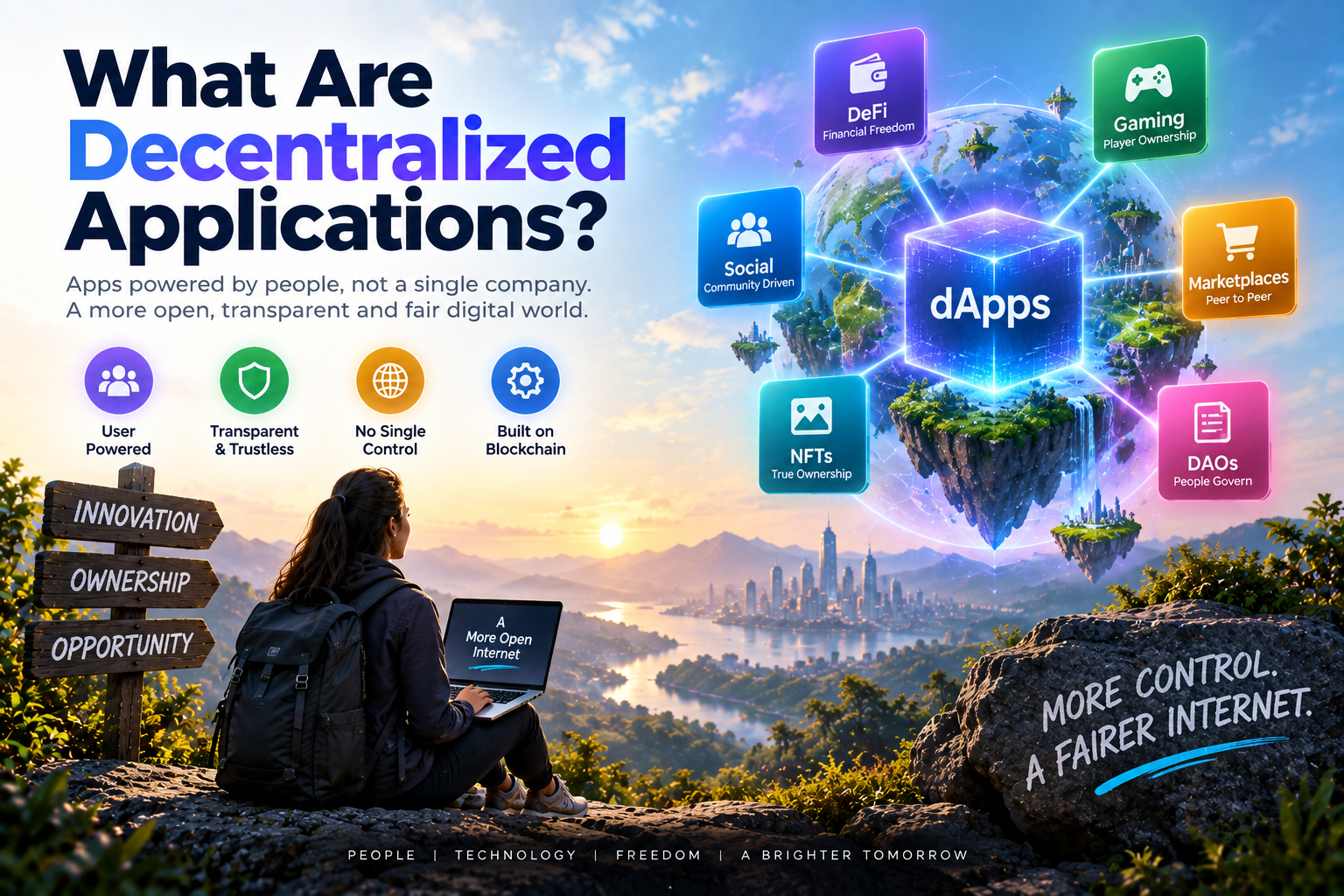
Decentralized applications, commonly called dApps, are applications that operate using blockchain networks or other decentralized technologies instead of relying entirely on a single central server or company.
Traditional applications such as social media platforms, online banking systems, shopping websites, and streaming services generally depend on centralized infrastructure. A company owns or controls the servers, manages the database, and determines how the application operates.
Decentralized applications take a different approach. Important parts of their operation can be handled by blockchain networks and smart contracts.
This can allow users to interact with applications without relying on a single organization to control every aspect of the system.
dApps have become an important part of the cryptocurrency and blockchain ecosystem. They are used for decentralized finance, gaming, marketplaces, social platforms, digital assets, payments, and many other applications.
How Do Decentralized Applications Work?
A decentralized application typically combines a user interface with blockchain based smart contracts and decentralized infrastructure.
The user interacts with the application through a website, mobile application, or other interface.
Behind the interface, smart contracts can handle important functions.
For example, a decentralized exchange may use smart contracts to manage cryptocurrency trades.
A lending application can use smart contracts to manage deposits, loans, collateral, and repayments.
The blockchain records relevant transactions and provides the underlying network on which the smart contracts operate.
A simplified process looks like this:
User → dApp Interface → Smart Contract → Blockchain → Transaction Result
The exact architecture differs from one dApp to another.
What Is a Smart Contract?
Smart contracts are an important part of many decentralized applications.
A smart contract is software deployed on a blockchain that automatically executes predefined instructions when specified conditions are met.
For example, a smart contract could be programmed to transfer digital assets when a particular transaction is completed.
Unlike a traditional application where a company may manually control important operations through a centralized server, smart contract logic can execute directly on a blockchain network.
Once deployed, the behavior of a smart contract depends on its programming and the rules of the blockchain.
This creates transparency because users can often inspect the contract and its transactions, although understanding the underlying code may require technical knowledge.
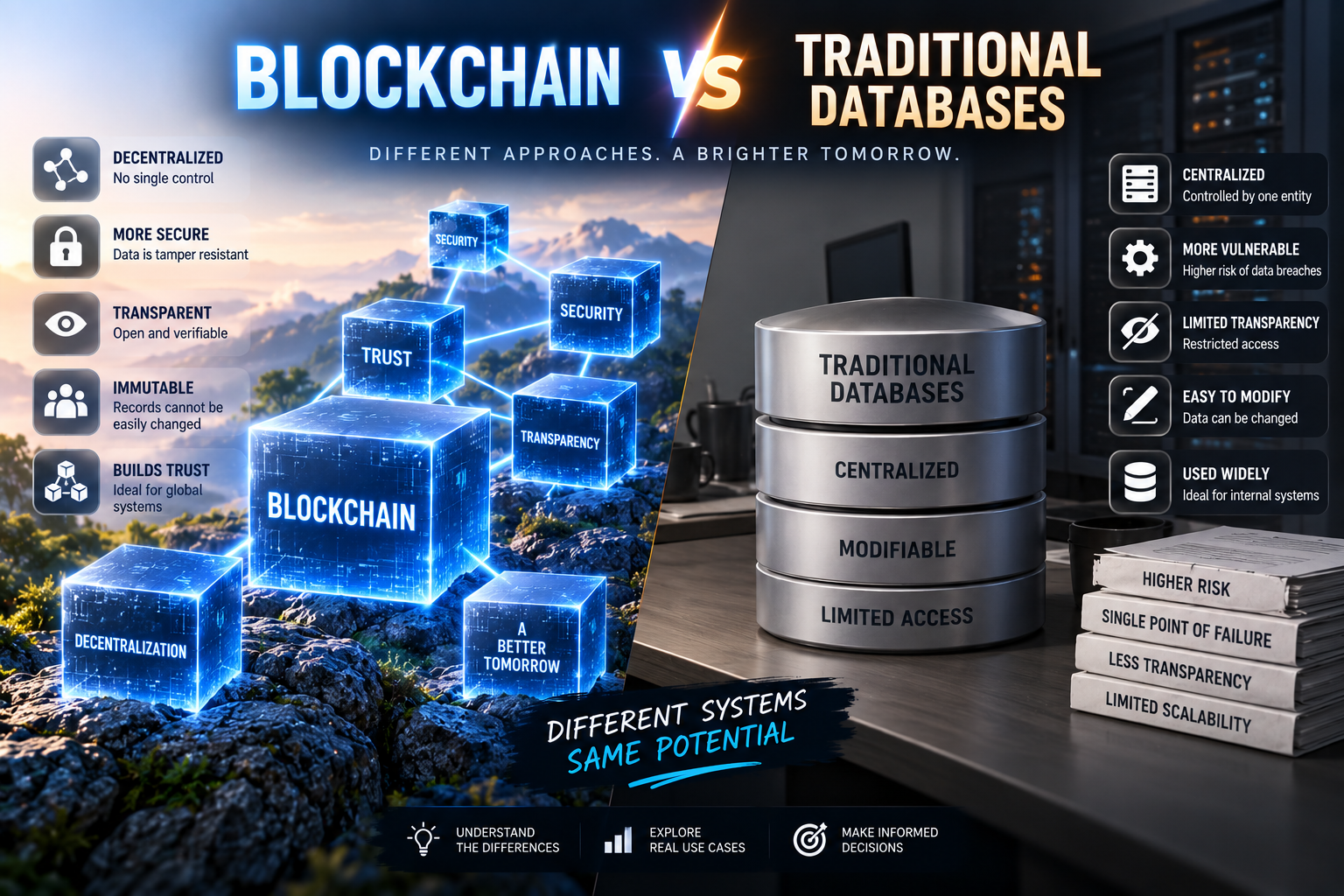
How Are dApps Different From Traditional Apps?
The biggest difference is the infrastructure and control model.
A traditional application generally relies on centralized servers and databases.
For example, when you use an online shopping platform, the company typically controls:
• Your account
• The database
• The application servers
• User permissions
• Payment processing
• Platform rules
A decentralized application can distribute some of these responsibilities across blockchain networks and smart contracts.
The difference does not mean that every part of a dApp is automatically decentralized.
Many dApps still use centralized websites, interfaces, hosting services, or other infrastructure.
The level of decentralization can therefore vary significantly between applications.
Main Characteristics of Decentralized Applications
Several characteristics commonly appear in dApps.
Blockchain Based
Many dApps use a blockchain to store transactions or execute smart contracts.
Smart Contracts
Smart contracts can automate important parts of an application’s functionality.
User Controlled Assets
Some dApps allow users to interact directly with their cryptocurrency wallets rather than depositing assets into a company’s traditional account.
Transparency
Blockchain transactions can often be publicly verified.
Open Participation
Depending on the blockchain and application, users may be able to interact with the system without creating a traditional account with a centralized company.
Decentralized Infrastructure
Some dApps use decentralized networks for important parts of their operation.
However, decentralization exists on a spectrum. An application may decentralize its financial transactions while still using centralized infrastructure for its user interface.
What Are dApps Used For?
Decentralized applications can be used for many different purposes.
Some of the largest categories include decentralized finance, gaming, marketplaces, social applications, digital collectibles, payments, and blockchain based financial services.
Decentralized Finance dApps
Decentralized finance, commonly called DeFi, is one of the most important categories of dApps.
DeFi applications allow users to access financial services through blockchain based systems.
Examples include:
• Cryptocurrency exchanges
• Lending platforms
• Borrowing applications
• Liquidity platforms
• Asset management applications
• Derivatives platforms
• Stablecoin applications
Instead of relying entirely on a bank or financial institution, users can interact directly with smart contracts.
This can provide greater accessibility, but it also creates new risks.
Decentralized Exchanges
A decentralized exchange, or DEX, allows users to trade digital assets using blockchain based smart contracts.
Traditional cryptocurrency exchanges generally operate as centralized companies.
Users may deposit assets into accounts controlled by the exchange.
A decentralized exchange can allow users to connect their own cryptocurrency wallet and interact directly with smart contracts.
This can reduce the need to transfer assets to a centralized exchange before trading.
However, users are responsible for understanding wallet security, transaction fees, smart contract risks, and the particular mechanics of the decentralized exchange.
Blockchain Gaming dApps
Gaming is another major area for decentralized applications.
Blockchain games can use smart contracts and digital assets to create new types of ownership.
Players may be able to own in game items represented as blockchain based assets.
Depending on the game, these assets may be transferable between wallets or potentially usable within different applications.
Blockchain gaming has introduced concepts such as play to earn, digital ownership, token based economies, and player controlled assets.
However, not every blockchain game is successful, and cryptocurrency based game economies can be highly volatile.
NFT Applications
Non fungible tokens, commonly known as NFTs, can also be used by decentralized applications.
NFTs are unique blockchain based tokens that can represent digital or physical items.
Possible applications include:
• Digital artwork
• Collectibles
• Memberships
• Tickets
• Gaming items
• Digital identities
• Certificates
The dApp can use smart contracts to create, transfer, or manage these assets.
Decentralized Marketplaces
Traditional marketplaces usually have a central company managing listings, payments, accounts, and disputes.
A decentralized marketplace can use smart contracts to automate parts of these processes.
Depending on the design, buyers and sellers may interact directly through blockchain infrastructure.
This can potentially reduce reliance on intermediaries.
However, decentralized marketplaces can still have centralized elements such as websites, search systems, moderation, or customer support.
Decentralized Social Applications
Blockchain technology is also being used to develop alternative social applications.
Traditional social networks generally control user accounts, content databases, recommendation systems, and platform policies.
Some decentralized social applications attempt to give users greater control over their identity, content, or social connections.
Certain systems allow users to move their social identity or content between compatible applications.
This approach could reduce dependence on a single platform.
However, decentralized social networking is still developing, and different projects use very different architectures.
What Is a dApp Wallet?
Many decentralized applications interact with cryptocurrency wallets.
A wallet allows users to hold digital assets and approve blockchain transactions.
When a user wants to interact with a dApp, the application may request permission to connect with the wallet.
The user can then approve specific transactions.
For example, when exchanging tokens through a decentralized exchange, the wallet may ask the user to approve the transaction before it is submitted to the blockchain.
This gives users more direct control over their assets.
It also means users are responsible for protecting their wallet credentials.
Do dApps Require an Account?
Many decentralized applications do not require a traditional username and password account.
Instead, a cryptocurrency wallet can function as the user’s identity for interacting with the application.
The wallet address represents the account on the blockchain.
However, some dApps may still require additional information or centralized accounts for specific services.
The exact requirements depend on the application.
Advantages of Decentralized Applications
dApps can provide several potential advantages.
Greater User Control
Users can interact directly with blockchain networks and, in some cases, maintain control over their assets.
Transparency
Transactions recorded on public blockchains can often be independently verified.
Reduced Dependence on Intermediaries
Smart contracts can automate processes that traditionally require intermediaries.
Global Accessibility
Many blockchain applications can be accessed by users from different countries with an internet connection and compatible wallet.
Programmability
Smart contracts allow developers to create complex financial and digital systems that operate according to predefined rules.
Open Ecosystems
Some dApps allow other developers to build additional applications on top of existing smart contracts and blockchain infrastructure.
Disadvantages of Decentralized Applications
dApps also have important limitations.
Technical Complexity
Blockchain applications can be more difficult for beginners to understand than traditional apps.
Transaction Fees
Users may need to pay blockchain network fees when interacting with smart contracts.
Smart Contract Risk
A programming mistake or vulnerability can potentially result in financial losses.
User Responsibility
Users may be responsible for managing private keys and wallet security.
Scalability
Some blockchain networks can experience congestion, resulting in slower transactions or higher fees.
Limited Customer Support
A decentralized application may not have the same customer service structure as a traditional company.
Are dApps Safe?
A decentralized application is not automatically safe simply because it uses blockchain technology.
Security depends on several factors.
These include:
• Smart contract quality
• Blockchain security
• Wallet security
• Application design
• Developer practices
• User behavior
• Third party integrations
One of the biggest risks is interacting with malicious applications or signing transactions that users do not fully understand.
A blockchain transaction can be difficult or impossible to reverse after it has been confirmed.
Users should therefore carefully check what they are approving before signing transactions.
What Are Gas Fees?
Many blockchain based dApps require users to pay transaction fees.
On networks such as Ethereum, these fees are commonly called gas fees.
Gas is essentially the computational cost associated with executing transactions and smart contracts.
For example, swapping tokens, transferring digital assets, or interacting with a smart contract may require a network fee.
The amount can vary depending on the blockchain and network activity.
Some newer blockchain networks and layer 2 systems are designed to provide lower transaction costs.
Can dApps Be Hacked?
dApps can experience security problems.
The blockchain itself may be secure while the smart contract or application built on top of it contains a vulnerability.
Potential problems include:
• Smart contract bugs
• Oracle manipulation
• Wallet attacks
• Phishing
• Private key theft
• Front end attacks
• Bridge vulnerabilities
• Malicious smart contracts
This is why users should not assume that decentralization eliminates cybersecurity risks.
Are All dApps Completely Decentralized?
No.
The term dApp does not necessarily mean that every component is decentralized.
A project may use blockchain smart contracts for its financial operations while using centralized servers for its website.
Another project may decentralize its data storage but maintain centralized governance.
Therefore, users should examine how an application actually works instead of relying only on the term “decentralized.”
Blockchain vs dApps
Blockchain is the underlying technology used by many decentralized applications.
A blockchain provides the network where transactions can be recorded and smart contracts can operate.
A dApp is an application built using blockchain and related technologies.
A simple comparison is:
Blockchain = Infrastructure
dApp = Application built using that infrastructure
Ethereum, for example, provides blockchain infrastructure that developers can use to create decentralized applications.
Examples of dApp Functions
A single dApp can perform multiple functions.
For example, a decentralized finance application might allow users to:
- Connect a cryptocurrency wallet.
- Deposit digital assets.
- Exchange one asset for another.
- Provide liquidity.
- Earn protocol based rewards.
- Withdraw assets.
Each operation can interact with smart contracts and generate blockchain transactions.
The user interface may look similar to a traditional website, but the underlying transaction process is different.
The Future of Decentralized Applications
The development of dApps is still ongoing.
Future applications could expand into areas such as:
• Financial services
• Digital identity
• Tokenized assets
• Supply chain systems
• Gaming
• Social networking
• Creator platforms
• International payments
• Digital ownership
• Decentralized organizations
As blockchain networks become faster and transaction costs improve, developers may be able to create applications that are more practical for everyday users.
However, widespread adoption will depend on more than technology.
User experience, security, regulation, scalability, privacy, and real world usefulness will all influence the future of decentralized applications.
Final Thoughts
Decentralized applications represent a different approach to building digital services.
Instead of relying entirely on a central company and its private infrastructure, dApps can use blockchain networks, smart contracts, decentralized storage, and cryptocurrency wallets to distribute certain parts of an application’s operation.
They are already being used in decentralized finance, cryptocurrency trading, gaming, digital assets, marketplaces, and other areas.
Their biggest potential advantages include transparency, user controlled assets, programmable transactions, and reduced dependence on intermediaries.
At the same time, dApps introduce new challenges. Users may need to understand wallets, transaction fees, smart contracts, private keys, and blockchain security.
Most importantly, decentralization does not automatically make an application safe, private, fast, or reliable.
The quality of a dApp depends on its technology, design, security, governance, and real world usefulness.
As blockchain infrastructure continues to evolve, decentralized applications could become an increasingly important part of the digital economy.
Frequently Asked Questions
What is a decentralized application?
A decentralized application, or dApp, is an application that uses blockchain networks and smart contracts to handle some or all of its operations without relying entirely on a centralized authority.
How does a dApp work?
A user interacts with the application’s interface, which communicates with smart contracts and blockchain networks. Transactions are then processed according to the rules of the underlying blockchain.
Are dApps the same as normal applications?
No. Traditional applications generally rely on centralized servers and databases, while dApps use blockchain technology for some important functions.
Do dApps use smart contracts?
Many dApps use smart contracts to automate transactions and application logic.
Do I need cryptocurrency to use a dApp?
Many blockchain applications require cryptocurrency to pay transaction fees or interact with their features. The exact requirements depend on the dApp.
What is a dApp wallet?
A wallet allows users to manage blockchain assets and connect with decentralized applications. It can also be used to approve blockchain transactions.
Are dApps safe?
Safety varies between applications. Smart contract vulnerabilities, scams, phishing, wallet theft, and other security problems can create significant risks.
Can dApps be hacked?
Yes. Vulnerabilities can exist in smart contracts, application interfaces, bridges, wallets, or other components connected to a dApp.
What are gas fees?
Gas fees are transaction costs associated with performing operations on certain blockchain networks. They compensate the network for processing transactions and executing smart contracts.
What are the most common dApp categories?
Common categories include decentralized finance, decentralized exchanges, blockchain gaming, NFT applications, marketplaces, social applications, and blockchain based financial services.
Are all dApps completely decentralized?
No. Some applications decentralize only certain components while continuing to rely on centralized websites, infrastructure, governance, or other services.
Can dApps replace traditional applications?
Some dApps may provide alternatives to traditional applications, particularly in finance and digital ownership. However, traditional applications remain more practical for many everyday services.
What is the biggest advantage of dApps?
One major advantage is the ability to interact with blockchain based services and, in some cases, maintain greater control over digital assets without relying entirely on a central intermediary.
What is the biggest disadvantage of dApps?
Complexity and security risk are major disadvantages. Users may need to manage wallets, understand transactions, pay network fees, and take responsibility for protecting their assets.