Blockchain technology is one of the most important technologies behind cryptocurrencies such as Bitcoin and Ethereum. However, blockchain is not limited to digital currencies. It can also be used for applications involving payments, digital assets, supply chains, identity systems, records, and decentralized applications.
For beginners, blockchain can seem complicated because it combines several technologies and concepts at once. At its core, however, the basic idea is relatively simple.
A blockchain is a digital record system where information is stored in groups called blocks and connected together in a chronological chain. Instead of relying on one central database, many blockchain networks distribute copies of their records across multiple computers.
This structure can make it possible for participants to verify transactions without depending entirely on a single central authority.
What Is a Blockchain?
A blockchain is a type of distributed digital ledger.
A ledger is simply a record of transactions or information.
Traditional financial systems usually maintain records through centralized databases controlled by institutions.
A blockchain can distribute copies of its ledger across a network of computers.
When new information is accepted by the network, it can be recorded in a new block and connected to previous blocks.
This creates a chronological record of activity.
Why Is It Called Blockchain?
The name comes from the way information is organized.
Transactions or other records are grouped into blocks.
Each block is connected to the previous block.
The blocks form a chain.
This is why the technology is commonly called a blockchain.
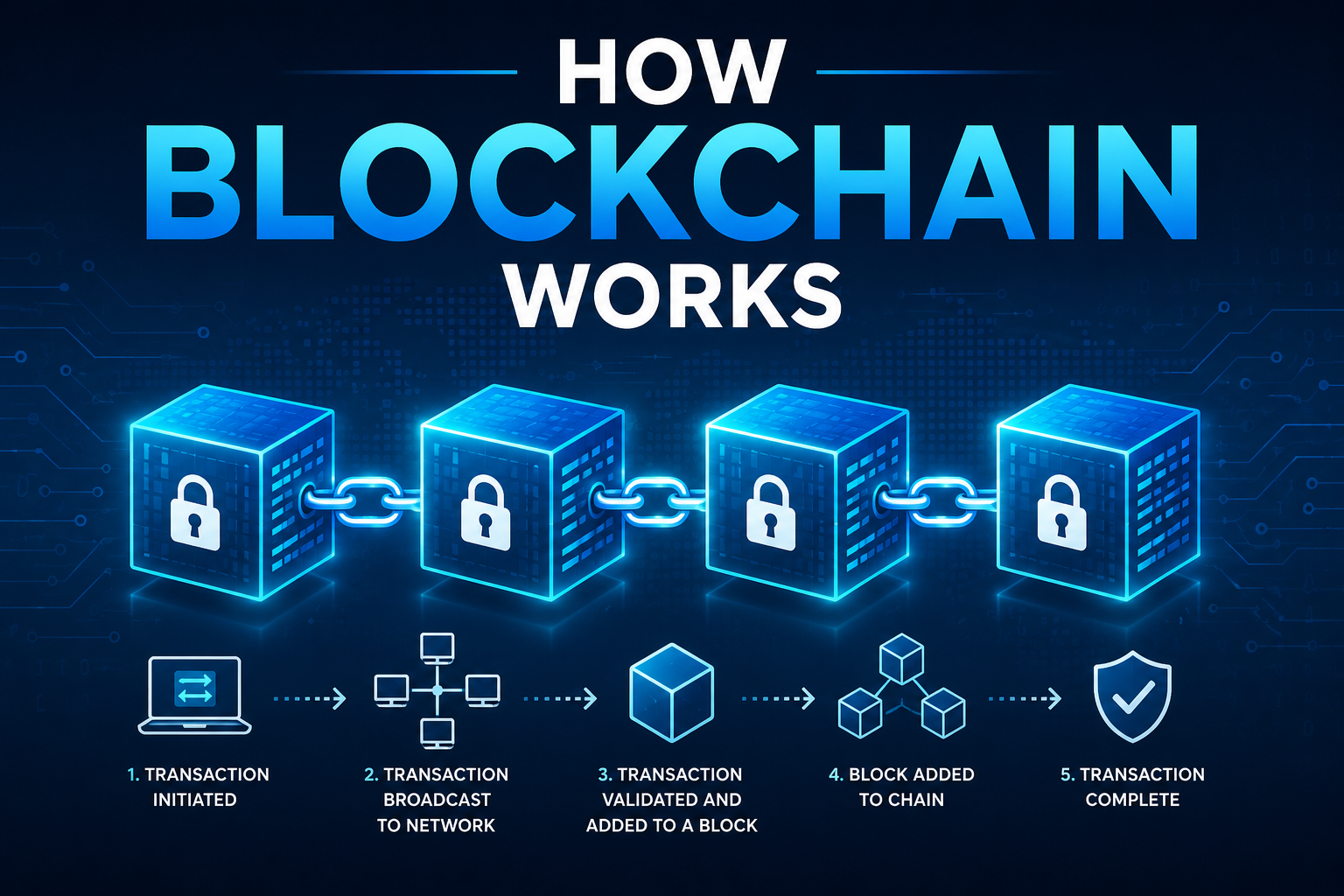
A simplified structure looks like this:
Block 1 → Block 2 → Block 3 → Block 4
Each block contains information that connects it to the history of the blockchain.
What Is Inside a Block?
The exact structure varies between blockchain networks, but a block can contain several important pieces of information.
These may include:
- Transaction data
- A timestamp
- A reference to the previous block
- A block identifier
- Other technical information required by the network
The previous block reference helps connect blocks together.
If information in an earlier block is changed, the cryptographic relationships between blocks can be affected.
What Is a Hash?
A hash is a unique looking digital fingerprint generated from information.
Blockchain systems use cryptographic hashing to help connect and protect information.
A small change in the original information can produce a very different hash.
For example, imagine a block contains a transaction record.
The network can generate a hash from the block’s contents.
That hash can then be used as part of the information connecting the next block to the previous one.
This helps make unauthorized changes easier to detect.
How Does a Blockchain Transaction Work?
Imagine that Alice wants to send cryptocurrency to Bob.
The basic process can be explained in several stages.
Step 1: Alice Creates a Transaction
Alice uses a cryptocurrency wallet to create a transaction.
The transaction specifies the amount and the destination address.
Step 2: The Transaction Is Signed
The transaction is digitally signed using cryptographic information associated with Alice’s wallet.
This helps prove that the person initiating the transaction has the authority to spend the relevant assets.
Step 3: The Transaction Is Broadcast
The transaction is sent to the blockchain network.
Multiple computers can receive and check it.
Step 4: The Network Verifies the Transaction
Network participants verify whether the transaction follows the rules.
They may check whether the transaction is properly signed and whether the sender has sufficient funds.
Step 5: The Transaction Is Included in a Block
Valid transactions can be grouped into a block.
The exact process depends on the blockchain’s consensus mechanism.
Step 6: The Block Is Added to the Blockchain
Once the network reaches the required agreement, the block is added to the blockchain.
The transaction becomes part of the recorded history.
Step 7: The Recipient Receives the Funds
Bob’s wallet can recognize the transaction and display the received cryptocurrency after the appropriate network confirmations.
What Is Decentralization?
Decentralization is one of the defining ideas behind many blockchain networks.
Instead of maintaining one central database controlled by a single organization, blockchain networks can distribute copies of the ledger among many participants.
These participants can independently verify information according to the network’s rules.
This can reduce dependence on one central authority.
However, decentralization is not identical across every blockchain.
Different networks have different levels of participation, governance, validator distribution, and technical design.
What Are Blockchain Nodes?
A node is a computer that participates in a blockchain network.
Depending on the network and type of node, it may store blockchain data, verify transactions, relay information, or participate in consensus.
A network can contain many nodes distributed across different locations.
The more independently operated participants a network has, the more distributed its infrastructure may become.
What Is Consensus?
Blockchain networks need a way for participants to agree on which transactions are valid and what the current state of the blockchain should be.
This process is known as consensus.
Different blockchains use different consensus mechanisms.
Two well known examples are Proof of Work and Proof of Stake.
How Does Proof of Work Work?
Bitcoin uses Proof of Work.
In this system, miners use computing power to compete in solving a cryptographic problem associated with producing new blocks.
The process requires computational resources.
A successful miner can add a block according to the network’s rules and may receive a reward.
Proof of Work makes certain types of attacks expensive because controlling the network requires significant computational resources.
How Does Proof of Stake Work?
Proof of Stake uses validators rather than traditional mining competition.
Participants can commit cryptocurrency to the network as stake.
Validators help process and confirm transactions according to the protocol’s rules.
Ethereum uses Proof of Stake.
The economic incentives and penalties associated with staking are designed to encourage validators to behave honestly.
What Are Smart Contracts?
Smart contracts are programs that operate on a blockchain.
They can execute predefined instructions when specified conditions are met.
Ethereum is widely known for supporting smart contracts.
Smart contracts can be used to create applications such as:
- Decentralized exchanges
- Lending applications
- Digital asset platforms
- Games
- Token systems
- Governance applications
Smart contracts make blockchain technology programmable.
What Is a Wallet?
A cryptocurrency wallet is a tool that allows users to manage their blockchain assets and interact with blockchain networks.
A wallet does not physically store coins.
Instead, it manages cryptographic credentials that allow users to control assets associated with blockchain addresses.
Wallets can take different forms, including software wallets and hardware wallets.
What Is a Public Address?
A blockchain address is an identifier that can be used to receive digital assets.
Users can generally share a receiving address when they want someone to send cryptocurrency to them.
Different blockchain networks use different address formats.
Always verify an address before sending funds because blockchain transactions may be difficult or impossible to reverse.
What Is a Private Key?
A private key is a cryptographic credential used to authorize certain blockchain transactions.
It should remain confidential.
Anyone who gains control of a private key may be able to control the associated assets.
This is why cryptocurrency security depends heavily on protecting private credentials.
What Is a Seed Phrase?
Many cryptocurrency wallets provide a recovery phrase, often called a seed phrase.
It can be used to restore access to a compatible wallet.
A recovery phrase should be treated as extremely sensitive information.
It should never be shared with another person or entered into an unfamiliar website.
Why Are Blockchain Records Difficult to Change?
Many blockchain networks are designed to make historical records difficult to alter.
Blocks are connected using cryptographic references.
The network also uses consensus rules to determine which version of the blockchain is accepted.
Changing an older transaction could require overcoming several layers of technical and economic protections.
However, it is more accurate to describe blockchains as tamper resistant rather than absolutely impossible to change.
The exact level of resistance depends on the blockchain’s design and security.
Is Blockchain Completely Immutable?
The word immutable is often used to describe blockchain records, but the concept requires some context.
Once information has been confirmed and deeply embedded in a blockchain, changing it can be extremely difficult.
However, blockchain networks can experience reorganizations, software upgrades, governance decisions, or other events that affect how records are handled.
Therefore, blockchain should generally be understood as highly tamper resistant rather than magically unchangeable.
How Does Blockchain Transparency Work?
Many public blockchains allow anyone to inspect transaction records.
A blockchain explorer can display information such as:
- Transaction amounts
- Wallet addresses
- Block numbers
- Transaction times
- Confirmation information
However, transparency does not necessarily mean that users’ real world identities are directly visible.
Blockchain addresses are generally pseudonymous rather than automatically connected to someone’s name.
Is Blockchain Anonymous?
Blockchain is often described as anonymous, but this can be misleading.
Many public blockchains are better described as pseudonymous.
A transaction may show a blockchain address rather than a person’s name.
However, if an address becomes associated with a real identity, transaction history connected to that address may potentially be analyzed.
The privacy characteristics depend on the specific blockchain and technology being used.
What Is Blockchain Mining?
Mining is a process used by some blockchain networks, particularly Proof of Work systems.
Miners use computational resources to help secure the network and process blocks.
Bitcoin is the most prominent example of a blockchain that uses mining.
Not all blockchains use mining.
Proof of Stake networks use validators instead.
What Are Blockchain Validators?
Validators participate in the consensus process on Proof of Stake networks.
They help verify transactions and participate in block production.
Validators generally need to follow the network’s rules.
Depending on the protocol, dishonest or improper behavior can result in penalties.
What Are Blockchain Transaction Fees?
Blockchain networks generally charge fees for processing transactions.
The exact fee system differs between networks.
Fees can depend on:
- Network demand
- Transaction complexity
- Transaction size
- Required computational resources
- Network design
During periods of high demand, fees can increase.
Why Do Blockchain Networks Have Fees?
Transaction fees can serve several purposes.
They can compensate miners or validators for processing activity.
They can also help prevent network abuse by making it costly to submit large numbers of unnecessary transactions.
Some blockchain networks use different fee structures depending on their architecture.
What Are Tokens?
A token is a digital asset created on a blockchain.
Tokens can represent different things.
Examples include:
- Digital currencies
- Governance rights
- Utility assets
- Digital collectibles
- Tokenized real world assets
Ethereum supports many token standards, allowing developers to create different types of digital assets.
What Is a Blockchain Network Used For?
Blockchain technology can support many applications.
These include:
- Cryptocurrency
- Digital payments
- Decentralized finance
- Digital identity
- Supply chain records
- Tokenized assets
- Digital collectibles
- Smart contracts
- Decentralized applications
- Cross border value transfers
Not every blockchain is suitable for every use case.
Blockchain vs Traditional Database
A traditional database is generally controlled by a specific organization.
That organization can determine who can access the database and how records are modified.
A blockchain distributes the ledger across a network and uses consensus rules to determine which updates are accepted.
A blockchain can therefore provide advantages in situations where multiple parties need to share records without relying completely on one central database.
However, traditional databases can often be faster, cheaper, and easier to manage for applications that do not require blockchain characteristics.
Is Blockchain Secure?
Blockchain technology can provide strong security properties, but no blockchain system is completely risk free.
Potential risks include:
- Software vulnerabilities
- Private key theft
- Smart contract bugs
- Exchange hacks
- Phishing
- Consensus attacks
- Network failures
- User mistakes
Blockchain security depends on both the network’s technical design and how users interact with it.
What Are the Advantages of Blockchain?
Blockchain technology can offer several potential advantages.
Decentralization
Information can be distributed across multiple participants.
Transparency
Public blockchains can make transaction records publicly inspectable.
Tamper Resistance
Cryptographic structures and consensus can make unauthorized changes difficult.
Programmability
Smart contract networks can support automated applications.
Global Accessibility
Public blockchain networks can potentially be accessed by users around the world with an internet connection.
What Are the Disadvantages of Blockchain?
Blockchain technology also has limitations.
Scalability
Some blockchain networks can experience congestion during periods of high demand.
Fees
Transaction costs can increase depending on network activity.
Complexity
Blockchain systems can be difficult for beginners to understand.
Security Responsibility
Users may be responsible for protecting their own wallet credentials.
Regulatory Uncertainty
Rules surrounding blockchain applications can vary between countries and change over time.
Why Is Blockchain Important?
Blockchain introduced a new approach to maintaining digital records between parties that may not fully trust one another.
Instead of requiring a single organization to maintain the authoritative record, a blockchain can use cryptography, distributed networks, and consensus mechanisms to establish a shared record.
This concept has applications beyond cryptocurrency.
Final Thoughts
Blockchain works by combining several technologies and processes, including distributed networks, cryptographic hashing, digital signatures, blocks, consensus mechanisms, and sometimes smart contracts.
A typical blockchain transaction begins when a user creates and signs a transaction. The transaction is broadcast to the network, verified according to the blockchain’s rules, included in a block, and added to the existing chain after the required consensus process.
Different blockchain networks operate differently.
Bitcoin uses Proof of Work and focuses primarily on decentralized digital money.
Ethereum uses Proof of Stake and provides a programmable platform for smart contracts and decentralized applications.
Understanding these fundamentals makes it easier to understand cryptocurrencies, digital assets, decentralized finance, Web3, and other blockchain based technologies.
Blockchain is not a solution for every problem, but where decentralized record keeping, verifiability, and shared control are valuable, it can provide a different approach to managing digital information.
Frequently Asked Questions
What is blockchain in simple terms?
Blockchain is a digital record system that stores information in connected blocks and distributes the ledger across a network of computers.
How does blockchain work?
Transactions or other information are verified by a blockchain network, grouped into blocks, and added to a chronological chain according to the network’s consensus rules.
What is a blockchain block?
A block is a collection of transactions or other blockchain data that is connected to previous blocks.
Why are blocks connected?
Blocks are connected using cryptographic references that help maintain the chronological relationship between records.
What is a blockchain hash?
A hash is a cryptographic output generated from information. Blockchain systems use hashes to help identify data and connect blocks.
What is decentralization in blockchain?
Decentralization means that control and record keeping are distributed across multiple network participants rather than being managed entirely by one central authority.
What is a blockchain node?
A node is a computer that participates in a blockchain network by storing, verifying, relaying, or otherwise supporting blockchain data and operations.
What is blockchain consensus?
Consensus is the process through which network participants agree on valid transactions and the accepted state of the blockchain.
What is Proof of Work?
Proof of Work is a consensus mechanism that uses computational work to help secure a blockchain and produce new blocks.
What is Proof of Stake?
Proof of Stake is a consensus mechanism in which validators commit cryptocurrency as part of the process used to secure and operate the network.
Does every blockchain use mining?
No. Mining is primarily associated with Proof of Work networks. Proof of Stake networks use validators instead.
What is a smart contract?
A smart contract is a program that runs on a blockchain and follows predefined rules.
Is Bitcoin a blockchain?
Bitcoin refers to both a cryptocurrency and the blockchain network that records Bitcoin transactions, depending on the context.
Is Ethereum a blockchain?
Ethereum is a blockchain network and ecosystem designed to support ETH, smart contracts, and decentralized applications.
What is a blockchain wallet?
A blockchain wallet is a tool used to manage cryptographic credentials and interact with blockchain assets.
Can blockchain transactions be reversed?
Many blockchain transactions are difficult or impossible to reverse after confirmation. Users should carefully verify transaction details before sending assets.
Is blockchain anonymous?
Public blockchains are generally pseudonymous rather than completely anonymous. Transactions may be associated with addresses rather than real names.
Is blockchain secure?
Blockchain networks can provide strong security properties, but they are not completely risk free. Wallet theft, software vulnerabilities, smart contract bugs, and other risks can still occur.
What are blockchain transaction fees?
Transaction fees are charges associated with processing activity on a blockchain network. Their calculation varies between networks.
Why can blockchain fees increase?
Fees can increase when network demand rises or when users compete for limited transaction capacity.
What can blockchain be used for?
Blockchain can support cryptocurrency, digital payments, smart contracts, decentralized applications, digital assets, supply chain systems, and other applications.
What is the difference between blockchain and a database?
A traditional database is generally controlled by a central organization, while a decentralized blockchain can distribute records across multiple participants and use consensus to approve updates.
Can blockchain records be changed?
Blockchain records are designed to be difficult to alter after confirmation, but the exact level of immutability depends on the network’s design and circumstances.
Is blockchain only used for cryptocurrency?
No. Cryptocurrency is one major application, but blockchain technology can also support digital assets, smart contracts, supply chains, identity systems, and other applications.
What is the biggest advantage of blockchain?
One major advantage is the ability to maintain a shared, verifiable digital record across multiple participants without relying entirely on a single central authority.
What is the biggest limitation of blockchain?
Scalability, transaction costs, technical complexity, security responsibilities, and regulatory uncertainty can all present challenges depending on the blockchain and application.
Is blockchain suitable for every business?
No. Blockchain is most useful when its specific characteristics provide a meaningful advantage over traditional databases or centralized systems.
