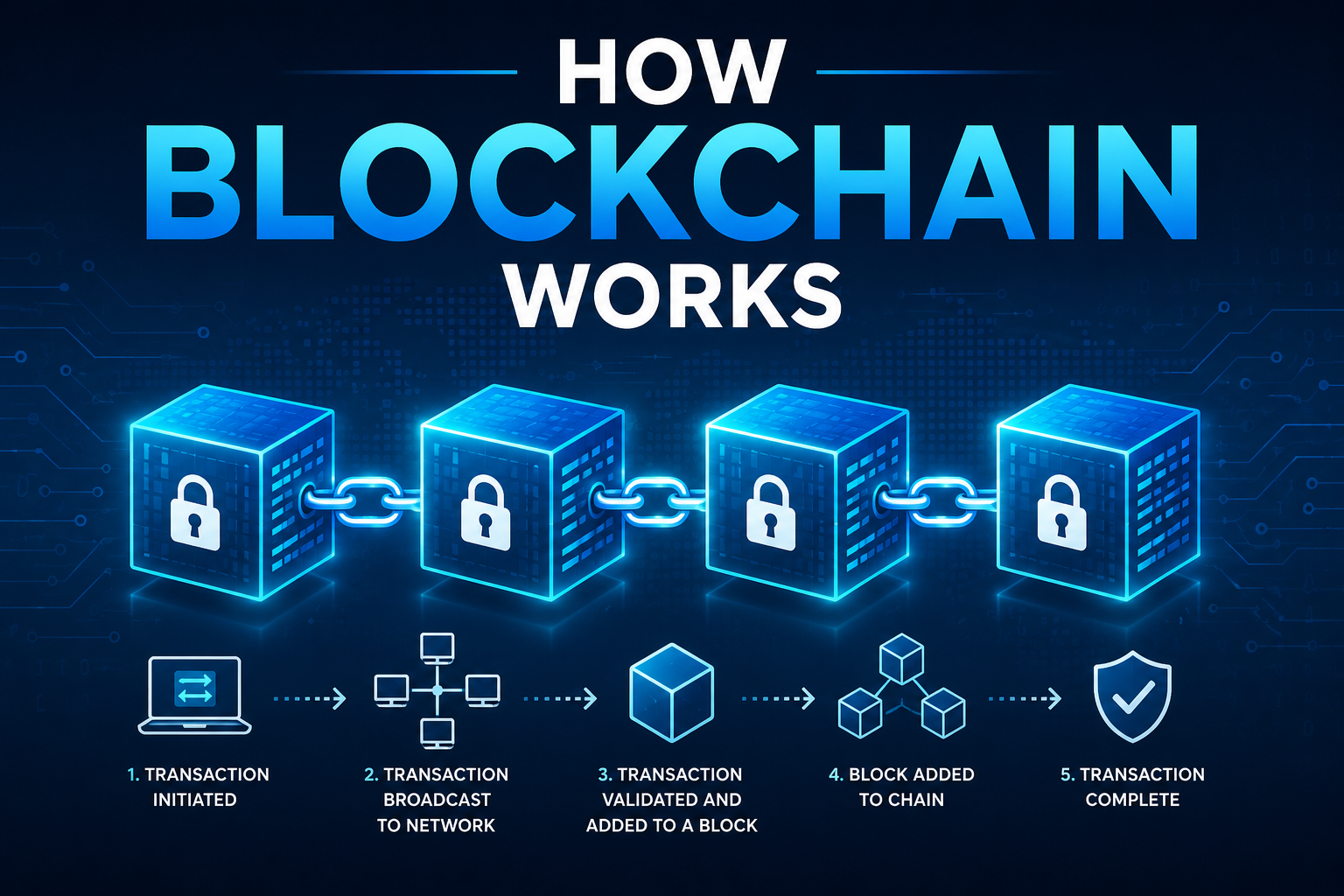
Blockchain technology is a digital system for recording and sharing information across a network of computers. Instead of keeping records in one central database controlled by a single organization, a blockchain distributes records across multiple participants.
The technology is best known for supporting cryptocurrencies such as Bitcoin and Ethereum, but its potential uses extend beyond digital currencies.
Blockchain can be used to record transactions, track digital assets, verify ownership, support automated agreements, and build decentralized applications.
How Does Blockchain Technology Work?
A blockchain stores information in groups called blocks.
When transactions or other records are created, they can be grouped together into a block. The block is then verified according to the rules of the particular blockchain.
Once accepted, the block is connected to previous blocks, creating a chronological chain of records.
This structure makes it difficult to alter historical information without detection.
Why Is It Called a Blockchain?
The name comes from the way information is organized.
A blockchain consists of blocks of information connected together in sequence.
Each block generally contains information about transactions or other activities, along with information that connects it to the previous block.
This creates a chain of records.
The exact structure and technical details vary between different blockchain networks.
What Is a Block?
A block is a collection of information recorded on a blockchain.
Depending on the network, a block may contain:
- Transactions
- Time related information
- References to previous blocks
- Validation information
- Other network specific data
Once a block has been accepted by the network, it becomes part of the blockchain’s history.
What Makes Blockchain Different From a Traditional Database?
A traditional database is usually managed by an organization or administrator.
That organization controls who can access, modify, or manage the database.
A blockchain can distribute control across multiple participants.
For example, instead of one company maintaining a transaction ledger, multiple computers can maintain copies of the ledger and participate in validating new activity.
This decentralized structure is one of the defining characteristics of blockchain technology.
What Is Decentralization?
Decentralization means that control is distributed rather than concentrated in one central authority.
In a decentralized blockchain, multiple participants contribute to maintaining the network.
The degree of decentralization differs between blockchain networks.
Some networks have thousands of participants, while others may rely on a smaller or more controlled group.
What Are Blockchain Nodes?
Nodes are computers that participate in a blockchain network.
Depending on the blockchain and node type, they may store blockchain data, verify transactions, communicate with other nodes, or participate in consensus.
A distributed network of nodes helps maintain the blockchain and reduces dependence on a single computer or server.
What Is Blockchain Consensus?
Consensus is the process through which participants in a blockchain network agree on the valid state of the network.
Different blockchain networks use different consensus mechanisms.
Two well known approaches are:
Proof of Work
Proof of Stake
Each method uses a different process to help the network agree on which transactions should be accepted.
What Is Proof of Work?
Proof of Work is a consensus mechanism used by Bitcoin.
Participants known as miners use computing power to solve complex mathematical problems.
The process requires significant computational resources.
Successful miners can receive rewards according to the rules of the network.
Proof of Work is designed to make it costly to manipulate the blockchain while allowing participants to agree on the valid chain.
What Is Proof of Stake?
Proof of Stake uses participants called validators rather than relying primarily on energy intensive mining.
Validators commit cryptocurrency through a staking mechanism and participate in transaction validation and network security.
Networks such as Ethereum use Proof of Stake.
The exact rules vary from one blockchain to another.
What Are Blockchain Transactions?
A blockchain transaction is an action recorded on a blockchain.
In a cryptocurrency network, this could involve transferring digital assets from one wallet to another.
Transactions can also represent interactions with smart contracts, token transfers, or other activities depending on the blockchain.
What Are Cryptographic Hashes?
Cryptographic hashing is an important part of blockchain technology.
A hash is a unique looking string of characters generated from information.
If the underlying information changes, the resulting hash can change significantly.
Blockchains use hashes in various ways to connect blocks and help detect changes to stored information.
Why Is Blockchain Considered Difficult to Alter?
Blockchain records are linked together using cryptographic techniques and maintained across a distributed network.
Changing an old record could require overcoming multiple layers of protection and, depending on the blockchain, gaining control over significant network resources.
This does not mean blockchains are completely immune to attacks.
Different networks have different security models and vulnerabilities.
What Are Smart Contracts?
Smart contracts are programs that run on blockchain networks that support programmable functionality.
They can automatically perform actions when predefined conditions are satisfied.
For example, a smart contract could be designed to transfer a digital asset when certain conditions are met.
Smart contracts are widely associated with networks such as Ethereum.
What Are Blockchain Tokens?
A token is a digital asset that exists within a blockchain ecosystem.
Tokens can represent different things depending on how they are designed.
They may represent:
- Digital assets
- Utility within an application
- Governance rights
- Digital collectibles
- Stable value assets
- Other blockchain based resources
The exact characteristics depend on the token and the network on which it operates.
What Is a Cryptocurrency?
Cryptocurrency is a type of digital asset that uses cryptographic technology and blockchain or similar distributed ledger infrastructure.
Bitcoin is one example.
Ethereum’s ETH is another.
Many cryptocurrencies operate on their own blockchain, while other tokens operate on existing blockchain networks.
Is Blockchain the Same as Cryptocurrency?
No.
Cryptocurrency is one application of blockchain technology.
Blockchain can be used for other purposes that do not involve cryptocurrency.
The distinction is important because blockchain is a broader technology category.
How Is Blockchain Used in Finance?
Financial institutions and companies have explored blockchain for various applications.
Potential uses include:
- Digital payments
- Asset transfers
- Settlement
- Tokenization
- Transaction tracking
- Digital identity
- Automated agreements
Blockchain can potentially reduce the need for certain intermediaries in specific processes, although practical implementation depends on regulatory, technical, and business requirements.
Blockchain and Supply Chain Management
Blockchain can also be used to record information about products as they move through a supply chain.
For example, a system could record events involving:
Manufacturing
Shipping
Warehousing
Distribution
Delivery
A shared record may help organizations coordinate information and improve traceability.
However, blockchain cannot automatically guarantee that information entered into the system is accurate.
If incorrect information is entered, the blockchain may preserve that incorrect information.
Blockchain and Digital Identity
Blockchain technology has also been explored for digital identity systems.
A blockchain based identity system could potentially allow users to control or verify certain credentials without relying entirely on a centralized database.
Applications may include:
Educational credentials
Professional certifications
Identity verification
Access management
Digital documents
The design of these systems must consider privacy and security carefully.
Blockchain in Healthcare
Healthcare organizations have explored blockchain for areas such as data sharing, credential verification, supply chain tracking, and administrative processes.
However, healthcare information is highly sensitive.
Any blockchain based healthcare system must consider privacy, regulatory requirements, access controls, and data protection.
Blockchain in Gaming
Blockchain can also support gaming applications.
Developers may use blockchain to represent digital assets, ownership records, or tokens.
Players may be able to interact with blockchain based assets outside a traditional game database.
However, blockchain gaming remains an evolving area, and the usefulness of blockchain depends on the specific game and application.
What Are the Benefits of Blockchain?
Blockchain technology can provide several potential benefits.
Transparency
Depending on the network, blockchain records may be publicly visible and independently verifiable.
Shared Records
Multiple participants can maintain copies of the same ledger.
Traceability
Blockchain can provide a chronological record of transactions and other events.
Reduced Dependence on Central Authorities
Some blockchain networks allow users to interact directly without relying entirely on a central intermediary.
Programmability
Smart contract capable blockchains can support automated applications and digital agreements.
What Are the Limitations of Blockchain?
Blockchain is not a solution for every problem.
Potential limitations include:
- Scalability challenges
- Transaction costs
- Network congestion
- Energy consumption for some consensus systems
- Technical complexity
- Regulatory uncertainty
- Privacy concerns
- Smart contract vulnerabilities
- User security risks
The appropriate technology depends on the specific use case.
Is Blockchain Completely Secure?
No technology is completely secure.
Blockchain networks can have vulnerabilities.
Risks may involve:
- Software bugs
- Smart contract vulnerabilities
- Wallet theft
- Phishing
- Private key loss
- Exchange failures
- Network attacks
- Fraudulent applications
Users and organizations need appropriate security practices.
Can Blockchain Data Be Deleted?
One of the important characteristics of many blockchains is that historical records are designed to be difficult to modify or remove.
However, blockchain permanence varies by network and application.
Some systems may store sensitive or large information off chain while keeping a reference or verification record on the blockchain.
This can be important for privacy and data protection.
What Does Immutable Mean?
Immutability generally means that information recorded on a blockchain is designed to resist unauthorized modification.
It does not mean that absolutely nothing can ever change.
Blockchain networks can experience software upgrades, reorganizations, governance decisions, or other technical events.
The practical meaning of immutability depends on the blockchain’s architecture and consensus rules.
Is Blockchain Private or Public?
Blockchains can be designed differently.
A public blockchain allows broad participation and may allow anyone to view transaction data.
A private blockchain can restrict participation to approved organizations or users.
There are also permissioned systems that provide controlled access.
The choice depends on the intended application.
What Is a Public Blockchain?
A public blockchain is generally open for anyone to participate in according to the network’s rules.
Bitcoin and Ethereum are examples of public blockchain networks.
Users can interact with these networks without needing permission from a single company.
What Is a Private Blockchain?
A private blockchain is controlled by a specific organization or group.
Access may be restricted.
Private blockchain systems can be useful when organizations need shared records but do not want unrestricted public participation.
What Is Blockchain Interoperability?
Interoperability refers to the ability of different blockchain networks and systems to communicate or transfer information between one another.
Different blockchains often operate independently.
Interoperability technologies attempt to connect these ecosystems.
This remains an active area of blockchain development.
What Is Blockchain Scalability?
Scalability refers to a network’s ability to handle increasing amounts of activity without unacceptable delays or costs.
As blockchain adoption grows, networks need to process more transactions efficiently.
Different blockchains use different approaches to improve scalability.
Some focus on faster base layers.
Others use additional networks or technologies designed to process activity outside the main blockchain.
What Is a Layer 2 Blockchain?
Layer 2 refers to technologies built on top of an existing blockchain to improve transaction processing or reduce costs.
For example, some Layer 2 networks are built around Ethereum.
They process certain activity separately and use the underlying blockchain for security or settlement functions.
The exact architecture differs between Layer 2 systems.
Why Is Blockchain Technology Important?
Blockchain introduced a new approach to digital record keeping.
Instead of relying entirely on one organization to maintain a trusted database, blockchain networks can allow multiple participants to maintain and verify a shared record.
This concept has applications beyond cryptocurrency.
The Future of Blockchain Technology
Blockchain development continues to evolve.
Future applications may involve:
- Tokenized assets
- Digital identity
- Decentralized finance
- Supply chain tracking
- Digital credentials
- Automated agreements
- Cross network applications
- Digital payments
- Enterprise systems
However, adoption will depend on whether blockchain provides meaningful advantages over conventional technologies.
Final Thoughts
Blockchain technology is a method of recording and sharing information across a distributed network.
It uses cryptography, network participants, and consensus mechanisms to maintain a shared record.
Cryptocurrencies are one of its most visible applications, but blockchain can also support smart contracts, digital assets, decentralized applications, identity systems, supply chain tracking, and other use cases.
The technology has significant potential, but it also has limitations involving scalability, security, privacy, regulation, and complexity.
Understanding these advantages and limitations is important when evaluating whether blockchain is suitable for a particular application.
Frequently Asked Questions
What is blockchain technology in simple words?
Blockchain is a digital record keeping system that allows information to be stored and shared across a network of computers instead of relying entirely on one central database.
Is blockchain the same as Bitcoin?
No. Bitcoin is a cryptocurrency and blockchain network. Blockchain is the broader technology used by Bitcoin and many other systems.
Is blockchain the same as cryptocurrency?
No. Cryptocurrency is one application of blockchain technology. Blockchain can also be used for other purposes.
How does a blockchain work?
Information is grouped into blocks, verified according to network rules, and connected to previous blocks to create a chronological chain.
What is a blockchain block?
A block is a collection of information recorded on a blockchain. It may contain transactions and other network specific information.
What are blockchain nodes?
Nodes are computers that participate in a blockchain network by storing information, communicating with other participants, verifying transactions, or performing other network functions.
What is decentralization?
Decentralization means that control and network participation are distributed among multiple participants rather than being controlled entirely by one central authority.
What is a smart contract?
A smart contract is a program that runs on a blockchain and can automatically execute predefined actions according to its programming.
What is Proof of Work?
Proof of Work is a consensus mechanism that uses computational work to help secure a blockchain and validate new blocks.
What is Proof of Stake?
Proof of Stake is a consensus mechanism where validators participate in securing a blockchain through staking rather than relying primarily on computational mining.
Is blockchain secure?
Blockchain networks can provide strong security mechanisms, but they are not completely immune to attacks, software vulnerabilities, fraud, or user mistakes.
Can blockchain records be changed?
Many blockchains are designed to make historical records difficult to modify. However, the exact level of immutability depends on the network and its architecture.
Can blockchain be used without cryptocurrency?
Yes. Blockchain systems can be designed for applications that do not require a traditional cryptocurrency.
Where is blockchain used?
Blockchain has been explored for finance, digital assets, supply chains, identity systems, gaming, digital credentials, payments, and decentralized applications.
What are the main advantages of blockchain?
Potential advantages include shared records, transparency, traceability, decentralization, and programmability.
What are the main disadvantages of blockchain?
Potential disadvantages include scalability challenges, technical complexity, transaction costs, privacy concerns, security risks, and regulatory uncertainty.
Is blockchain the future?
Blockchain may become an important technology in certain industries, but its long term adoption will depend on whether it provides practical advantages over traditional systems.
What is a public blockchain?
A public blockchain is generally open to broad participation and allows users to interact with the network according to its rules.
What is a private blockchain?
A private blockchain restricts participation and is typically controlled by an organization or group.
Why is blockchain important?
Blockchain provides a way to maintain shared digital records without relying entirely on a single central authority, creating possibilities for new forms of digital ownership, transactions, and applications.