The internet has changed dramatically since its early days. Websites that once provided mostly static information have evolved into interactive platforms where people communicate, create content, shop, work, play games, and manage digital services.
Web3 represents another possible stage in that evolution.
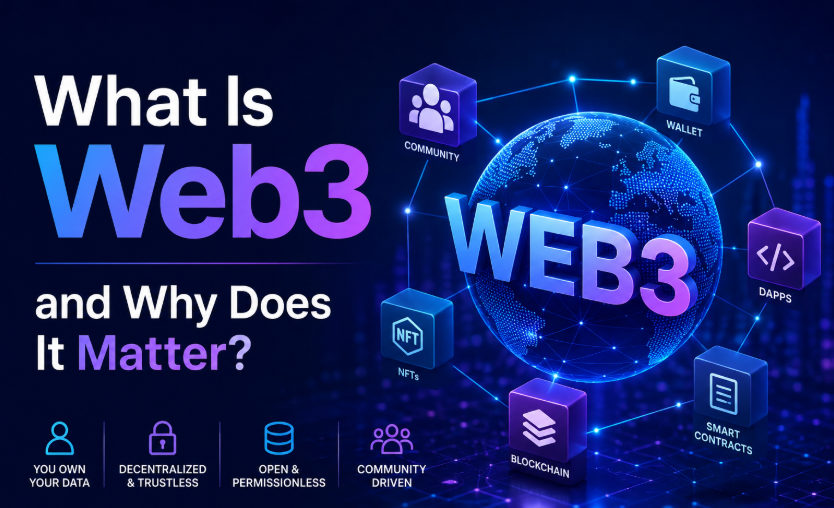
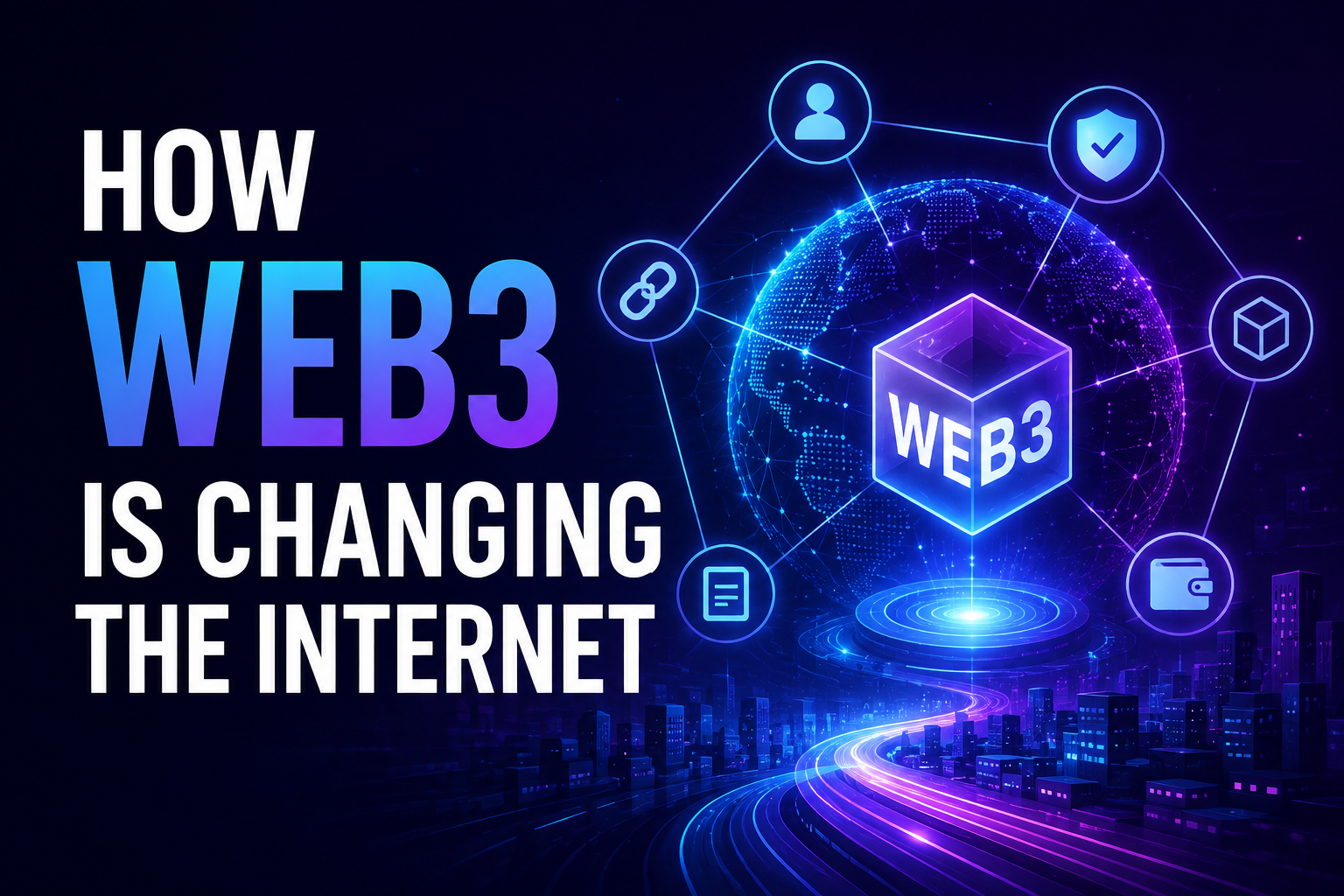
Web3 is a broad concept focused on building internet applications that use technologies such as blockchain, smart contracts, digital assets, and decentralized networks. Instead of relying entirely on centralized companies to manage online platforms and digital ownership, Web3 explores models where users can have greater control over assets, identities, and online interactions.
Web3 is still developing, and not every idea associated with it will become mainstream. However, several Web3 concepts are already influencing how people think about digital ownership, online communities, finance, and applications.
What Is Web3?
Web3 generally refers to a vision of a more decentralized and user controlled internet.
The term is often associated with blockchain technology and decentralized applications.
In traditional internet services, a company may control the platform, database, user accounts, and digital infrastructure.
Web3 applications can use blockchain networks to distribute certain functions and allow users to interact directly with digital assets and smart contracts.
The exact meaning of Web3 varies because it represents a broad collection of technologies and ideas rather than one specific platform.
Web1, Web2, and Web3
Understanding the evolution of the internet makes the Web3 concept easier to understand.
Web1
Early websites were largely focused on providing information.
Users primarily consumed content rather than interacting extensively with websites.
Web2
Web2 introduced highly interactive platforms.
Users could create content, communicate with others, build communities, and use online services.
Social networks, video platforms, online marketplaces, and cloud applications became major parts of the internet.
Web3
Web3 aims to introduce greater decentralization and digital ownership.
Users can potentially interact with blockchain based applications and control digital assets through cryptographic wallets.
The transition is not a simple replacement of Web2 with Web3. Many modern services combine traditional technologies with blockchain based features.
How Blockchain Supports Web3
Blockchain is one of the foundational technologies associated with Web3.
A blockchain can maintain a shared record of transactions and digital asset ownership without relying entirely on one central database.
This allows applications to create systems where certain information or assets can be verified through a blockchain network.
Ethereum is one of the most widely known blockchain platforms used for Web3 development.
Other blockchain networks also support Web3 applications.
What Are Decentralized Applications?
Decentralized applications are commonly called dApps.
They are applications that use blockchain networks or decentralized infrastructure for some of their functionality.
A dApp can use smart contracts to perform specific actions according to programmed rules.
Examples of potential dApp categories include:
- Decentralized finance
- Digital marketplaces
- Gaming
- Digital collectibles
- Governance
- Social applications
- Asset management
Not every part of a dApp necessarily needs to be decentralized.
Some applications combine blockchain components with traditional web infrastructure.
Web3 and Digital Ownership
Digital ownership is one of the most frequently discussed Web3 concepts.
Traditional digital platforms often control how users access digital items.
For example, a digital item purchased inside a platform may remain closely tied to that platform’s account system.
Blockchain based assets can provide a different model.
Ownership information can be recorded on a blockchain, allowing users to control certain digital assets through their wallets.
This does not automatically mean that every blockchain asset has meaningful value or utility.
The actual usefulness depends on the application and how the asset is designed.
NFTs and Web3
NFT stands for non fungible token.
An NFT is a blockchain based token designed to represent a unique digital or physical asset.
NFTs became widely known through digital art and collectibles, but their potential applications are broader.
They can be used for:
- Digital collectibles
- Gaming assets
- Memberships
- Tickets
- Digital certificates
- Brand experiences
- Tokenized items
Web3 developers have explored NFTs as a way to create digital assets that can exist independently of a single platform.
Web3 and Cryptocurrency
Cryptocurrency is closely connected to Web3.
Many Web3 applications use digital assets to facilitate transactions, pay network fees, reward users, or participate in governance.
For example, users may need cryptocurrency to interact with certain blockchain networks.
However, Web3 is broader than cryptocurrency.
The underlying technologies can support digital identity, decentralized storage, applications, and other systems.
Web3 and Digital Identity
Traditional online identities are often managed by individual platforms.
A user may have separate accounts for different websites.
Web3 introduces the concept of blockchain based identities and wallet based authentication.
A wallet can allow a user to connect with multiple applications without creating a separate traditional account for each service.
This model is sometimes described as user controlled digital identity.
However, wallet based identity also introduces new security responsibilities.
Losing access to a wallet or exposing private credentials can create serious problems.
Web3 and Data Ownership
Data ownership is another important Web3 discussion.
Large internet platforms have traditionally collected and managed enormous amounts of user data.
Web3 advocates argue that decentralized systems could give users more control over certain digital assets and interactions.
However, blockchain does not automatically solve data ownership.
Public blockchains can make information permanently visible, which can create privacy concerns.
Effective Web3 systems need to consider both ownership and privacy.
Web3 and Decentralized Finance
Decentralized finance, commonly known as DeFi, is one of the most developed Web3 sectors.
DeFi applications use smart contracts to provide financial functions without relying entirely on traditional intermediaries.
Examples include:
- Decentralized exchanges
- Lending platforms
- Borrowing systems
- Asset management
- Payment applications
- Stablecoin based services
DeFi can provide new financial tools, but it also introduces risks such as smart contract vulnerabilities, market volatility, liquidity problems, and scams.
Web3 and Online Payments
Blockchain networks can allow users to transfer digital assets directly between compatible wallets.
This can create new possibilities for online payments.
Traditional payment systems often require banks, payment processors, or other intermediaries.
Blockchain based payments can operate through decentralized networks.
However, transaction fees, price volatility, regulatory requirements, user experience, and scalability can affect whether blockchain payments are practical for everyday use.
Web3 and Gaming
Gaming is another area where Web3 concepts have attracted attention.
Blockchain based games can allow players to own certain digital assets.
These assets may include:
- Characters
- Items
- Collectibles
- Virtual land
- Equipment
- Rewards
The idea is that some digital assets could potentially be transferred between compatible applications or marketplaces.
However, interoperability is still limited, and not every blockchain game provides meaningful ownership or long term utility.
Web3 and Creator Economies
Web3 can also influence how creators interact with their audiences.
Traditional platforms often control distribution and monetization.
Web3 models can allow creators to use blockchain based assets, memberships, tokens, or direct payment systems.
Potential applications include:
- Digital memberships
- Token based communities
- Collectibles
- Direct payments
- Fan experiences
The effectiveness of these models depends on user adoption and the value provided to the community.
Web3 and Online Communities
Web3 has introduced new approaches to online communities.
Some projects use tokens to provide access to communities or participate in governance.
Others use decentralized systems to allow community members to influence decisions.
These communities can operate differently from traditional social media groups.
However, token ownership does not automatically create a healthy community.
Strong communities still require useful products, active participation, good moderation, and clear objectives.
What Are DAOs?
DAO stands for decentralized autonomous organization.
A DAO is an organizational structure that uses blockchain technology and smart contracts to coordinate activities.
Some DAOs allow members to vote on proposals using blockchain based governance systems.
Potential DAO activities include:
- Managing community funds
- Voting on proposals
- Funding projects
- Managing digital assets
- Coordinating decentralized communities
DAOs vary significantly in their structure and level of decentralization.
Web3 and Smart Contracts
Smart contracts are essential to many Web3 applications.
A smart contract is a program deployed on a blockchain.
It can execute predefined actions when certain conditions are satisfied.
For example, a decentralized exchange can use smart contracts to facilitate transactions between users.
Because smart contracts can control digital assets, their security is extremely important.
A programming error can potentially create significant financial consequences.
Web3 and Decentralized Storage
Traditional websites often rely on centralized cloud infrastructure.
Web3 projects have explored decentralized storage systems that distribute data across networks.
Potential benefits can include greater redundancy and reduced dependence on a single provider.
However, decentralized storage can introduce challenges involving performance, cost, accessibility, and data management.
Web3 and Privacy
Web3 does not automatically mean greater privacy.
Public blockchain transactions can often be viewed by anyone.
Wallet addresses may not display a person’s real name, but blockchain activity can sometimes be analyzed and connected with other information.
Privacy focused technologies are being developed, but users should understand the difference between decentralization and anonymity.
How Web3 Could Change Businesses
Web3 could influence business models in several ways.
Companies may use blockchain technology for:
- Digital memberships
- Loyalty programs
- Tokenized assets
- Digital collectibles
- Payments
- Supply chain records
- Customer communities
- Digital identity
Some businesses may use blockchain behind the scenes without customers even knowing that blockchain technology is involved.
Web3 and Brand Loyalty
Traditional loyalty programs generally use centralized databases.
Web3 can introduce blockchain based loyalty assets that users may potentially hold and interact with outside a single company platform.
For example, a brand could create a digital membership asset that provides access to experiences or benefits.
The success of such programs depends on utility rather than simply issuing a token.
Web3 and Advertising
Web3 could also change aspects of digital advertising.
Blockchain based systems can potentially introduce new models for tracking transactions, rewarding users, and managing digital assets.
Some projects have explored models where users receive rewards for interacting with advertisements or controlling how their data is used.
These models are still evolving.
Web3 and Artificial Intelligence
Artificial intelligence and Web3 are increasingly being discussed together.
Blockchain can potentially help with areas such as:
- Digital ownership
- Data verification
- AI model marketplaces
- Creator compensation
- Machine identity
- Decentralized infrastructure
AI can also help improve blockchain applications through automation and intelligent interfaces.
The combination is still developing, and many proposed use cases remain experimental.
Challenges Facing Web3
Web3 has significant potential, but it also faces major challenges.
Complexity
Blockchain wallets, private keys, gas fees, and transactions can be confusing for beginners.
Security
Users can lose assets through phishing, compromised wallets, smart contract vulnerabilities, or other attacks.
Scalability
Some blockchain networks experience congestion when demand increases.
Regulation
Governments continue to develop rules for cryptocurrency and blockchain applications.
User Experience
Web3 applications can be more complicated than traditional websites.
Speculation
Some Web3 projects are heavily driven by token speculation rather than genuine utility.
Is Web3 Replacing Web2?
Not currently.
Web2 remains the dominant model of the internet.
Many Web3 applications still rely on traditional websites, cloud infrastructure, databases, and centralized services.
The future may involve a combination of centralized and decentralized technologies rather than one completely replacing the other.
Is Web3 the Future of the Internet?
Web3 could become an important part of the internet, but its final form is uncertain.
Some Web3 concepts may become widely adopted.
Others may remain niche.
The most successful technologies will likely be those that solve real problems while providing a better experience for users.
Users are unlikely to adopt complex systems simply because they use blockchain.
Practical benefits will matter.
How Beginners Can Learn About Web3
Beginners can start with the fundamentals.
Learn about:
- Blockchain
- Cryptocurrency
- Wallets
- Smart contracts
- NFTs
- DeFi
- DAOs
- Digital identity
- Decentralized applications
It is better to understand these concepts before buying digital assets or interacting with unfamiliar applications.
Final Thoughts
Web3 represents a broad vision for a more decentralized and user controlled internet.
Blockchain technology, smart contracts, cryptocurrency, digital assets, decentralized applications, and digital identity are some of the technologies associated with this vision.
Web3 can potentially change how people own digital assets, interact with applications, participate in communities, make payments, and engage with online businesses.
However, Web3 is still developing.
Technical complexity, security risks, scalability, regulation, privacy concerns, and speculation remain significant challenges.
The future of Web3 will ultimately depend on whether these technologies can provide meaningful benefits to everyday users.
Rather than thinking of Web3 as simply a replacement for today’s internet, it may be more useful to view it as an evolving collection of technologies that could become another layer of the digital world.
Frequently Asked Questions
What is Web3?
Web3 is a broad concept describing a more decentralized and user controlled internet that often uses blockchain, smart contracts, digital assets, and decentralized applications.
How is Web3 different from Web2?
Web2 is dominated by interactive platforms and centralized services, while Web3 explores greater decentralization, blockchain based ownership, and user controlled digital assets.
Is Web3 the same as cryptocurrency?
No. Cryptocurrency is one part of the Web3 ecosystem. Web3 also includes smart contracts, decentralized applications, digital identity, NFTs, DAOs, and other technologies.
Does Web3 use blockchain?
Many Web3 applications use blockchain technology, although the exact architecture can vary between projects.
What are Web3 applications?
Web3 applications are applications that use blockchain or decentralized technologies for some of their functions.
What is a dApp?
A dApp, or decentralized application, is an application that uses blockchain networks or decentralized infrastructure for some of its operations.
What are smart contracts in Web3?
Smart contracts are blockchain based programs that automatically execute predefined instructions.
What is Web3 ownership?
Web3 ownership generally refers to the ability to directly control certain digital assets through blockchain based systems and cryptographic wallets.
What are NFTs used for in Web3?
NFTs can represent unique digital assets such as collectibles, memberships, tickets, gaming items, and other digital or physical representations.
Can Web3 change online gaming?
Web3 can introduce blockchain based ownership of certain gaming assets and new models for digital economies, although widespread adoption is still developing.
What is a Web3 wallet?
A Web3 wallet is a digital wallet that allows users to manage blockchain assets and interact with decentralized applications.
Are Web3 wallets safe?
Web3 wallets can be secure when properly managed, but users are responsible for protecting passwords, private keys, and recovery phrases.
Is Web3 anonymous?
Not necessarily. Many public blockchain networks record transactions publicly. Web3 systems can provide pseudonymous interactions, but that is different from complete anonymity.
Can Web3 improve privacy?
Some Web3 technologies aim to improve privacy, but blockchain itself does not automatically provide privacy.
What is a DAO?
A DAO, or decentralized autonomous organization, is a blockchain based organizational structure that can use smart contracts and community governance mechanisms.
What is DeFi?
DeFi means decentralized finance. It refers to blockchain based financial applications that can provide functions such as trading, lending, and borrowing through smart contracts.
How can businesses use Web3?
Businesses can explore Web3 for digital memberships, loyalty programs, payments, digital assets, customer communities, tokenized products, and other applications.
Can Web3 help creators?
Web3 can provide creators with additional models for digital ownership, memberships, collectibles, payments, and community participation.
Is Web3 replacing the current internet?
Web3 is not currently replacing Web2. Most Web3 applications still interact with traditional internet infrastructure.
What are the biggest Web3 challenges?
Major challenges include security, complexity, scalability, regulation, privacy, user experience, and excessive speculation.
Is Web3 safe for beginners?
Web3 can involve significant technical and financial risks. Beginners should learn how wallets, blockchain transactions, smart contracts, and security practices work before using unfamiliar applications.
Is Web3 a good investment?
Web3 is a technology concept rather than a single investment. Individual cryptocurrencies and Web3 projects can be highly volatile and should be researched independently.
What should beginners learn before using Web3?
Start with blockchain basics, cryptocurrency wallets, private keys, smart contracts, transaction fees, decentralized applications, and common security threats.
Will Web3 become mainstream?
It is possible that some Web3 technologies will become more widely adopted, but the future development and level of mainstream adoption remain uncertain.