Blockchain and traditional databases are both technologies used to store, manage, and retrieve information. At first glance, they may appear similar because both can record transactions and maintain digital records.
The major difference is how they manage that information.
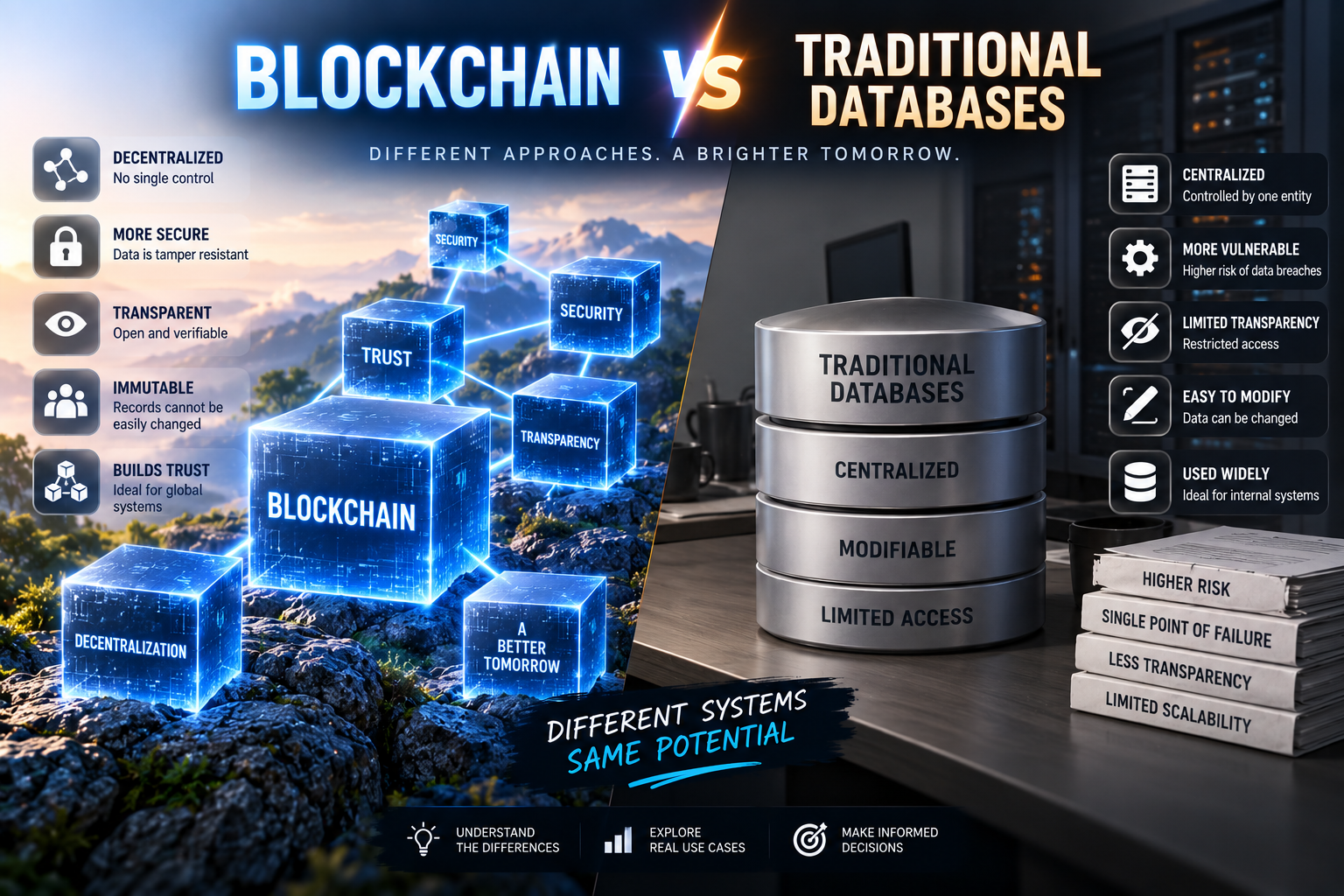
Traditional databases are generally controlled by a central organization or administrator. Blockchain distributes records across a network and uses cryptographic methods and consensus mechanisms to maintain a shared record.
This difference affects control, security, transparency, speed, flexibility, privacy, cost, and the types of applications each technology is suitable for.
Understanding these differences is important for businesses, developers, and anyone learning about blockchain technology.
What Is a Traditional Database?
A traditional database is a system designed to store and organize information so that applications and authorized users can easily access it.
Common database technologies include relational databases such as MySQL, PostgreSQL, Oracle Database, and Microsoft SQL Server. There are also NoSQL databases designed for different types of data and workloads.
Traditional databases are used almost everywhere.
They can store:
• Customer information
• Product catalogs
• Employee records
• Financial transactions
• Website content
• Medical records
• Inventory information
• Banking information
• Business applications
A database administrator or organization normally controls who can access the database and what they are allowed to do.
Records can generally be created, modified, updated, or deleted according to the permissions provided to users.
What Is Blockchain?
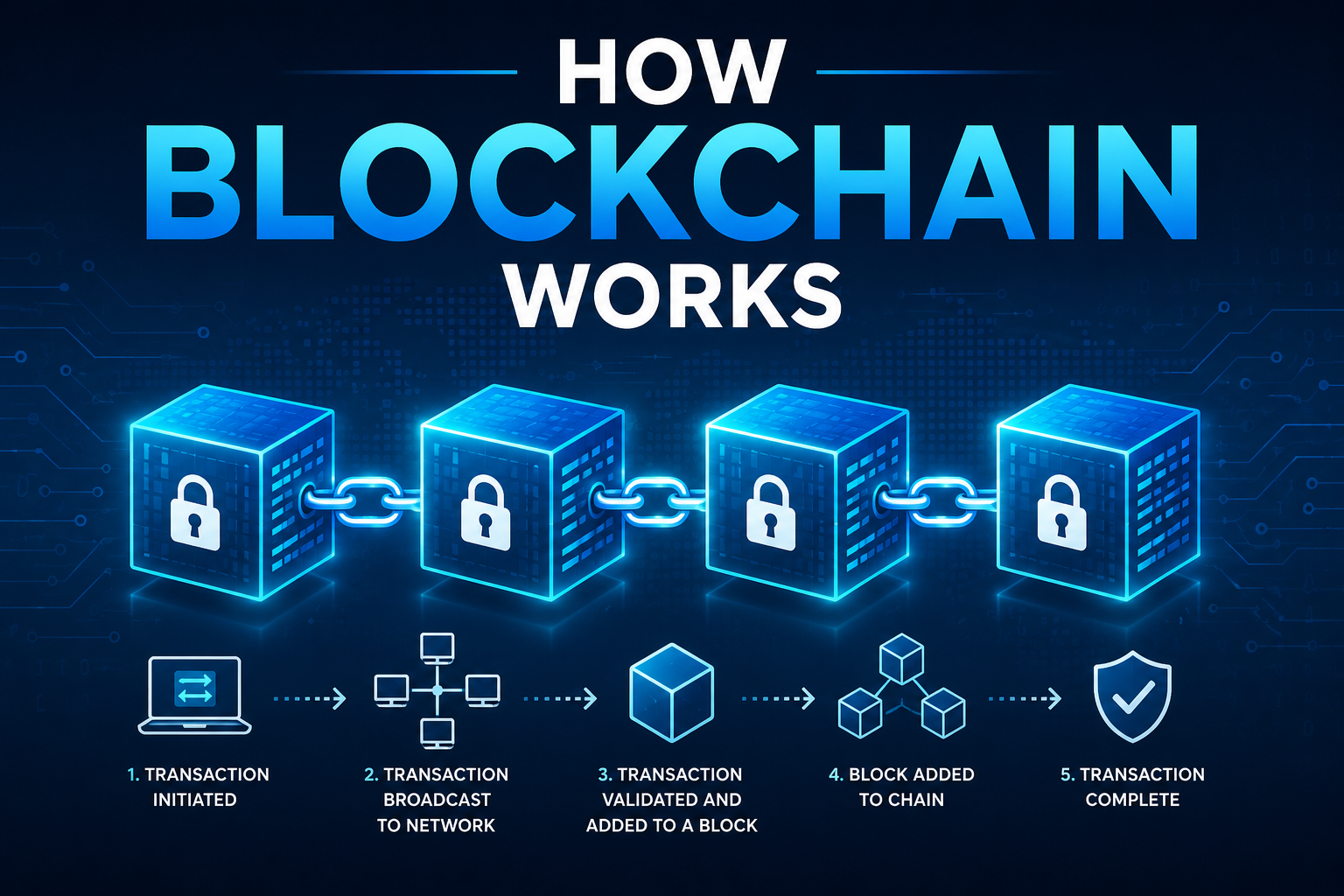
Blockchain is a type of distributed ledger technology.
Instead of relying on one central database administrator, blockchain can distribute copies of a ledger across multiple computers or participants in a network.
Information is organized into blocks, and blocks are connected using cryptographic techniques.
Once transactions are confirmed and added to the blockchain, changing historical information becomes difficult because the network’s records and validation mechanisms are designed to detect inconsistencies.
Different blockchains use different consensus mechanisms and governance structures.
Public blockchain networks can allow participants from around the world to independently verify transactions and network activity.
Blockchain vs Traditional Database: The Main Difference
The biggest difference is the way control and trust are organized.
A traditional database generally has a central authority.
For example, a company may operate a database containing customer information. The company determines who can access it, who can modify records, and how the system is maintained.
A blockchain can distribute control among multiple participants.
Instead of asking one organization to maintain the definitive record, participants use the blockchain’s protocol and consensus mechanism to agree on the state of the ledger.
This can be useful when multiple organizations need to share information but do not want one party to have complete control over the record.
Blockchain vs Traditional Database Comparison
| Feature | Blockchain | Traditional Database |
|---|---|---|
| Architecture | Distributed | Usually centralized |
| Control | Shared or distributed | Central administrator |
| Data modification | Generally append only | Can be updated or deleted |
| Verification | Consensus and cryptography | Administrator and database controls |
| Transparency | Can be highly transparent | Usually permission based |
| Speed | Generally slower | Generally faster |
| Query flexibility | More limited | Highly flexible |
| Privacy | Depends on blockchain design | Strong permission controls |
| Scalability | Can involve significant tradeoffs | Highly scalable for many workloads |
| Cost | Can be higher depending on network | Generally efficient |
| Best suited for | Shared records and multi party trust | Business applications and centralized data |
Centralization vs Decentralization
Traditional databases are usually centralized.
This does not necessarily mean that the database exists on only one physical computer. Modern systems can use multiple servers, backups, replicas, and cloud infrastructure.
However, control typically remains with one organization.
Blockchain takes a different approach.
Multiple participants can maintain copies of the ledger, and network rules determine how new transactions are accepted.
This can reduce dependence on one central authority.
For example, a company may control its internal employee database completely.
A blockchain network can instead provide a shared record that multiple independent participants can verify.
Data Modification
One of the biggest differences is how data can be changed.
Traditional databases are designed to support regular updates.
If a customer changes their address, the database can update the existing record.
If a product changes price, the database can replace the old information with the new information.
If an administrator needs to correct an error, the appropriate record can generally be modified.
Blockchain usually follows an append only model.
Instead of changing an old transaction, a new transaction or record can be added to represent what happened afterward.
This creates a historical record of activity.
That characteristic can be valuable for audit trails, transaction histories, certificates, ownership records, and other situations where preserving historical information is important.
Speed and Performance
Traditional databases generally have an advantage when speed is the main priority.
Modern database systems are designed to handle large numbers of queries and transactions efficiently.
They can use indexing, caching, replication, query optimization, and other techniques to improve performance.
Blockchain networks have additional processing requirements.
Transactions may need to be validated by multiple participants and confirmed through a consensus mechanism.
This can reduce transaction throughput compared with many centralized database systems.
The exact performance depends heavily on the blockchain architecture and the database technology being compared.
For applications that require extremely fast and frequent data operations, a traditional database is often more practical.
Security
Both technologies can provide strong security, but they approach it differently.
Traditional databases commonly use:
• User authentication
• Passwords
• Encryption
• Access controls
• Role based permissions
• Firewalls
• Monitoring
• Backups
The organization operating the database is responsible for securing the system.
Blockchain uses cryptographic techniques and distributed network architecture.
Transactions are validated according to the network’s rules, and cryptographic links help make historical records tamper evident.
However, blockchain is not automatically secure simply because it uses cryptography.
Wallet security, private keys, smart contracts, applications, exchanges, and user behavior can all introduce risks.
Transparency
Transparency is another important difference.
Public blockchains can allow anyone to inspect transaction history and independently verify activity.
This can be useful when participants need a shared record that does not depend entirely on one organization.
Traditional databases generally use permission based access.
A company may allow employees to see certain information while restricting sensitive records to authorized personnel.
This can provide stronger privacy for many business applications.
Therefore, transparency is not always an advantage.
For some applications, keeping information private is more important than allowing everyone to verify it.
Privacy
Traditional databases generally provide more direct control over private information.
Organizations can determine which users can access specific records.
For example, a hospital can restrict medical records to authorized employees and systems.
Public blockchains operate differently.
Transaction information may be visible to anyone, although blockchain addresses do not necessarily reveal a person’s real world identity directly.
Private or permissioned blockchain systems can provide greater access control, but their design is different from public blockchains.
For applications involving highly sensitive personal information, privacy requirements need to be considered carefully before choosing blockchain.
Scalability
Scalability is one of the major considerations when comparing blockchain with traditional databases.
Traditional databases have decades of development behind them and can support extremely large workloads.
Businesses can scale databases using additional servers, distributed architecture, cloud infrastructure, caching, indexing, replication, and other techniques.
Blockchain networks face additional challenges because transactions may need to be synchronized across multiple participants.
Improving blockchain scalability often involves tradeoffs involving decentralization, security, throughput, and network architecture.
This does not mean blockchain cannot scale.
It means scalability needs to be designed differently.
Cost
Traditional databases are generally cost efficient for applications that do not require decentralized verification.
Businesses can deploy databases using cloud infrastructure or their own servers and pay according to their requirements.
Blockchain costs can come from several areas.
These may include:
• Transaction fees
• Network infrastructure
• Development
• Smart contract deployment
• Security auditing
• Blockchain data storage
• Specialized technical expertise
Public blockchain transaction fees can also change according to network demand.
Therefore, using blockchain simply because it is available may not make economic sense.
The technology should solve a problem that justifies the additional complexity.
Trust and Intermediaries
Blockchain becomes particularly interesting when multiple organizations need to share information but do not fully trust one another.
Imagine several companies participating in a supply chain.
Each company may maintain its own database.
This can create reconciliation problems because different participants may have different versions of events.
A shared blockchain ledger can provide a common record that participants can independently verify.
Traditional databases are often better when one organization is already trusted to manage the information.
For example, an online store does not necessarily need blockchain to manage its product catalog.
The company can simply maintain its own database.
Blockchain Use Cases
Blockchain can be useful when multiple independent participants need a shared, verifiable record.
Potential applications include:
Cryptocurrency
Bitcoin and other cryptocurrencies use blockchain networks to record ownership and transactions.
Supply Chain Tracking
Blockchain can record events throughout a product’s journey and provide participants with a shared history.
Digital Assets
Blockchain can represent and transfer digital assets without requiring a traditional centralized database to maintain ownership.
Tokenization
Real world and financial assets can potentially be represented through blockchain based tokens.
Digital Certificates
Blockchain can help create records that are difficult to alter after verification.
Cross Organization Records
Multiple companies can use shared blockchain infrastructure when they need a common source of transaction history.
Traditional Database Use Cases
Traditional databases remain the standard choice for many applications.
They are particularly suitable for:
E Commerce
Product information, customer accounts, orders, payments, and inventory can all be managed through conventional databases.
Banking Systems
Banks use sophisticated databases to manage customer accounts, transactions, balances, and financial records.
Healthcare
Patient information and medical records often require strict access controls and privacy management.
Business Applications
Accounting systems, customer relationship management platforms, enterprise software, and internal applications commonly rely on databases.
Websites
Most websites use databases to store users, posts, products, settings, and other application data.
Can Blockchain Replace Traditional Databases?
In most cases, blockchain should not be viewed as a universal replacement for traditional databases.
The technologies solve different problems.
If an organization controls the data and needs fast queries, frequent updates, strong privacy, and flexible data management, a traditional database may be more suitable.
If multiple independent participants need a shared record and there is a strong reason to reduce dependence on one central authority, blockchain may be worth considering.
In many real world systems, the two technologies can also work together.
Hybrid Blockchain and Database Systems
A hybrid approach can combine traditional databases with blockchain.
For example, a business could store large amounts of private operational data in a traditional database while recording important transactions or verification information on a blockchain.
This approach can provide the performance and privacy of a database while using blockchain where shared verification or tamper resistant records are useful.
Hybrid architectures can therefore be practical when an organization does not need every piece of information to exist directly on a blockchain.
When Should You Use Blockchain?
Blockchain may be worth considering when several conditions exist.
Multiple Independent Participants
If several organizations need to share records, blockchain may provide a common ledger.
Limited Trust
If participants do not want one organization to have complete control, distributed verification can be useful.
Historical Records Matter
Blockchain can be useful when maintaining a tamper resistant history is important.
Auditability Is Important
A shared and verifiable transaction history can simplify certain auditing requirements.
Decentralization Has Real Value
Blockchain makes more sense when removing or reducing reliance on a central authority is an actual requirement rather than simply a marketing objective.
When Should You Use a Traditional Database?
A traditional database is often the better choice when:
• One organization controls the system
• Data needs frequent updates
• Complex queries are required
• High performance is important
• Private information must be tightly controlled
• The application needs mature database tools
• Costs need to remain predictable
• There is no meaningful need for decentralization
Traditional databases are not outdated technology.
They remain fundamental to modern software because they are flexible, efficient, mature, and well understood.
Blockchain vs Traditional Database: Which Is Better?
There is no universal winner.
The right technology depends on the problem being solved.
Blockchain offers benefits such as distributed control, shared verification, cryptographic integrity, and tamper resistant records.
Traditional databases offer speed, flexibility, privacy controls, mature tooling, and efficient data management.
Choosing blockchain simply because it is newer can create unnecessary complexity.
Choosing a traditional database when several independent parties genuinely need a shared and independently verifiable record can create other problems.
The best decision comes from understanding the application’s actual requirements.
Final Thoughts
Blockchain and traditional databases are not simply competing technologies.
They are different approaches to managing information.
Traditional databases are excellent for applications where one organization controls the data and needs fast, flexible, and private data management.
Blockchain is useful in situations where multiple participants need to share information and maintain a common record without relying entirely on one central authority.
Blockchain provides decentralization, cryptographic verification, and tamper resistant records, while traditional databases provide speed, flexibility, mature infrastructure, and powerful data management capabilities.
In some applications, a traditional database will be the obvious choice.
In others, blockchain can provide capabilities that a conventional database does not naturally offer.
And in increasingly complex systems, both technologies can work together.
The most important question is therefore not whether blockchain is better than a traditional database.
The better question is which technology is appropriate for the specific data, trust model, performance requirements, privacy needs, and business objectives of the application.
Frequently Asked Questions
What is the main difference between blockchain and a traditional database?
The main difference is how information is controlled and verified. Traditional databases are generally controlled by a central organization, while blockchain distributes records and uses consensus mechanisms to validate changes.
Is blockchain a database?
Blockchain can be considered a type of distributed ledger or database technology, but it has a different architecture and purpose from conventional databases.
Which is faster, blockchain or a traditional database?
Traditional databases are generally faster for high volume data operations and complex queries. Blockchain introduces additional validation and consensus requirements.
Is blockchain more secure than a database?
Both can be secure when properly designed. Blockchain uses cryptography and distributed verification, while traditional databases rely heavily on authentication, permissions, encryption, monitoring, and other security controls.
Can blockchain data be deleted?
Blockchain systems generally use an append only approach, meaning historical records are not normally edited or deleted in the same way as records in a traditional database.
Are traditional databases centralized?
Most traditional databases are centrally managed, although they can use distributed servers, replicas, and cloud infrastructure.
Why is blockchain useful if databases already exist?
Blockchain can be useful when multiple independent participants need a shared record and do not want to rely entirely on one organization to control that record.
Is blockchain more expensive than a traditional database?
It can be. Blockchain may involve network fees, specialized development, infrastructure, security auditing, and other costs that are not always required for conventional databases.
Can blockchain and databases work together?
Yes. A hybrid system can use a traditional database for high performance and private information while using blockchain for selected records, verification, or shared transactions.
Which technology is better for businesses?
It depends on the business requirement. Traditional databases are often suitable for internal applications, while blockchain may be useful when several independent organizations need a shared and verifiable record.
Is blockchain better for storing large amounts of data?
Traditional databases are generally better suited to large amounts of frequently accessed or frequently updated data. Blockchain can be inefficient for storing large volumes of general purpose information directly on chain.
Should every business use blockchain?
No. Blockchain should be used when its specific advantages solve a genuine business or technical problem. A traditional database is often the more practical option for conventional applications.