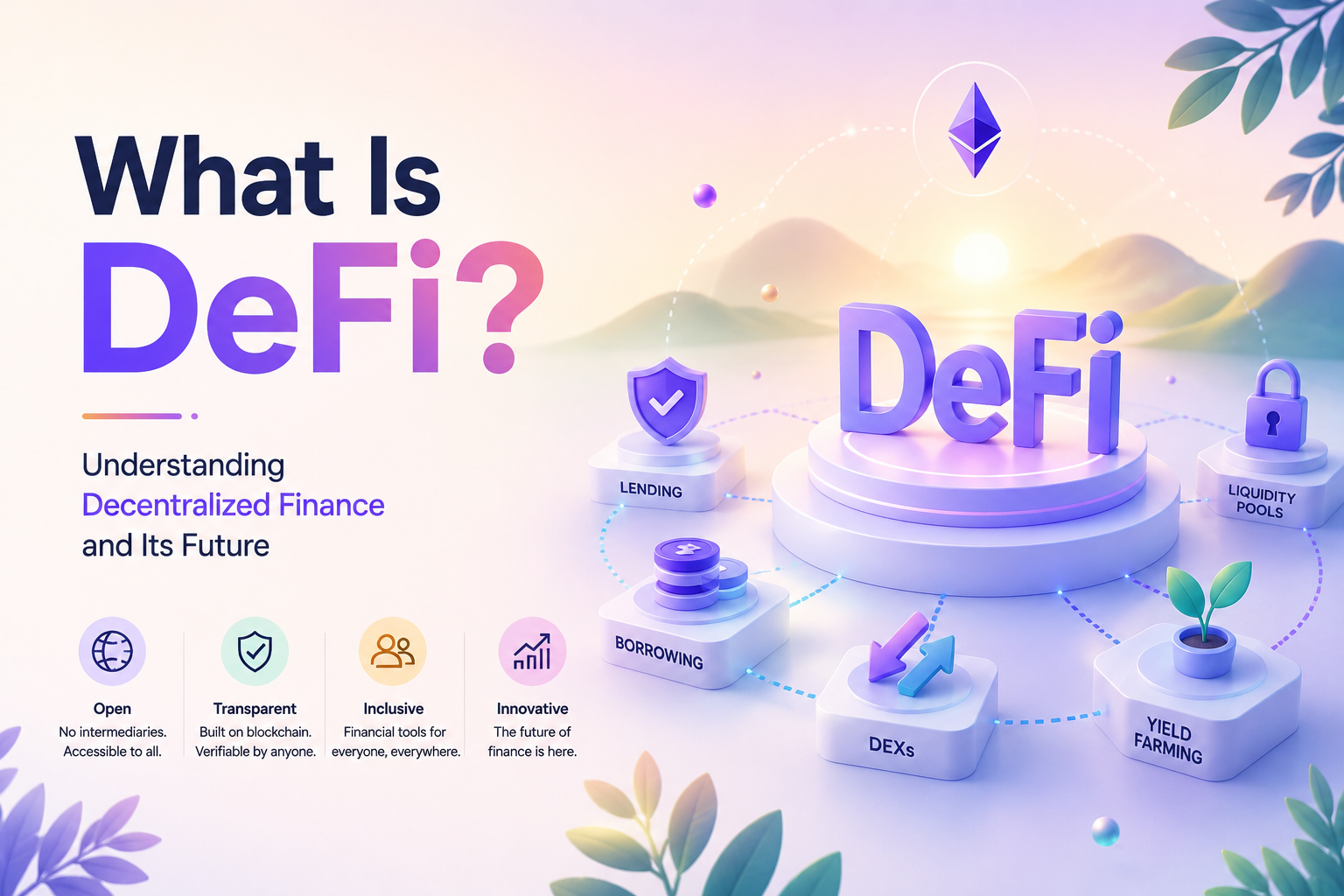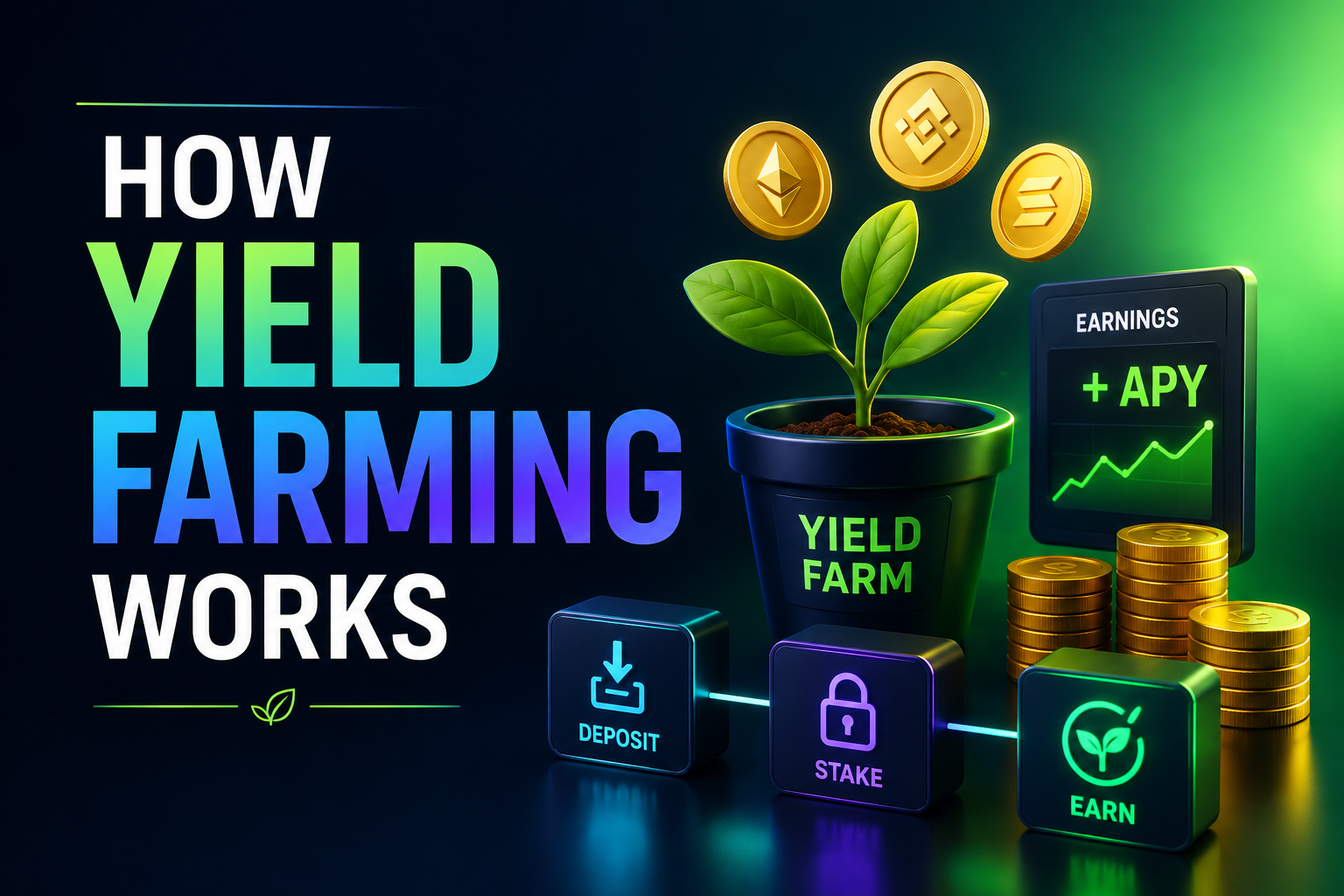
Yield farming is a decentralized finance activity that allows cryptocurrency users to potentially earn rewards by providing digital assets to blockchain based financial protocols.
The concept became popular during the growth of decentralized finance, commonly known as DeFi. Instead of keeping cryptocurrency inactive in a wallet, users can deposit certain assets into decentralized protocols and receive rewards according to the rules of the platform.
Yield farming can generate attractive returns, but it also involves significant risks. Cryptocurrency prices can change quickly, smart contracts can contain vulnerabilities, and the advertised return from a farming opportunity can change over time.
Understanding how yield farming works is therefore important before considering any DeFi strategy.
What Is Yield Farming?
Yield farming refers to using cryptocurrency assets in DeFi protocols to potentially earn rewards.
A user may provide cryptocurrency to a liquidity pool, lending protocol, or another decentralized application.
In return, the protocol may provide rewards.
These rewards can come from:
- Trading fees
- Interest
- Protocol incentives
- Newly issued tokens
- Other digital assets
The exact reward structure depends on the protocol.
How Does Yield Farming Work?
The basic process can be explained in several steps.
Step 1: Choose a DeFi Protocol
A user first selects a decentralized finance protocol that supports yield generating activities.
The protocol may offer liquidity pools, lending markets, staking opportunities, or other mechanisms.
Step 2: Connect a Wallet
The user connects a compatible cryptocurrency wallet to the decentralized application.
The wallet allows the user to interact with blockchain transactions and smart contracts.
Step 3: Deposit Assets
The user deposits supported cryptocurrency into the selected protocol.
The required assets depend on the specific opportunity.
Step 4: Provide Liquidity or Capital
The deposited assets may be used by the protocol.
For example, a liquidity pool can use deposited tokens to facilitate trading between users.
A lending protocol can allow deposited assets to be borrowed by other participants.
Step 5: Receive Rewards
The user may receive rewards based on the protocol’s rules.
Rewards can be generated from fees, interest, incentives, or other sources.
Step 6: Withdraw Assets
If the protocol allows it, the user can withdraw the deposited assets and accumulated rewards.
The exact withdrawal process and associated costs vary between protocols.
What Is a Liquidity Pool?
A liquidity pool is a collection of cryptocurrency assets deposited into a smart contract.
Decentralized exchanges can use liquidity pools to facilitate token swaps.
For example, a pool might contain two different tokens.
Users who trade through the pool interact with the available liquidity rather than directly matching with another individual trader.
Liquidity providers contribute assets to the pool.
In return, they may receive a portion of the trading fees generated by the pool.
What Is a Liquidity Provider?
A liquidity provider, often called an LP, is someone who deposits assets into a liquidity pool.
The provider contributes liquidity that allows other users to trade.
In exchange, the liquidity provider may receive a share of transaction fees and potentially additional protocol rewards.
The provider also accepts the risks associated with the pool.
What Are LP Tokens?
Some decentralized exchanges provide liquidity providers with tokens representing their share of a liquidity pool.
These are often called liquidity provider tokens.
They can represent a user’s claim on the assets held in the pool.
The exact function of these tokens varies between protocols.
In some yield farming systems, LP tokens can also be deposited into another smart contract to earn additional rewards.
What Is Double Yield Farming?
Some DeFi strategies involve depositing assets into one protocol and then using the resulting position or LP tokens in another protocol.
This can potentially create multiple sources of rewards.
For example, a user could:
- Deposit tokens into a liquidity pool
- Receive LP tokens
- Deposit those LP tokens into another farming contract
- Receive additional rewards
This can increase potential returns but also increases complexity and risk.
More smart contracts and protocols can mean more potential points of failure.
What Is APY in Yield Farming?
APY stands for Annual Percentage Yield.
It estimates the potential return from an investment over a year while taking compounding into account.
For example, a platform may advertise a particular APY for a farming opportunity.
However, the displayed APY is not necessarily guaranteed.
The rate can change based on market conditions, protocol incentives, token prices, liquidity, and user activity.
APY vs APR
APR stands for Annual Percentage Rate.
Unlike APY, APR generally does not include the effect of compounding.
APY can therefore appear higher than APR when rewards are regularly reinvested.
When comparing yield farming opportunities, investors should understand whether the advertised number is APR or APY.
Where Do Yield Farming Rewards Come From?
Yield farming rewards can have different sources.
Trading Fees
Liquidity providers may receive a portion of fees paid by users who trade through a liquidity pool.
Lending Interest
Users who provide assets to lending protocols may receive interest paid by borrowers.
Protocol Tokens
Some DeFi platforms distribute their own tokens as incentives.
Staking Rewards
Certain strategies can involve staking assets or protocol tokens to receive rewards.
The source of the reward is important because a high advertised yield is not necessarily sustainable.
Why Do DeFi Protocols Offer High Yields?
Protocols may offer incentives to attract liquidity.
A new project, for example, may distribute tokens to encourage users to provide liquidity.
High rewards can attract capital quickly.
However, if the rewards depend heavily on newly issued tokens, the return can fall rapidly when the token price decreases or the incentive program changes.
What Is Impermanent Loss?
Impermanent loss is one of the most important risks associated with liquidity farming.
It can occur when the prices of assets in a liquidity pool change relative to each other.
For example, imagine a pool containing two tokens.
If the price of one token rises significantly compared with the other, the pool’s automated market maker mechanism can change the proportion of each asset held by the liquidity provider.
The provider may end up with a different asset mix than they would have had by simply holding the original tokens.
Trading fees can potentially offset some or all of this difference, but they do not guarantee protection against losses.
Why Is It Called Impermanent Loss?
The term comes from the fact that the difference may decrease if the asset prices return to their previous relationship.
However, the loss can become effectively realized when the liquidity provider withdraws the assets under unfavorable conditions.
Therefore, impermanent loss should be treated as a genuine financial risk.
What Is Smart Contract Risk?
Yield farming depends heavily on smart contracts.
A smart contract controls how assets are deposited, managed, rewarded, and withdrawn according to its programmed rules.
If a smart contract contains a vulnerability, attackers may exploit it.
Potential consequences can include loss of deposited assets.
Security audits can reduce certain risks, but an audit does not guarantee that a smart contract is completely secure.
What Is Rug Pull Risk?
A rug pull occurs when project operators or malicious participants manipulate a cryptocurrency project in a way that causes users to lose funds.
This can happen through different mechanisms.
For example, an unsafe protocol may contain hidden functions or poorly designed controls.
Investors should be particularly careful with unfamiliar projects offering extremely high returns.
What Is Token Price Risk?
Yield farming rewards are sometimes paid in cryptocurrency tokens.
Even if the number of tokens received increases, the total value of those rewards can decline if the token’s market price falls.
For example, receiving 100 tokens does not necessarily mean the investment became more valuable.
The token’s market price matters.
What Is Liquidity Risk?
Liquidity refers to how easily an asset can be bought or sold without causing a significant price change.
Some DeFi tokens have limited liquidity.
If a farming position involves a low liquidity asset, exiting the position may be difficult or expensive.
What Is Gas Fee Risk?
Many DeFi activities occur on blockchain networks that charge transaction fees.
Users may have to pay fees when:
- Depositing assets
- Approving tokens
- Adding liquidity
- Claiming rewards
- Moving assets
- Removing liquidity
If the transaction fees are high, they can reduce the profitability of a farming strategy.
What Is Leverage in Yield Farming?
Some advanced DeFi strategies involve borrowing assets to increase exposure.
This can potentially increase returns.
It can also increase losses.
If the value of collateral falls too much, the position may be liquidated.
Beginners should understand how borrowing and liquidation work before considering leveraged DeFi strategies.
Yield Farming vs Staking
Yield farming and staking are related but different.
Staking generally involves committing cryptocurrency to a Proof of Stake blockchain or staking protocol to support network operations and receive rewards.
Yield farming usually involves using assets within DeFi protocols to generate returns.
Some strategies can combine staking and yield farming.
Yield Farming vs Lending
Crypto lending involves depositing assets into a lending protocol where borrowers can access those assets.
The lender may earn interest.
Yield farming is broader.
It can include liquidity provision, lending, staking related strategies, and other methods of earning rewards through DeFi.
Why Yield Farming Can Offer High Returns
Yield farming returns can sometimes be much higher than traditional financial products.
This can happen because protocols may offer incentives to attract liquidity.
However, higher potential returns usually come with higher risks.
A high APY should not automatically be interpreted as a safe opportunity.
Can Yield Farming Returns Change?
Yes.
Yield farming rates can change frequently.
Factors that can affect returns include:
- Number of users
- Amount of deposited liquidity
- Trading activity
- Token prices
- Protocol incentives
- Market conditions
- Reward emissions
An opportunity offering a high APY today may offer a much lower return later.
How to Evaluate a Yield Farming Opportunity
Before depositing funds, users should research several factors.
Understand the Protocol
Learn what the protocol does and why people use it.
Check the Smart Contracts
Review whether the contracts have been independently audited and examine the project’s security history.
Understand the Reward Source
Determine whether rewards come from actual fees or primarily from newly issued tokens.
Examine Liquidity
Consider how much liquidity is available and whether exiting could be difficult.
Review Tokenomics
Understand the supply, distribution, and emission schedule of reward tokens.
Calculate Fees
Consider transaction costs and other platform fees.
Understand Impermanent Loss
If providing liquidity, calculate how price changes could affect the position.
Common Yield Farming Mistakes
Chasing the Highest APY
The highest advertised yield may also involve the highest risk.
Ignoring Token Price
Rewards can lose value when the underlying token price falls.
Forgetting Gas Fees
Frequent transactions can reduce returns.
Ignoring Impermanent Loss
Liquidity providers can lose value when asset prices move significantly.
Trusting Unfamiliar Projects
A professional looking website does not guarantee that a protocol is safe.
Investing More Than You Can Afford to Lose
DeFi can involve significant financial risk.
Is Yield Farming Safe?
Yield farming is not risk free.
The risks can include:
- Smart contract vulnerabilities
- Token price declines
- Impermanent loss
- Liquidity problems
- Protocol failure
- Hacks
- Fraud
- High transaction fees
- Regulatory uncertainty
Users should understand these risks before depositing assets.
Can Beginners Use Yield Farming?
Beginners can learn about yield farming, but they should avoid treating high APYs as guaranteed income.
It is important to understand wallets, blockchain transactions, smart contracts, liquidity pools, fees, and token prices before using DeFi protocols.
Learning with a small amount that one can afford to lose may be less risky than immediately committing significant funds.
What Happens When Yield Farming Rewards End?
A protocol may reduce or stop its incentive program.
When rewards decrease, users may withdraw liquidity.
This can reduce the total liquidity available in the protocol and potentially change the economics of the farming strategy.
This is one reason why temporary high yields may not remain attractive over the long term.
Is Yield Farming Passive Income?
Yield farming can appear passive because smart contracts can generate rewards automatically.
However, it still requires monitoring.
Users may need to track:
- APY changes
- Token prices
- Protocol updates
- Smart contract risks
- Liquidity
- Reward changes
- Gas fees
A farming strategy can change significantly without the user actively trading.
Final Thoughts
Yield farming is a DeFi strategy that allows cryptocurrency users to potentially earn rewards by providing liquidity, lending assets, staking certain tokens, or participating in other blockchain based financial protocols.
The basic idea is straightforward. Users contribute digital assets to a protocol, the protocol uses those assets according to its design, and users may receive rewards.
The risks, however, can be complex.
Impermanent loss, smart contract vulnerabilities, token price changes, liquidity problems, transaction fees, and changing reward rates can all affect results.
A high APY does not guarantee a high profit.
Anyone researching yield farming should understand where the rewards come from, how the protocol works, what risks are involved, and how easily funds can be withdrawn.
Yield farming can be an interesting part of decentralized finance, but it should be approached as a high risk activity rather than guaranteed passive income.
Frequently Asked Questions
What is yield farming?
Yield farming is a DeFi strategy where users deposit cryptocurrency into decentralized protocols to potentially earn rewards.
How does yield farming work?
Users provide assets to liquidity pools, lending protocols, or other DeFi applications and may receive rewards based on the protocol’s rules.
What are yield farming rewards?
Rewards can come from trading fees, lending interest, protocol tokens, staking incentives, or other sources.
What is a liquidity pool?
A liquidity pool is a collection of cryptocurrency assets locked in a smart contract and used by certain DeFi applications to facilitate transactions.
What is a liquidity provider?
A liquidity provider is a user who deposits assets into a liquidity pool and may receive a share of trading fees or other rewards.
What is an LP token?
An LP token can represent a user’s share of a liquidity pool. Its specific function depends on the protocol.
What is APY in yield farming?
APY means Annual Percentage Yield and represents an estimated annual return that can include compounding.
Is yield farming APY guaranteed?
No. Yield farming APY can change based on market conditions, protocol activity, token prices, liquidity, and reward programs.
What is APR?
APR means Annual Percentage Rate. It generally does not account for compounding in the same way APY does.
What is impermanent loss?
Impermanent loss is a potential loss experienced by liquidity providers when the prices of assets in a liquidity pool change relative to each other.
Can impermanent loss become permanent?
Yes. The difference can become effectively realized when a liquidity provider withdraws assets while the price relationship remains unfavorable.
Is yield farming profitable?
Yield farming can generate returns, but it can also result in losses. Profitability depends on rewards, asset prices, fees, liquidity, and risks.
Why do some yield farms offer very high APYs?
Protocols may offer high incentives to attract liquidity. These rewards can sometimes decline rapidly as conditions change.
Can yield farming rewards lose value?
Yes. If rewards are paid in a token whose market price falls, the value of the rewards can decrease.
What is smart contract risk?
Smart contract risk refers to the possibility that vulnerabilities or design problems in blockchain programs could result in financial losses.
Does an audit make a yield farming protocol safe?
No. An audit can identify certain vulnerabilities but cannot guarantee that a protocol is completely secure.
What is rug pull risk?
Rug pull risk refers to the possibility that a project or malicious participant causes users to lose funds through fraudulent or harmful actions.
What are gas fees?
Gas fees are blockchain transaction costs. They may apply when interacting with DeFi protocols.
Can gas fees reduce yield farming profits?
Yes. High transaction costs can significantly reduce returns, particularly for smaller investments or strategies requiring frequent transactions.
What is the difference between yield farming and staking?
Staking generally involves participating in a Proof of Stake network or staking system, while yield farming involves using assets within DeFi protocols to generate rewards.
Is yield farming the same as crypto lending?
No. Crypto lending is one activity that can be part of yield generating strategies. Yield farming is a broader category that can include liquidity provision and other DeFi activities.
Can beginners participate in yield farming?
Beginners can learn about yield farming, but they should understand the risks and technical requirements before depositing funds.
What is the biggest risk in yield farming?
There is no single biggest risk. Smart contract vulnerabilities, impermanent loss, token price declines, liquidity problems, and protocol failure can all cause significant losses.
Can yield farming returns change?
Yes. Returns can change frequently based on liquidity, trading activity, reward emissions, token prices, and protocol decisions.
What should I check before choosing a yield farm?
Research the protocol, smart contracts, security history, reward sources, tokenomics, liquidity, fees, withdrawal process, and potential impermanent loss.
Is yield farming passive income?
It can generate rewards automatically, but it still requires monitoring because rates, token prices, risks, and protocol conditions can change.
Can you lose money yield farming?
Yes. Users can lose some or all of their deposited funds depending on market movements, smart contract problems, hacks, liquidity issues, or other risks.
Is yield farming suitable for everyone?
No. Yield farming involves significant risks and may not be suitable for people who cannot tolerate substantial losses.
What is the safest yield farming strategy?
There is no universally safe yield farming strategy. Every DeFi opportunity has its own risks, and users should evaluate those risks before committing funds.