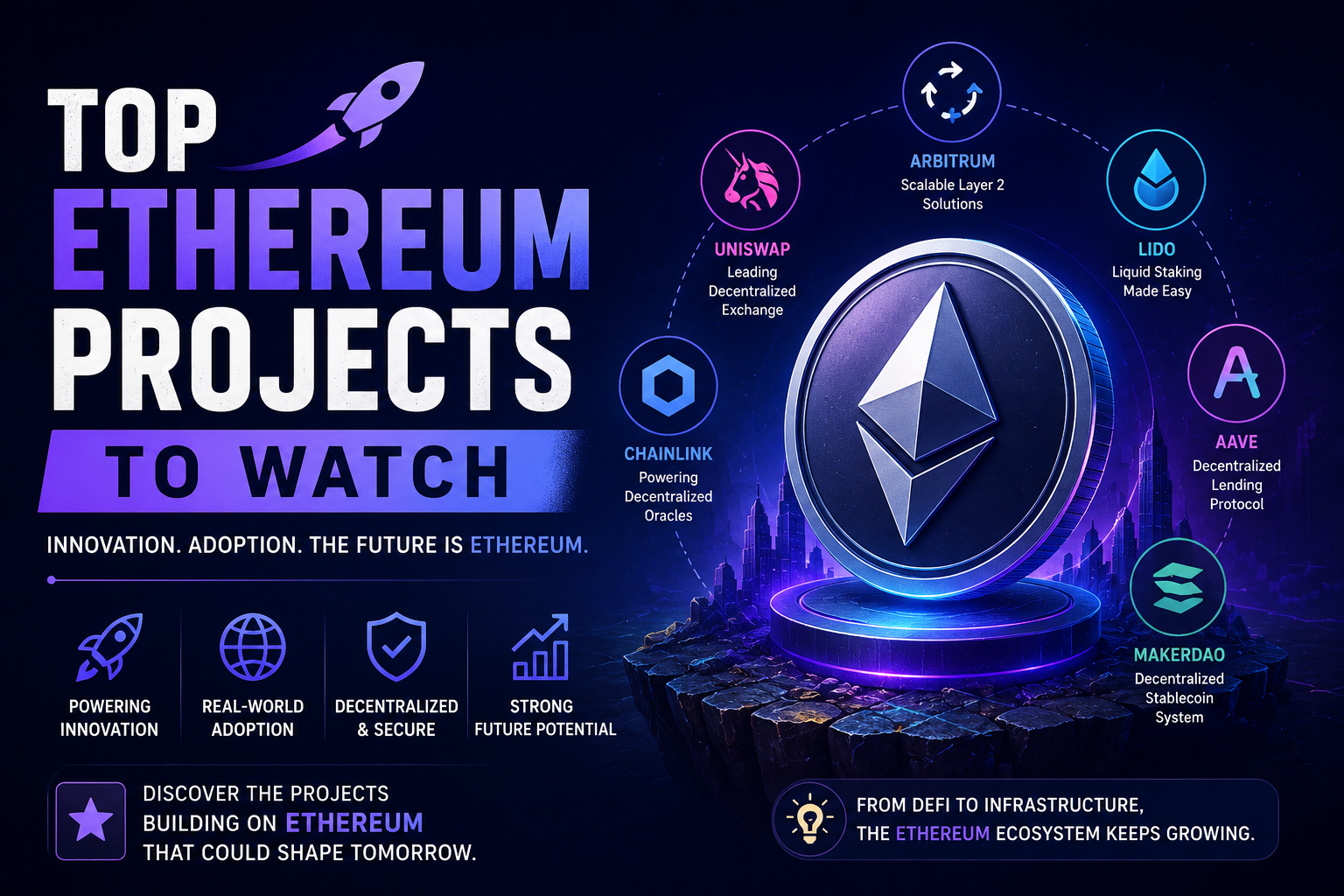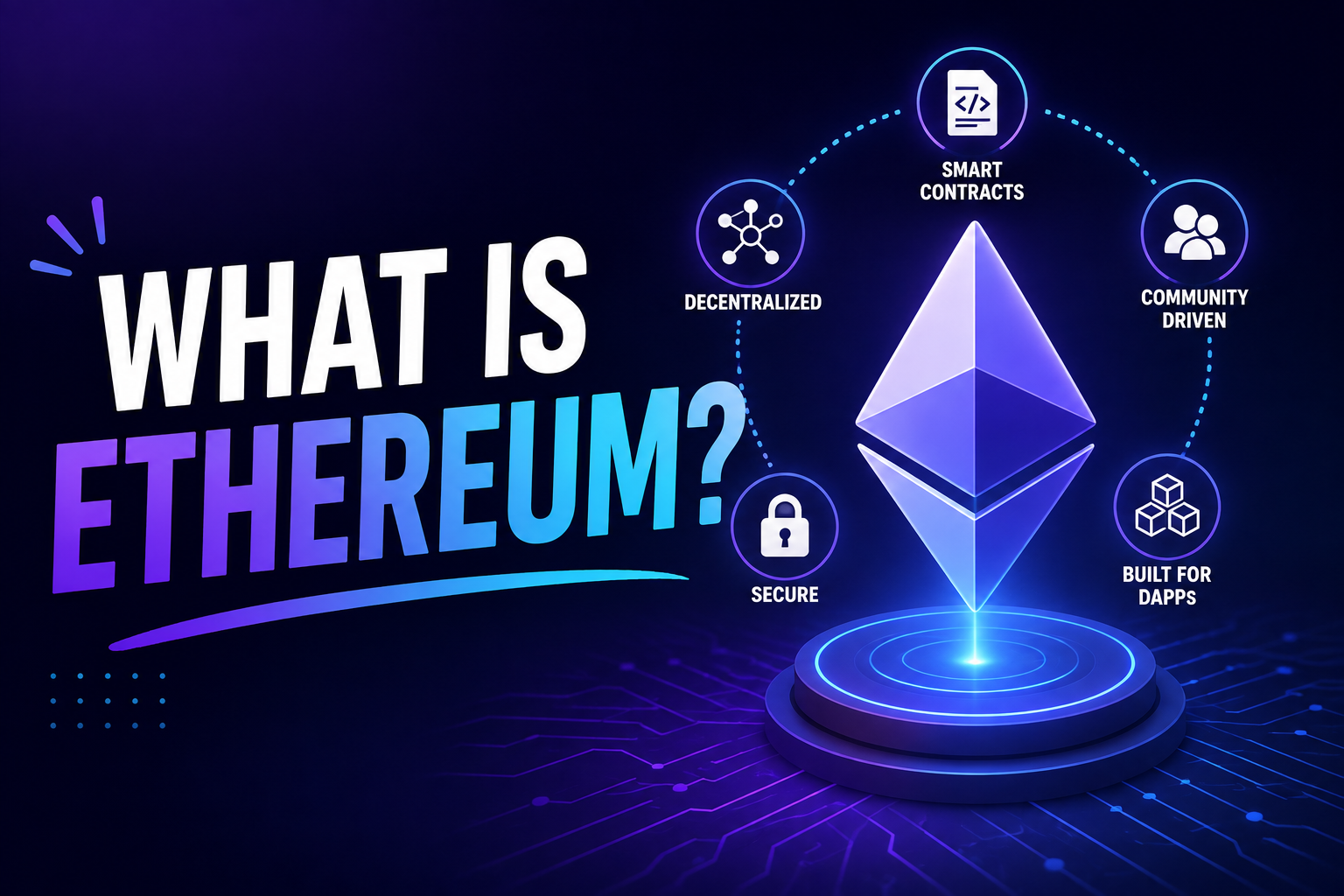
Ethereum is a decentralized blockchain network that allows people to send digital assets, build applications, and run programs without relying on a central authority such as a bank or technology company.
It was proposed by Vitalik Buterin in 2013 and launched in 2015. Unlike Bitcoin, which was primarily designed as a peer to peer digital currency, Ethereum was created as a programmable blockchain.
How Does Ethereum Work?
Ethereum uses a network of computers around the world to maintain a shared blockchain.
The network records transactions and other blockchain activity. Instead of one company controlling the database, participants collectively maintain and verify the network.
Ethereum uses smart contracts, which are programs stored on the blockchain. These programs can automatically execute actions when their predefined conditions are met.
For example, a smart contract could be designed to transfer a digital asset when a specific payment is received.
What Is Ether?
Ether, commonly represented as ETH, is the native cryptocurrency of the Ethereum network.
ETH is used for several purposes, including:
- Paying transaction fees
- Interacting with applications on Ethereum
- Staking to help secure the network
- Transferring value between users
It is important to distinguish between Ethereum and Ether.
Ethereum is the blockchain network.
Ether or ETH is the cryptocurrency used within that network.
What Are Ethereum Smart Contracts?
Smart contracts are programs that run on the Ethereum blockchain.
They can be used to create different types of applications, including:
- Decentralized finance applications
- Digital marketplaces
- Blockchain games
- Token systems
- Digital collectibles
- Decentralized organizations
Because smart contracts operate on blockchain infrastructure, users can interact with them without necessarily relying on a traditional intermediary.
What Is Ethereum Used For?
Ethereum has developed into a broad blockchain ecosystem.
Some common uses include decentralized finance, commonly called DeFi, where people can access financial services through blockchain based applications.
Ethereum is also used for creating and transferring tokens. Many digital assets have been built using Ethereum’s token standards.
Businesses and developers can also use Ethereum to create applications that need blockchain based ownership, transactions, or programmable rules.
Ethereum vs Bitcoin
Ethereum and Bitcoin are both decentralized blockchain networks, but they have different primary purposes.
| Ethereum | Bitcoin |
|---|---|
| Programmable blockchain | Primarily focused on digital money |
| Supports smart contracts | Limited scripting functionality |
| Uses ETH | Uses BTC |
| Hosts decentralized applications | Primarily used for storing and transferring value |
| Supports a broad token ecosystem | More focused on the Bitcoin monetary network |
The two networks are not necessarily direct replacements for one another. They were designed with different goals.
How Are Ethereum Transactions Verified?
Ethereum currently uses a proof of stake consensus system.
Validators participate in securing the network by staking ETH. The network uses validators to help process transactions and maintain the blockchain.
This replaced Ethereum’s previous proof of work system in 2022 through an upgrade commonly known as The Merge.
What Are Ethereum Gas Fees?
Ethereum transactions require fees known as gas fees.
Gas represents the computational work required to perform an operation on the network.
For example, sending ETH or interacting with a smart contract requires network resources. The associated fee is paid using ETH.
Gas fees can change depending on network activity and transaction demand.
Is Ethereum a Cryptocurrency?
Ethereum itself is not technically the name of the cryptocurrency.
Ethereum is the blockchain network.
ETH is the cryptocurrency.
However, people commonly use “Ethereum” when referring to ETH in casual conversation.
Is Ethereum Safe?
Ethereum’s underlying blockchain is designed to operate without a central controlling entity, but using Ethereum does not eliminate financial or technical risks.
Users can face risks involving:
- Cryptocurrency price volatility
- Smart contract vulnerabilities
- Phishing attacks
- Fake applications
- Lost private keys
- Fraudulent tokens
- Exchange or wallet security problems
A transaction confirmed on a blockchain may also be difficult or impossible to reverse.
Why Is Ethereum Important?
Ethereum helped expand the concept of blockchain beyond digital currency.
Its programmable infrastructure allows developers to create applications that operate using blockchain based rules.
This has contributed to the growth of areas such as DeFi, tokenized assets, decentralized applications, and digital collectibles.
Final Thoughts
Ethereum is a programmable decentralized blockchain that enables digital transactions, smart contracts, and blockchain based applications.
Its native cryptocurrency, ETH, is used to pay network fees, transfer value, interact with applications, and participate in network security through staking.
The key idea behind Ethereum is not simply digital currency. It is a blockchain platform designed to allow developers and users to build and interact with programmable systems without depending entirely on traditional centralized intermediaries.